

- Operating InstructionsPullMig
- General
- Installation and commissioning
- Mounting the torch neck
- Assemble wire guidance insert
- Assemble Inner Liner (Fronius connection without wire-guidance nozzle
- Assemble Inner Liner (Fronius connection with wire-guidance nozzle)
- Assemble Inner Liner (Euro connection without wire-guidance nozzle)
- Connecting up the welding torch
- Replace Feed Rolls
- Set Electrode Pressure
- Replace Wire Inlet Nozzle
- Up/Down
- JobMaster
- Troubleshooting
- Technical data
005-15042026
General
Device concept
PullMig is a wire feed unit for manual welding using soft welding wires and with long hose packs. Two toothed precision rolls ensure large-surface power transmission. This leads to outstanding wire feed even with very soft aluminium and CuSi wires and very long hose packs. The many different versions of PullMig available are one of its distinguishing features.
Thus there are several variations of torch connections available with both external and internal coolant connections. A variety of pipe bend designs ensures excellent weld accessibility.
Device concept
PullMig is a wire feed unit for manual welding using soft welding wires and with long hose packs. Two toothed precision rolls ensure large-surface power transmission. This leads to outstanding wire feed even with very soft aluminium and CuSi wires and very long hose packs. The many different versions of PullMig available are one of its distinguishing features.
Thus there are several variations of torch connections available with both external and internal coolant connections. A variety of pipe bend designs ensures excellent weld accessibility.
Intended use
The device has been manufactured in line with the state of the art and according to recognized safety standards.
The MIG/MAG manual welding torch is intended exclusively for MIG/MAG welding in manual applications. Utilisation for any other purpose, or in any other manner, shall be deemed to be not in accordance with the intended use.
Intended use also includes:- Following all the instructions contained in the operating instructions
- Performing all stipulated inspection and maintenance work
WARNING!
Danger due to incorrect operation and incorrectly performed work.
This can result in serious injury and damage to property.
All the work and functions described in this document must only be carried out by technically trained and qualified personnel.
Fully read and understand this document.
Read and understand all safety rules and user documentation for this device and all system components.
WARNING!
Danger from electric current.
This can result in serious injury and damage to property.
Before starting maintenance or servicing work, switch off all the devices and components involved and disconnect them from the mains.
Secure all the devices and components involved to prevent unintentional restarting.
After opening the device, use a suitable measuring instrument to check that electrically charged components (such as capacitors) have been discharged.
WARNING!
Danger from electric current due to defective system components and incorrect operation.
This can result in serious personal injury and damage to property.
All cables, leads and hosepacks must always be securely connected, undamaged and correctly insulated.
Only use adequately dimensioned cables, leads and hosepacks.
CAUTION!
Danger due to emerging wire electrode.
This can result in personal injury.
Hold the welding torch with the end directed away from the face and body.
Wear suitable protective goggles.
Do not point the welding torch at people.
Ensure that the wire electrode can only intentionally make contact with electrically conductive objects.
CAUTION!
Danger due to hot system components and/or equipment.
This can result in burns or scalding.
Before starting work, allow all hot system components and/or equipment to cool to +25°C/+77°F (e.g., coolant, water-cooled system components, wirefeeder drive motor, etc.).
Wear suitable protective equipment if cooling down is not possible (e.g., heat-resistant gloves, safety goggles, etc.).
CAUTION!
Danger due to operation without coolant.
This can result in damage to property.
Never operate water-cooled devices without coolant.
During welding, ensure that there is a proper coolant flow. When using Fronius cooling units, this is the case if a proper coolant return flow can be seen in the coolant container of the cooling unit.
CAUTION!
Danger due to exposed mechanically moving parts.
This can result in personal injury and damage to property.
Only operate the device when all covers are closed and/or completely mounted.
System requirements
Power source
- TS 4000 / 5000
- TPS 2700 / 4000 / 5000
Software
- Power source: Software version 3.10.22 or higher
- Wire feed: Software version 1.70.16 or higher
Options
- Installation set „PMR4000 PullMig TS/TPS 2700-5000 (4,100,217)“
- Software „FS Drive (4,061,113)“
Installation and commissioning
Mounting the torch neck
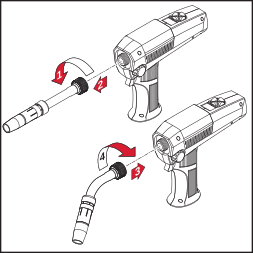
IMPORTANT! Risk of coolant leakage (on water-cooled welding torches) or damage from overheating (on gas-cooled welding torches). When mounting the torch neck, make sure that the swivel nut is fixed firmly.
Mounting the torch neck
IMPORTANT! Risk of coolant leakage (on water-cooled welding torches) or damage from overheating (on gas-cooled welding torches). When mounting the torch neck, make sure that the swivel nut is fixed firmly.
Assemble wire guidance insert
1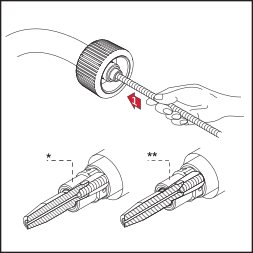
2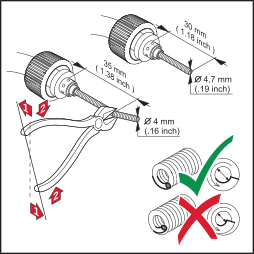
When cutting the inner liner to length, make sure that
- no burr (sharp edges) protrudes into the inner liner at the cut location.
- Hold the side-cutting pliers at a slight angle (the burr is then pulled towards the outside).
- Grind off the burr
* Contact tube with centering bore
** Contact tube without centering bore
Ø 4 mm (.16 in.): 40,0002,0014; 40,0002,0015
Ø 4,7 mm (.19 in.): 40,0002,0004; 40,0002,0017
Assemble Inner Liner (Fronius connection without wire-guidance nozzle
1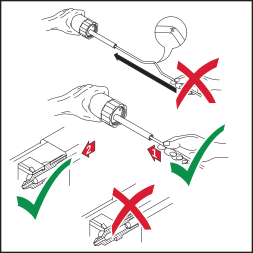
2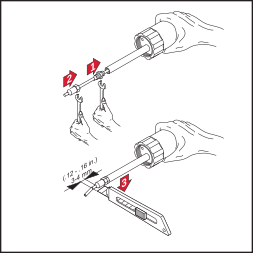
3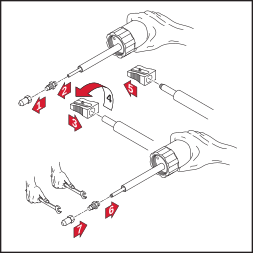
4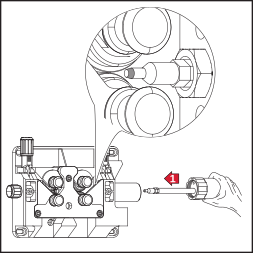
5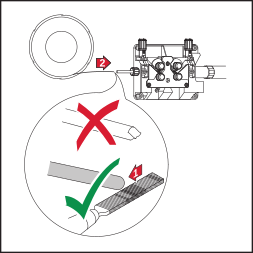
IMPOTRTANT! Bring the inner liner as close as possible to the wirefeed rollers, but without touching them.
Before threading in the welding wire, round off the ends of the wire.
Assemble Inner Liner (Fronius connection with wire-guidance nozzle)
1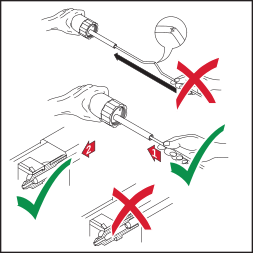
2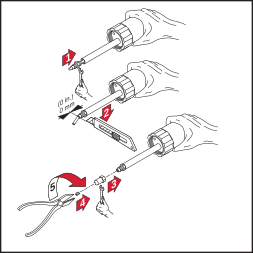
3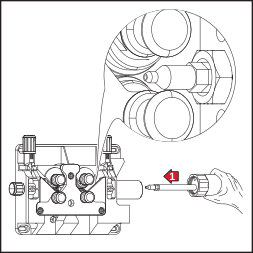
4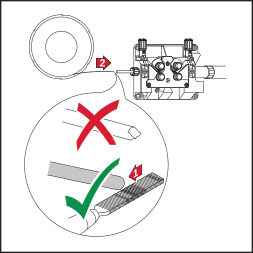
Only use wire guidance nozzles corresponding to diameter of wire. The following wire guidance nozzles are available:
- 0,8 mm (.030 in.)
- 1,0 mm (.040 in.)
- 1,2 mm (.045 in.)
- 1,6 mm (1/16 in.)
Before threading in the welding wire, round off the ends of the wire.
Assemble Inner Liner (Euro connection without wire-guidance nozzle)
1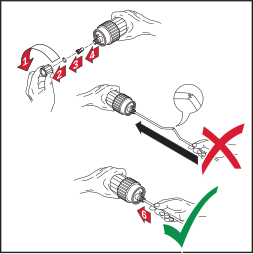
2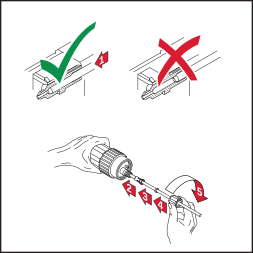
3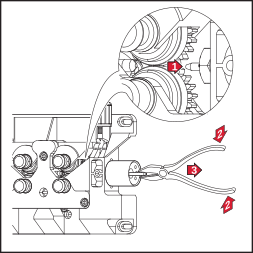
4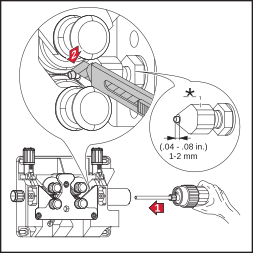
5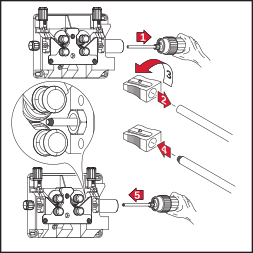
6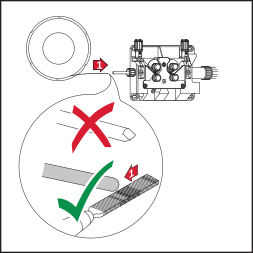
* Optional infeed nozzle (42,0001,5421)
IMPORTANT! Bring the inner liner / the infeed nozzle as close as possible to the wirefeed rollers, but without touching them. Before threading in the welding wire, round off the ends of the wire.
Connecting up the welding torch
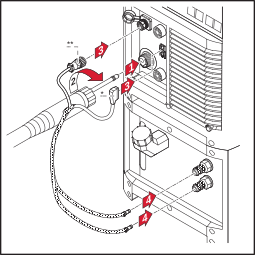
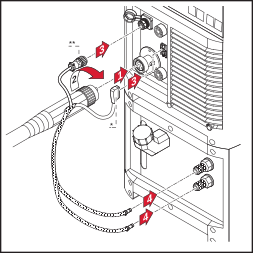
* Standard plug (Standard or Up/Down torches)
** JobMaster plug (JobMaster welding torches)
Replace Feed Rolls
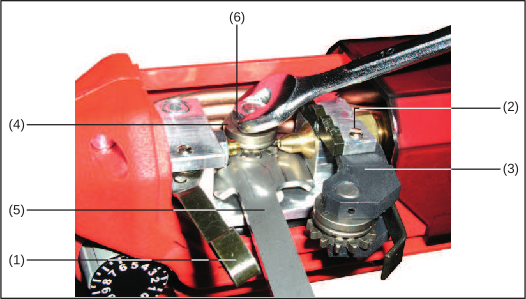
1Unscrew pressure lever (1)
2Unscrew axle (2) using slotted screwdriver
3Remove complete unit (3)
4Fix drive roll (4) using driving gear key (5) provided
5Unscrew hexagon nut (6) using open-ended spanner - spanner size 10 mm (.394 in.)
6Remove drive roll (4)
Set Electrode Pressure
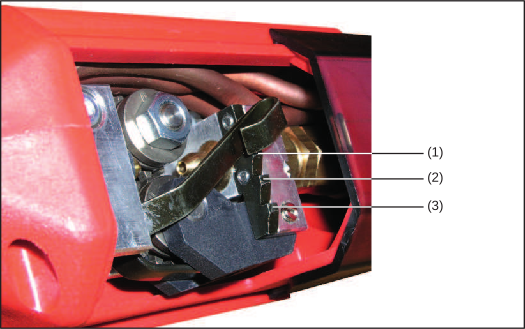
1hard (e.g. CrNi)
2medium (e.g. AlMg / CuSi)
3soft (e.g. AlSi)
Replace Wire Inlet Nozzle
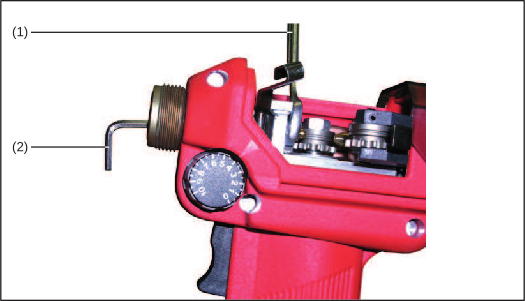
1Unscrew hexagon nut using open-ended spanner (1)
- spanner size 10 mm (.394 in.)
2Unscrew and remove wire inlet nozzle using Allen key (2)
- key width 2.5 mm (.099 in.)
Up/Down
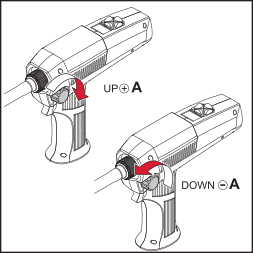
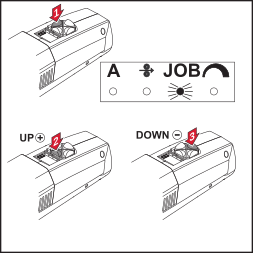
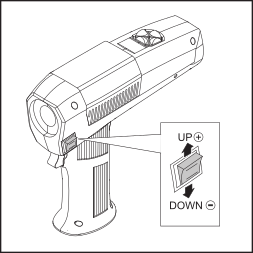
- Set welding output using Up/Down function
1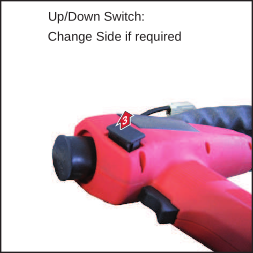
2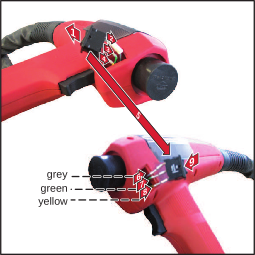
3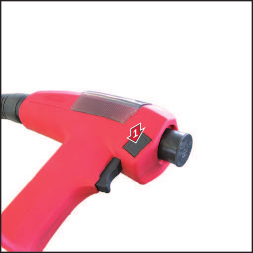
JobMaster
- Select and set desired parameter using JobMaster function
IMPORTANT! Refer to MIG/MAG Torch Operating Instructions, chapter headed „JobMaster“ for more detailed information on the JobMaster function.
Troubleshooting
Troubleshooting
Troubleshooting
No number („PPU“) selectable for PullMig (PushPull Unit)
| Cause: | „PMR4000 PullMig“ installation set is not installed |
| Remedy: | Install installation set |
Number for PullMig (e.g. „PPU | 5“), for PushPull equalisation is not selectable
| Cause: | Power source does not have „FS Drive“ software |
| Remedy: | Provide power source with „FS Drive“ software |
PullMig feed rolls are not turning
| Cause: | PullMig control plug is not plugged in |
| Remedy: | Connect PullMig control plug at torch control connection |
| Cause: | PullMig connection cable damaged |
| Remedy: | Check cable and replace if necessary |
Irregular wire speed
Wire electrode forms a loop between feed rolls and wire inlet nozzle
| Cause: | Feed rolls not suitable for wire electrode being used |
| Remedy: | Use appropriate feed rolls |
| Cause: | Wrong electrode pressure of PullMig or 4-roll drive |
| Remedy: | Optimise electrode pressure |
Welding wire is deformed or breaks off
| Cause: | Electrode pressure of PullMig or 4-roll drive set too high |
| Remedy: | Set electrode pressure of PullMig or 4-roll drive correctly |
| Cause: | PullMig turns too fast or too slow |
| Remedy: | Select right number (e.g. „PPU | 5“) for PullMig during PushPull equalisation |
PullMig becomes too hot
| Cause: | Inadequate cooling; water circulation too low or non-existent in cooling unit |
| Remedy: | Check whether PullMig is properly connected; check cooling unit and bleed if necessary; check coolant throughflow for PullMig |
EFd | xx.x, EFd | 8.1
| Cause: | Wire drive blocked/faulty |
| Remedy: | Inspect/replace motor for wire drive |
EFd | 8.2
| Cause: | Fault in wire feed system (overcurrent in PullMig drive) |
| Remedy: | Lay hose pack out in as straight a line as possible; check liner for kink or dirt; check contact pressure of PullMig feed rolls |
EFd | 9.1
| Cause: | External supply voltage: supply voltage has dropped below tolerance range |
| Remedy: | Check external supply voltage |
EFd | 9.2
| Cause: | External supply voltage: supply voltage has exceeded tolerance range |
| Remedy: | Check external supply voltage |
Technical data
PullMig hosepack gas-cooled
I (Amp.) 10 min/40° C | 40 % d.c.* 280 | ||||||
I (Amp.) 10 min/40° C | 40 % d.c.* 330 | ||||||
 | [m] | 6 / 8 / 10 | |||||
 | [V] DC | 42 | |||||
 | [A] | 0,8 | |||||
 | [m/min] (ipm) | 0,5 - 18 | |||||
 | [mm] | 0,8 - 1,6 | |||||
* d.c. = duty cycle | |||||||
PullMig hosepack gas-cooled
I (Amp.) 10 min/40° C | 40 % d.c.* 280 | ||||||
I (Amp.) 10 min/40° C | 40 % d.c.* 330 | ||||||
| [m] | 6 / 8 / 10 | |||||
| [V] DC | 42 | |||||
| [A] | 0,8 | |||||
| [m/min] (ipm) | 0,5 - 18 | |||||
| [mm] | 0,8 - 1,6 | |||||
* d.c. = duty cycle | |||||||
PullMig hosepack water-cooled
I (Amp.) 10 min/40° C | 100 % d.c.* 400 | ||||||
I (Amp.) 10 min/40° C | 100 % d.c.* 500 | ||||||
| [m] | 6 / 8 / 10 | |||||
Pmin |  | [W]** | 1450 / 1800 / 2000 W |
|
| ||
Qmin | | [l/min] | 1 |
|
| ||
pmin | | [bar] | 3 |
|
| ||
pmin | | [bar] | 5,5 |
|
| ||
| [V] DC | 42 | |||||
| [A] | 0,8 | |||||
| [m/min] (ipm) | 0,5 - 18 | |||||
| [mm] | 0,8 - 1,6 | |||||
* d.c. = duty cycle | |||||||
** Minimum cooling power in accordance with standard IEC 60974-2 | |||||||
PullMig torch neck gas-cooled
| AL216 | AL236 | AL306 | AL406 | ||
|---|---|---|---|---|---|---|
| I (Amp.) 10 min/40° C | 35 % 180 | 40 % 200 | 40 % 260 | 40 % 350 | |
I (Amp.) 10 min/40° C | 35 % 210 | 40 % 230 | 40 % 300 | 40 % 400 | ||
| [mm] | 0,6-1,0 | 0,6-1,0 | 0,8-1,2 | 1,0-1,6 | |
| AL2300 | AL2400 | AL3000 | AL4000 | ||
|---|---|---|---|---|---|---|
| I (Amp.) 10 min/40° C | 40 % 200 | 40 % 200 | 40 % 250 | 40 % 350 | |
I (Amp.) 10 min/40° C | 40 % 230 | 40 % 240 | 40 % 400 | 40 % 400 | ||
| [mm] | 0,6-1,0 | 0,6-1,0 | 0,8-1,2 | 1,0-1,6 | |
*d.c. = duty cycle | ||||||
PullMig torch neck water-cooled
| AW252 | AW332 | AW335 | AW352 | ||
|---|---|---|---|---|---|---|
| I (Amp.) 10 min/40° C |
| 60 % 200 | 60 % 200 |
| |
I (Amp.) 10 min/40° C |
| 60 % 250 | 60 % 250 |
| ||
| [mm] | 0,6-1,2 | 0,8-1,2 | 0,8-1,2 | 1,0-1,6 | |
| AW502 | AW652 | ||||
|---|---|---|---|---|---|---|
| I (Amp.) 10 min/40° C |
|
| |||
I (Amp.) 10 min/40° C |
|
| ||||
| [mm] | 1,0-1,6 | 1,0-2,4 | |||
| AW2500 | AW4000 | AW5000 | AW7000 | ||
|---|---|---|---|---|---|---|
| I (Amp.) 10 min/40° C |
|
|
|
| |
I (Amp.) 10 min/40° C |
|
|
|
| ||
| [mm] | 0,6-1,2 | 0,8-1,2 | 1,0-1,6 | 1,0-1,6 | |
* d.c. = duty cycle | ||||||
PullMig - hosepack / torch neck
- for manually guided torches: 113 V
- for mechanically guided torches: 141 V
The product complies with standard IEC 60974-7.
PushPull Equalisation
PushPull equalisation is adjusted in accordance with the Power Source Operating Instructions, chapter headed „PushPull Unit“