

- Operating instructionsTTB 80 - 300, THP 120 - 300 SH
- Safety
- Welding torch variants
- Functions of the Up/Down torch
- Mounting the Wearing Parts
- Fitting the torch body and connecting the welding torch
- Changing the torch body of a gas-cooled welding torch
- Changing the torch body of a water-cooled welding torch
- Service, maintenance and disposal
- Troubleshooting
- Technical data
005-21042026
Safety
WARNING!
Danger from incorrect operation and work that is not carried out properly.
This can result in serious personal injury and damage to property.
All the work and functions described in this document must only be carried out by technically trained and qualified personnel.
Read and understand this document in full.
Read and understand all safety rules and user documentation for this equipment and all system components.
WARNING!
Danger from electrical current.
This can result in serious personal injury and damage to property.
Before starting work, switch off all the devices and components involved and disconnect them from the grid.
Secure all devices and components involved so they cannot be switched back on.
WARNING!
Danger from electric current due to defective system components and incorrect operation.
This can result in serious personal injury and damage to property.
All cables, leads, and hosepacks must always be securely connected, undamaged, and correctly insulated.
Only use adequately dimensioned cables, leads, and hosepacks.
WARNING!
Danger from contact with toxic welding fumes.
Serious personal injuries may result.
Always extract welding fumes.
Ensure that there is a sufficient supply of fresh air. Ensure that there is a ventilation flow rate of at least 20 m³ (11.77 cfm) per hour at all times.
In case of doubt, the concentration of noxious substances at the work station should be assessed by a safety engineer.
CAUTION!
Danger due to hot system components and/or equipment.
This can result in burns or scalding.
Before starting work, allow all hot system components and/or equipment to cool to +25°C/+77°F (e.g., coolant, water-cooled system components, wirefeeder drive motor, etc.).
Wear suitable protective equipment if cooling down is not possible (e.g., heat-resistant gloves, safety goggles, etc.).
CAUTION!
Danger from operation without coolant.
This can result in damage to property.
Never commission water-cooled devices without coolant.
During welding, ensure that the coolant is circulating correctly. When using Fronius cooling units, this will be the case if proper return flow of coolant can be seen in the cooling unit’s coolant container.
CAUTION!
Risk of coolant escaping.
Personal injury and damage to property may result.
When disconnecting a water-cooled welding torch from the cooling unit or other system components, always seal the coolant hoses using the plastic seal attached to the torch.
WARNING!
Danger from incorrect operation and work that is not carried out properly.
This can result in serious personal injury and damage to property.
All the work and functions described in this document must only be carried out by technically trained and qualified personnel.
Read and understand this document in full.
Read and understand all safety rules and user documentation for this equipment and all system components.
WARNING!
Danger from electrical current.
This can result in serious personal injury and damage to property.
Before starting work, switch off all the devices and components involved and disconnect them from the grid.
Secure all devices and components involved so they cannot be switched back on.
WARNING!
Danger from electric current due to defective system components and incorrect operation.
This can result in serious personal injury and damage to property.
All cables, leads, and hosepacks must always be securely connected, undamaged, and correctly insulated.
Only use adequately dimensioned cables, leads, and hosepacks.
WARNING!
Danger from contact with toxic welding fumes.
Serious personal injuries may result.
Always extract welding fumes.
Ensure that there is a sufficient supply of fresh air. Ensure that there is a ventilation flow rate of at least 20 m³ (11.77 cfm) per hour at all times.
In case of doubt, the concentration of noxious substances at the work station should be assessed by a safety engineer.
CAUTION!
Danger due to hot system components and/or equipment.
This can result in burns or scalding.
Before starting work, allow all hot system components and/or equipment to cool to +25°C/+77°F (e.g., coolant, water-cooled system components, wirefeeder drive motor, etc.).
Wear suitable protective equipment if cooling down is not possible (e.g., heat-resistant gloves, safety goggles, etc.).
CAUTION!
Danger from operation without coolant.
This can result in damage to property.
Never commission water-cooled devices without coolant.
During welding, ensure that the coolant is circulating correctly. When using Fronius cooling units, this will be the case if proper return flow of coolant can be seen in the cooling unit’s coolant container.
CAUTION!
Risk of coolant escaping.
Personal injury and damage to property may result.
When disconnecting a water-cooled welding torch from the cooling unit or other system components, always seal the coolant hoses using the plastic seal attached to the torch.
Intended use
The TIG manual welding torch is intended solely for TIG welding and TIG brazing in manual applications.
Any other use is deemed to be "not in accordance with the intended purpose.”
- Following all the instructions in the Operating Instructions
- Carrying out all the specified inspection and maintenance work.
Welding torch variants
Available welding torch variants
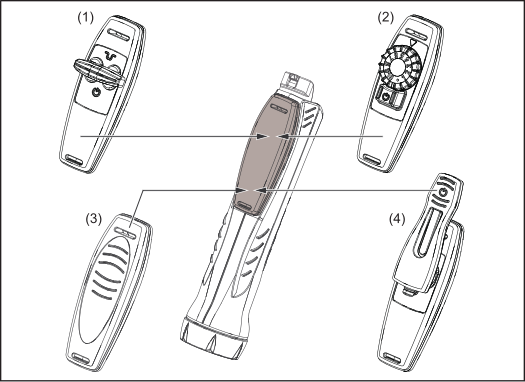
| (1) | Standard interface Pushing the button backward:
Pushing the button forward during welding:
|
| (2) | Potentiometer interface Pressing the Start button:
Potentiometer:
|
| (3) | Without torch trigger |
| (4) | Standard interface with torch trigger extension Pushing the button backward:
Pushing the button forward during welding:
|
| (5) | Up-Down interface (not shown) The welding torch is supplied from the factory with an Up/Down interface. For more information, see the following section Functions of the Up/Down torch from page (→). |
Available welding torch variants
| (1) | Standard interface Pushing the button backward:
Pushing the button forward during welding:
|
| (2) | Potentiometer interface Pressing the Start button:
Potentiometer:
|
| (3) | Without torch trigger |
| (4) | Standard interface with torch trigger extension Pushing the button backward:
Pushing the button forward during welding:
|
| (5) | Up-Down interface (not shown) The welding torch is supplied from the factory with an Up/Down interface. For more information, see the following section Functions of the Up/Down torch from page (→). |
Functions of the Up/Down torch
Operating elements of the Up/Down-torch
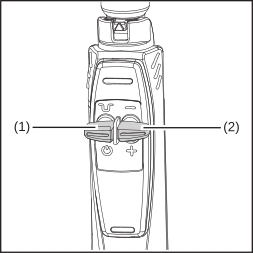
| (1) | Start button The button initiates the following functions:
|
| (2) | Up/Down button For changing the welding power |
Operating elements of the Up/Down-torch
| (1) | Start button The button initiates the following functions:
|
| (2) | Up/Down button For changing the welding power |
Functional description of the Up/Down-torch
Changing the welding power:
1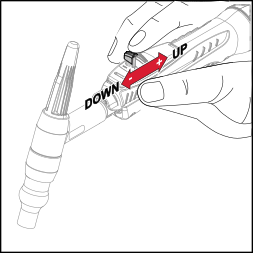
Intermediate lowering:
1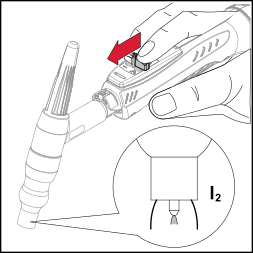
Push the button forward and hold until intermediate lowering is complete
Mounting the Wearing Parts
Fitting an A-type wearing part with gas nozzle (push-on type)
CAUTION!
Risk of damage due to excessive tightening torque on the fixing sleeve (1) or gas lens (2).
Damage to the thread may result.
Only tighten the fixing sleeve (1) or gas lens (2) a little.
| * | Replaceable rubber sealing sleeve only for TTB 220 G/A |
| ** | A gas lens (2) may be used instead of the fixing sleeve (1) depending on the type of welding torch |
1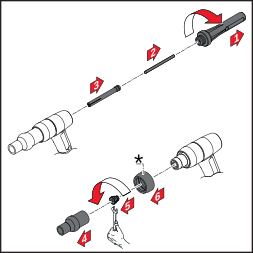
2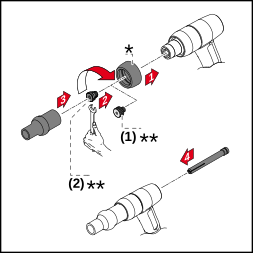
CAUTION!
Risk of damage due to excessive tightening torque on the torch cap.
Damage to the thread may result.
Only tighten the torch cap enough so that the tungsten electrode can no longer be moved by hand.
3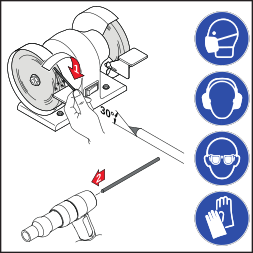
4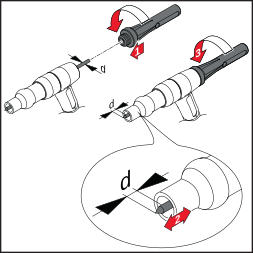
Screw down the torch cap
Fitting an A-type wearing part with gas nozzle (push-on type)
CAUTION!
Risk of damage due to excessive tightening torque on the fixing sleeve (1) or gas lens (2).
Damage to the thread may result.
Only tighten the fixing sleeve (1) or gas lens (2) a little.
| * | Replaceable rubber sealing sleeve only for TTB 220 G/A |
| ** | A gas lens (2) may be used instead of the fixing sleeve (1) depending on the type of welding torch |
1
2
CAUTION!
Risk of damage due to excessive tightening torque on the torch cap.
Damage to the thread may result.
Only tighten the torch cap enough so that the tungsten electrode can no longer be moved by hand.
3
4
Screw down the torch cap
Fitting a P-type wearing part with gas nozzle (screw type)
CAUTION!
Risk of damage due to excessive tightening torque on the fixing sleeve (1) or gas lens (2).
Damage to the thread may result.
Only tighten the fixing sleeve (1) or gas lens (2) a little.
| * | Replaceable rubber sealing sleeve only for TTB 220 G/P |
| ** | A gas lens (2) may be used instead of the fixing sleeve (1) depending on the type of welding torch |
1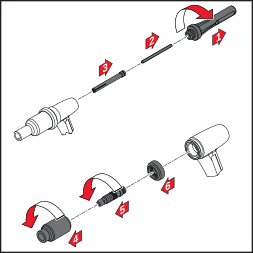
2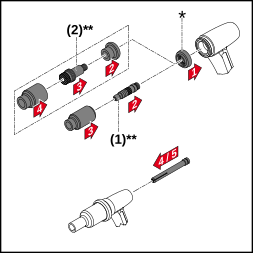
CAUTION!
Risk of damage due to excessive tightening torque on the torch cap.
Damage to the thread may result.
Only tighten the torch cap enough so that the tungsten electrode can no longer be moved by hand.
3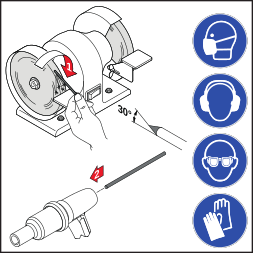
4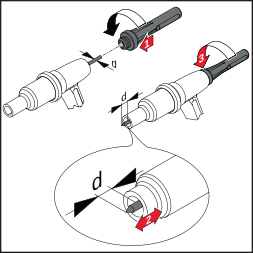
Screw down the torch cap
Fitting the torch body and connecting the welding torch
Fitting the torch body
NOTE!
Risk due to damaged O-ring on the torch body.
A damaged O-ring on the torch body can lead to contamination of the shielding gas, resulting in a defective weld.
Before each start-up, ensure that the O-ring on the torch body is undamaged.
1* Grease the O-ring on the torch body
2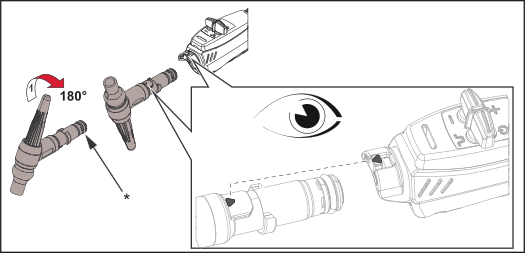
3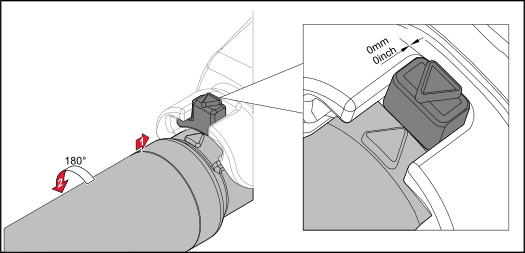
Push the torch body locking device fully back and at the same time turn the torch body 180°
4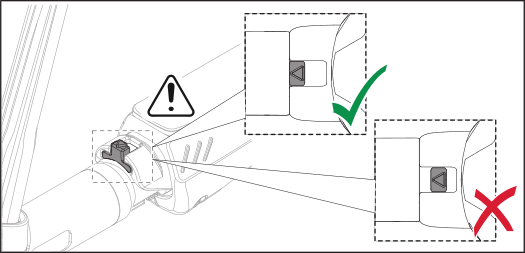
CAUTION!
Danger due to incorrectly fitted torch body.
This can result in damage to property.
Ensure that the locking device is fully forward after fitting the torch body - only then is the torch body properly fitted and locked.
Fitting the torch body
NOTE!
Risk due to damaged O-ring on the torch body.
A damaged O-ring on the torch body can lead to contamination of the shielding gas, resulting in a defective weld.
Before each start-up, ensure that the O-ring on the torch body is undamaged.
1* Grease the O-ring on the torch body
2
3
Push the torch body locking device fully back and at the same time turn the torch body 180°
4
CAUTION!
Danger due to incorrectly fitted torch body.
This can result in damage to property.
Ensure that the locking device is fully forward after fitting the torch body - only then is the torch body properly fitted and locked.
Connecting the welding torch
NOTE!
Risk due to damaged O-ring on the welding torch connection.
A damaged O-ring on the welding torch connection can lead to contamination of the shielding gas, resulting in a defective weld.
Before each start-up, ensure that the O-ring on the welding torch connection is undamaged.
1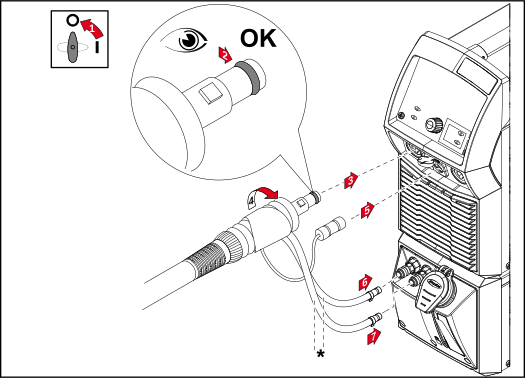
* only with water-cooled welding system
Rotating the torch body
1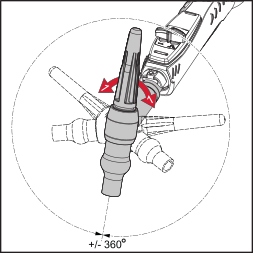
Changing the torch body of a gas-cooled welding torch
Changing the torch body
Removing the torch body:
1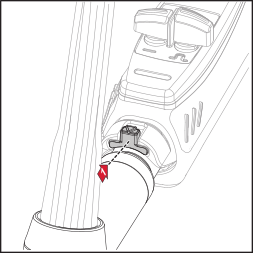
2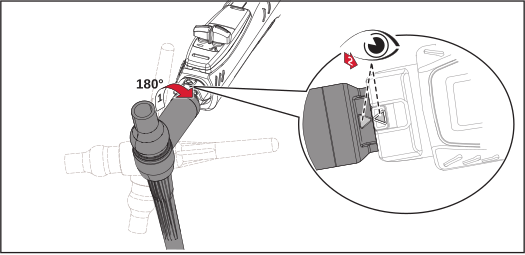
3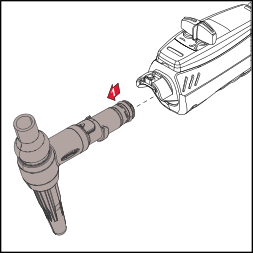
4Remove contamination from the hosepack interface
5Remove contamination from the torch body interface
6Fit the protective cap to the torch body interface
Fitting the torch body:
CAUTION!
Danger due to incompatible system components.
This can result in damage to property.
Only connect torch bodies and hosepacks that are using the same type of cooling.
Only fit gas-cooled torch bodies to gas-cooled hosepacks.
NOTE!
Risk due to damaged O-ring on the torch body.
A damaged O-ring on the torch body can lead to contamination of the shielding gas, resulting in a defective weld.
Before each start-up, ensure that the O-ring on the torch body is undamaged.
1* Grease the O-ring on the torch body
2
3
Push the torch body locking device fully back and at the same time turn the torch body 180°
4
CAUTION!
Danger due to incorrectly fitted torch body.
This can result in damage to property.
Ensure that the locking device is fully forward after fitting the torch body - only then is the torch body properly fitted and locked.
5Perform a test weld and check the quality of the weld
Changing the torch body
Removing the torch body:
1
2
3
4Remove contamination from the hosepack interface
5Remove contamination from the torch body interface
6Fit the protective cap to the torch body interface
Fitting the torch body:
CAUTION!
Danger due to incompatible system components.
This can result in damage to property.
Only connect torch bodies and hosepacks that are using the same type of cooling.
Only fit gas-cooled torch bodies to gas-cooled hosepacks.
NOTE!
Risk due to damaged O-ring on the torch body.
A damaged O-ring on the torch body can lead to contamination of the shielding gas, resulting in a defective weld.
Before each start-up, ensure that the O-ring on the torch body is undamaged.
1* Grease the O-ring on the torch body
2
3
Push the torch body locking device fully back and at the same time turn the torch body 180°
4
CAUTION!
Danger due to incorrectly fitted torch body.
This can result in damage to property.
Ensure that the locking device is fully forward after fitting the torch body - only then is the torch body properly fitted and locked.
5Perform a test weld and check the quality of the weld
Changing the torch body of a water-cooled welding torch
Automatic emptying of the welding torch and changing the torch body
CAUTION!
Danger from switched on power source during automatic emptying of the welding torch.
Unintentional arc ignitions can occur.
Follow the instructions for automatic emptying of the welding torch in the cooling unit Operating Instructions, the power source Operating Instructions, and on the power source control panel.
When carrying out the work on the torch body as described below, keep at least 1 m (39.37 in.) away from electrically conductive objects.
Automatic emptying of the welding torch (e.g., with CU 600t /MC) and removing the torch body:
1Empty the torch hosepack using the corresponding cooling unit function
2
3
4
5Remove contamination and coolant residues from the hosepack interface
6Remove contamination and coolant residues from the torch body interface
7Fit the protective cap to the torch body interface
Fitting the torch body:
CAUTION!
Danger due to incompatible system components.
This can result in damage to property.
Only connect torch bodies and hosepacks that are using the same type of cooling.
Only fit water-cooled torch bodies to water-cooled hosepacks.
NOTE!
Risk due to damaged O-ring on the torch body.
A damaged O-ring on the torch body can lead to contamination of the shielding gas, resulting in a defective weld.
Before each start-up, ensure that the O-ring on the torch body is undamaged.
1* Grease the O-ring on the torch body
2
3
Push the torch body locking device fully back and at the same time turn the torch body 180°
4
CAUTION!
Danger due to incorrectly fitted torch body.
This can result in damage to property.
Ensure that the locking device is fully forward after fitting the torch body - only then is the torch body properly fitted and locked.
5Press the gas-test button on the power source
Shielding gas flows out for 30 s.
Shielding gas flows out for 30 s.
6Check the coolant flow:
You must be able to see a strong return flow into the cooling unit coolant container.
You must be able to see a strong return flow into the cooling unit coolant container.
7Perform a test weld and check the quality of the weld
Automatic emptying of the welding torch and changing the torch body
CAUTION!
Danger from switched on power source during automatic emptying of the welding torch.
Unintentional arc ignitions can occur.
Follow the instructions for automatic emptying of the welding torch in the cooling unit Operating Instructions, the power source Operating Instructions, and on the power source control panel.
When carrying out the work on the torch body as described below, keep at least 1 m (39.37 in.) away from electrically conductive objects.
Automatic emptying of the welding torch (e.g., with CU 600t /MC) and removing the torch body:
1Empty the torch hosepack using the corresponding cooling unit function
2
3
4
5Remove contamination and coolant residues from the hosepack interface
6Remove contamination and coolant residues from the torch body interface
7Fit the protective cap to the torch body interface
Fitting the torch body:
CAUTION!
Danger due to incompatible system components.
This can result in damage to property.
Only connect torch bodies and hosepacks that are using the same type of cooling.
Only fit water-cooled torch bodies to water-cooled hosepacks.
NOTE!
Risk due to damaged O-ring on the torch body.
A damaged O-ring on the torch body can lead to contamination of the shielding gas, resulting in a defective weld.
Before each start-up, ensure that the O-ring on the torch body is undamaged.
1* Grease the O-ring on the torch body
2
3
Push the torch body locking device fully back and at the same time turn the torch body 180°
4
CAUTION!
Danger due to incorrectly fitted torch body.
This can result in damage to property.
Ensure that the locking device is fully forward after fitting the torch body - only then is the torch body properly fitted and locked.
5Press the gas-test button on the power source
Shielding gas flows out for 30 s.
Shielding gas flows out for 30 s.
6Check the coolant flow:
You must be able to see a strong return flow into the cooling unit coolant container.
You must be able to see a strong return flow into the cooling unit coolant container.
7Perform a test weld and check the quality of the weld
Manually emptying the welding torch and changing the torch body
Manually emptying the welding torch and removing the torch body:
1Switch off the power source and disconnect from the grid
2Wait for the cooling unit to run down
3Shut off the coolant supply hose from the cooling unit
4Purge the coolant supply hose with compressed air at maximum 4 bar (58.02 psi)
- This will cause a large part of the coolant to flow back into the coolant container
5
6
7
8Remove contamination and coolant residues from the hosepack interface
9Remove contamination and coolant residues from the torch body interface
10Fit the protective cap to the torch body interface
Fitting the torch body:
CAUTION!
Danger due to incompatible system components.
This can result in damage to property.
Only connect torch bodies and hosepacks that are using the same type of cooling.
Only fit water-cooled torch bodies to water-cooled hosepacks.
NOTE!
Risk due to damaged O-ring on the torch body.
A damaged O-ring on the torch body can lead to contamination of the shielding gas, resulting in a defective weld.
Before each start-up, ensure that the O-ring on the torch body is undamaged.
1* Grease the O-ring on the torch body
2
3
Push the torch body locking device fully back and at the same time turn the torch body 180°
4
CAUTION!
Danger due to incorrectly fitted torch body.
This can result in damage to property.
Ensure that the locking device is fully forward after fitting the torch body - only then is the torch body properly fitted and locked.
5Connect the power source to the grid and switch on
6Press the gas-test button on the power source
Shielding gas flows out for 30 s.
Shielding gas flows out for 30 s.
7Check the coolant flow:
You must be able to see a strong return flow into the cooling unit coolant container.
You must be able to see a strong return flow into the cooling unit coolant container.
8Perform a test weld and check the quality of the weld
Service, maintenance and disposal
Prohibited
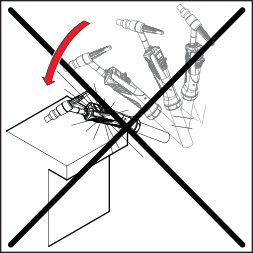
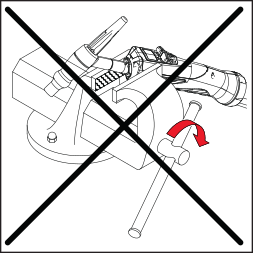
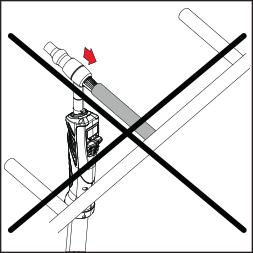
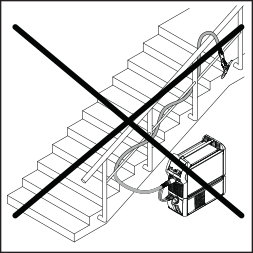
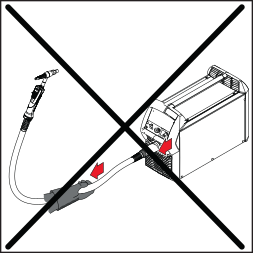
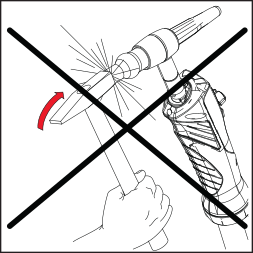
Prohibited
Maintenance at every start-up
- Check wearing parts, replace faulty wearing parts
- Purge the gas nozzle of welding spatter
In addition to the above list of steps to be carried out at every start-up, for water-cooled welding torches:
- Ensure that all coolant connections are leak-tight
- Ensure that there is a proper coolant return flow
Disposal
Materials should be disposed of according to valid local and national regulations.
Troubleshooting
Troubleshooting
Troubleshooting
Welding torch cannot be connected
| Cause: | Bayonet lock bent |
| Remedy: | Replace bayonet lock |
No welding current
Power source switched on, power source indication illuminates, shielding gas present
| Cause: | Incorrect ground connection |
| Remedy: | Establish proper ground connection |
| Cause: | Power cable in welding torch interrupted |
| Remedy: | Replace welding torch |
| Cause: | Tungsten electrode loose |
| Remedy: | Tighten tungsten electrode using torch cap |
| Cause: | Wearing parts loose |
| Remedy: | Tighten wearing parts |
No function after pressing torch trigger
Power source switched on, power source indication illuminates, shielding gas present
| Cause: | Power plug not plugged in |
| Remedy: | Plug in power plug |
| Cause: | Welding torch or welding torch control line faulty |
| Remedy: | Replace welding torch |
| Cause: | Plug connections "torch trigger/control line/power source" faulty |
| Remedy: | Check plug connection / send power source or welding torch to service team |
| Cause: | PCB in welding torch faulty |
| Remedy: | Replace PCB |
HF flashover at welding torch connection
| Cause: | Welding torch connection not sealed |
| Remedy: | Replace O-ring on the bayonet lock |
HF flashover at the shell-type handle
| Cause: | Hosepack is not sealed |
| Remedy: | Replace hosepack |
| Cause: | Shielding gas hose connection to torch body not sealed |
| Remedy: | Adjust and seal hose |
No shielding gas
All other functions present
| Cause: | Gas cylinder empty |
| Remedy: | Change gas cylinder |
| Cause: | Gas pressure regulator faulty |
| Remedy: | Replace gas pressure regulator |
| Cause: | Gas hose kinked, damaged, or not attached |
| Remedy: | Attach and straighten gas hose. Replace faulty gas hose |
| Cause: | Welding torch faulty |
| Remedy: | Replace welding torch |
| Cause: | Gas solenoid valve faulty |
| Remedy: | Contact service team (have gas solenoid valve replaced) |
Poor-quality weld properties
| Cause: | Incorrect welding parameters |
| Remedy: | Check settings |
| Cause: | Incorrect ground connection |
| Remedy: | Check ground connection and terminal for polarity |
Welding torch gets very hot
| Cause: | Welding torch is inadequately dimensioned |
| Remedy: | Observe duty cycle and load limits |
| Cause: | For water-cooled systems only: Coolant flow too low |
| Remedy: | Check water level, water flow rate, water contamination, etc. Coolant pump blocked: Switch on shaft of coolant pump at the gland using a screwdriver |
| Cause: | For water-cooled systems only: "Cooling unit Ctrl" parameter is set to "OFF". |
| Remedy: | In the Setup menu, set the "Cooling unit Ctrl" parameter to "Aut" or "ON". |
Porosity of weld seam
| Cause: | Spattering in the gas nozzle, causing inadequate gas shield for weld seam |
| Remedy: | Remove welding spatter |
| Cause: | Holes in gas hose or imprecise gas hose connection |
| Remedy: | Replace gas hose |
| Cause: | O-ring at central connector is cut or faulty |
| Remedy: | Replace O-ring |
| Cause: | Moisture/condensate in the gas line |
| Remedy: | Dry gas line |
| Cause: | Gas flow too strong or weak |
| Remedy: | Correct gas flow |
| Cause: | Inadequate quantity of gas at the start or end of welding |
| Remedy: | Increase gas pre-flow and gas post-flow |
| Cause: | Too much parting agent applied |
| Remedy: | Remove excess parting agent/apply less parting agent |
Poor ignition properties
| Cause: | Unsuitable tungsten electrode (e.g., WP electrode for DC welding) |
| Remedy: | Use suitable tungsten electrode |
| Cause: | Wearing parts loose |
| Remedy: | Screw on wearing parts tightly |
Gas nozzle is cracked
| Cause: | Tungsten electrode not protruding far enough out of the gas nozzle |
| Remedy: | Have tungsten electrode protrude more out of the gas nozzle |
Technical data
General
This product meets the requirements set out in standard IEC 60974-7.
NOTE!
The performance data specifications only apply when using standard wearing parts.
When using gas lenses and shorter gas nozzles, the welding current is reduced.
NOTE!
The welding current specifications apply to gas-cooled torch bodies only from a length of 65 mm (2.56 in.).
When using shorter torch bodies, the welding current is reduced by 30%.
NOTE!
When welding at the power limit of the welding torch, use larger tungsten electrodes and gas nozzle opening diameters to increase the service life of the wearing parts.
Take amperage, AC balance, and AC current offset into account as performance-enhancing factors.
General
This product meets the requirements set out in standard IEC 60974-7.
NOTE!
The performance data specifications only apply when using standard wearing parts.
When using gas lenses and shorter gas nozzles, the welding current is reduced.
NOTE!
The welding current specifications apply to gas-cooled torch bodies only from a length of 65 mm (2.56 in.).
When using shorter torch bodies, the welding current is reduced by 30%.
NOTE!
When welding at the power limit of the welding torch, use larger tungsten electrodes and gas nozzle opening diameters to increase the service life of the wearing parts.
Take amperage, AC balance, and AC current offset into account as performance-enhancing factors.
Gas-cooled torch body –
TTB 80,TTB 120, TTB 160, TTB 220
| TTB 80 G | TTB 120 G | TTB 160 G / F |
|---|---|---|---|
DC welding current at 10 min / 40 °C (104 °F) | 35 % D.C.1) / 80 A | 15 % D.C.1) / 120 A | 35 % D.C.1) / 160 A |
60 % D.C.1) / 60 A | 35 % D.C.1) / 80 A | 60 % D.C.1) / 120 A | |
100 % D.C.1) / 50 A | 60 % D.C.1) / 60 A | 100 % D.C.1) / 90 A | |
|
| 100 % D.C.1) / 50 A |
|
AC welding current at 10 min / 40 °C (104 °F) | 35 % D.C.1) / 30 A | 35 % D.C.1) / 40 A | 35 % D.C.1) / 120 A |
| 60 % D.C.1) / 90 A | ||
| 100 % D.C.1) / 70 A | ||
Shielding gas | Argon | Argon | Argon |
Electrode diameter | 1,0 - 3,2 mm | 1,0 - 3,2 mm | 1,0 - 3,2 mm |
Permissible tungsten electrode types | in accordance with standard EN ISO 6848 | ||
| TTB 220 G |
|---|---|
DC welding current at 10 min / 40 °C (104 °F) | 35% D.C.1) / 220 A |
60% D.C.1) / 170 A | |
100% D.C.1) / 130 A | |
AC welding current at 10 min / 40 °C (104 °F) | 35% D.C.1) / 180 A |
60% D.C.1) / 130 A | |
100% D.C.1) / 100 A | |
Shielding gas (Standard EN ISO 14175) | Argon |
Electrode diameter | 1.0 - 4.0 mm |
Permissible tungsten electrode types | in accordance with standard EN ISO 6848 |
| TTB 220 A G F | TTB 220 P G F |
|---|---|---|
DC welding current at 10 min / 40 °C (104 °F) | 35% D.C.1) / 220 A | 30% D.C.1) / 220 A |
60% D.C.1) / 170 A | 60% D.C.1) / 160 A | |
100% D.C.1) / 130 A | 100% D.C.1) / 130 A | |
AC welding current at 10 min / 40 °C (104 °F) | 35% D.C.1) / 180 A | 30% D.C.1) / 170 A |
60% D.C.1) / 120 A | 60% D.C.1) / 120 A | |
100% D.C.1) / 100 A | 100% D.C.1) / 100 A | |
Shielding gas (Standard EN ISO 14175) | Argon | Argon |
Electrode diameter | 1.0 - 4.0 mm | 1.0 - 4.0 mm |
Permissible tungsten electrode types | in accordance with standard EN ISO 6848 | |
| 1) | D.C. = duty cycle |
Water-cooled torch body -
TTB 180, TTB 300
| TTB 180 W | TTB 300 W |
|---|---|---|
DC welding current at 10 min / 40 °C (104 °F) | 60% D.C.1) / 180 A | 60% D.C.1) / 300 A |
100% D.C.1) / 140 A | 100% D.C.1) / 230 A | |
AC welding current at 10 min / 40 °C (104 °F) | 60% D.C.1) / 140 A | 60% D.C.1) / 250 A |
100% D.C.1) / 110 A | 100% D.C.1) / 190 A | |
Shielding gas (Standard EN ISO 14175) | Argon | Argon |
Electrode diameter | 1.0 - 3.2 mm | 1.0 - 3.2 mm |
Minimum permissible coolant flow Qmin | 1 l/min | 1 l/min |
Permissible tungsten electrode types | in accordance with standard EN ISO 6848 | |
| 1) | D.C. = duty cycle |
Gas-cooled hosepack -
THP 120 G SH,
THP 180 G SH
| THP 120 G SH | THP 180 G SH |
|---|---|---|
DC welding current | 35% D.C.1) / 120 A | 35% D.C.1) / 180 A |
60% D.C.1) / 100 A | 60% D.C.1) / 130 A | |
100% D.C.1) / 80 A | 100% D.C.1) / 100 A | |
AC welding current | 35% D.C.1) / 90 A | 35% D.C.1) / 120 A |
60% D.C.1) / 70 A | 60% D.C.1) / 90 A | |
100% D.C.1) / 50 A | 100% D.C.1) / 70 A | |
Shielding gas (Standard EN ISO 14175) | Argon | Argon |
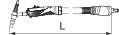 | 4.0 m / 8.0 m | 4.0 m / 8.0 m |
Maximum permitted open circuit voltage (U0) | 113 V | 113 V |
Maximum permitted striking voltage (UP) | 10 kV | 10 kV |
Torch trigger Umax | 35 V | 35 V |
Torch trigger Imax | 100 mA | 100 mA |
| 1) | D.C. = duty cycle |
Gas-cooled hosepack -
THP 150 G SH
NOTE!
The THP 150 G SH hosepack is not intended or suitable for arc ignition devices, for example high frequency ignition.
The hosepack is intended for use with TransPocket 150/180 and AccuPocket 150 power sources only.
| THP 150 G SH |
|---|---|
DC welding current | 25% D.C.1) / 150 A |
35% D.C.1) / 120 A | |
60% D.C.1) / 100 A | |
100% D.C.1) / 80 A | |
AC welding current | 25% D.C.1) / 110 A |
35% D.C.1) / 90 A | |
60% D.C.1) / 70 A | |
100% D.C.1) / 50 A | |
Shielding gas (Standard EN ISO 14175) | Argon |
| 4.0 m / 8.0 m |
Maximum permitted open circuit voltage U0 | 113 V |
Maximum permitted striking voltage UP |  Not intended for or suitable for arc ignition devices! |
| 1) | D.C. = duty cycle |
Water-cooled hosepack - THP 300 SH
| THP 300 SH |
|---|---|
DC welding current | 60% D.C.1) / 300 A |
100% D.C.1) / 230 A | |
AC welding current | 60% D.C.1) / 250 A |
100% D.C.1) / 190 A | |
Shielding gas (Standard EN ISO 14175) | Argon |
| 4.0 m / 8.0 m |
Lowest cooling capacity as per IEC standard 60974-2, depending on the hosepack length | 650 W / 650 W |
Minimum permissible coolant flow Qmin | 1 l/min |
Minimum permissible coolant pressure pmin | 3 bar |
Maximum permissible coolant pressure pmax | 5.5 bar |
Maximum permitted open circuit voltage U0 | 113 V |
Maximum permitted striking voltage UP | 10 kV |
| 1) | D.C. = duty cycle |