Safety rules
General
Explanation of safety notices
DANGER!
Indicates immediate danger.
If not avoided, death or serious injury will result.
WARNING!
Indicates a potentially hazardous situation.
If not avoided, death or serious injury may result.
CAUTION!
Indicates a situation where damage or injury could occur.
If not avoided, minor injury and/or damage to property may result.
NOTE!
Indicates a risk of flawed results and possible damage to the equipment.
General
Explanation of safety notices
DANGER!
Indicates immediate danger.
If not avoided, death or serious injury will result.
WARNING!
Indicates a potentially hazardous situation.
If not avoided, death or serious injury may result.
CAUTION!
Indicates a situation where damage or injury could occur.
If not avoided, minor injury and/or damage to property may result.
NOTE!
Indicates a risk of flawed results and possible damage to the equipment.
Explanation of safety notices
DANGER!
Indicates immediate danger.
If not avoided, death or serious injury will result.
WARNING!
Indicates a potentially hazardous situation.
If not avoided, death or serious injury may result.
CAUTION!
Indicates a situation where damage or injury could occur.
If not avoided, minor injury and/or damage to property may result.
NOTE!
Indicates a risk of flawed results and possible damage to the equipment.
Environmental conditions
Transport, storage or operation of the device outside the stipulated range will be deemed improper. The manufacturer shall not be held liable for any damage arising from such usage.
Ambient air temperature range:- During operation: -10 °C to + 40 °C (14 °F to 104 °F)
- During transport: -20 °C to +55 °C (-4 °F to 131 °F)
- Recommended temperature range during charging:
+ 4 °C to + 40 °C (+ 39.2 °F to + 104 °F) - Recommended temperature range during storage:
0 °C to + 20 °C (+ 32 °F to + 68 °F)
When placing in storage, the state of charge should ideally be at 50 - 80% (corresponds to approx. 2 to 3 bars on the charging status indication).
- Up to 50% at 40 °C (104 °F)
- Up to 90 % at 20 °C (68 °F)
The surrounding air must be free from dust, acids, corrosive gases or substances, etc.
Can be used at altitudes up to 2000 m (6561 ft.)
Obligations of the operator
- are familiar with the fundamental instructions regarding safety at work and accident prevention and have been instructed in how to use the device
- have read and understood these operating instructions, especially the section "safety rules", and have confirmed as much with their signatures
- are trained to produce the required results.
Checks must be carried out at regular intervals to ensure that operators are working in a safety-conscious manner.
Obligations of personnel
- to observe the basic instructions regarding safety at work and accident prevention,
- to read these operating instructions, especially the "Safety rules" section and sign to confirm that they have understood them and will follow them.
Before leaving the workplace, ensure that people or property cannot come to any harm in your absence.
EMC Device Classifications
- Are only designed for use in industrial settings
- Can cause line-bound and radiated interference in other areas
- Satisfy the emissions criteria for residential and industrial areas. This is also true for residential areas in which the energy is supplied from the public low-voltage mains.
EMC device classification as per the rating plate or technical data.
Disposal
Waste electrical and electronic equipment must be collected separately and recycled in an environmentally responsible manner in accordance with the EU Directive and national law. Used equipment must be returned to the distributor or through a local, authorised collection and disposal system. Correct disposal of the used device promotes sustainable recycling of resources and prevents negative effects on health and the environment.
Packaging materials- Collect separately
- Observe locally valid regulations
- Compress the cardboard box to reduce volume
Data security
- backing up any changes made to the factory settings
- saving and retaining personal settings
Copyright
Copyright of these operating instructions remains with the manufacturer.
Text and illustrations were accurate at the time of printing, subject to change.
We are grateful for suggestions for improvement and information regarding any discrepancies in the operating instructions.
Power source
General
- injury or death to the operator or a third party,
- damage to the device and other material assets belonging to the operating company,
- inefficient operation of the device.
- be suitably qualified,
- have sufficient knowledge of welding and
- read and follow these operating instructions carefully.
The operating instructions must always be at hand wherever the device is being used. In addition to the operating instructions, attention must also be paid to any generally applicable and local regulations regarding accident prevention and environmental protection.
All safety and danger notices on the device- must be in a legible state,
- must not be damaged,
- must not be removed,
- must not be covered, pasted or painted over.
For the location of the safety and danger notices on the device, refer to the section headed "General" in the operating instructions for the device.
Before switching on the device, rectify any faults that could compromise safety.
This is for your personal safety!
General
- injury or death to the operator or a third party,
- damage to the device and other material assets belonging to the operating company,
- inefficient operation of the device.
- be suitably qualified,
- have sufficient knowledge of welding and
- read and follow these operating instructions carefully.
The operating instructions must always be at hand wherever the device is being used. In addition to the operating instructions, attention must also be paid to any generally applicable and local regulations regarding accident prevention and environmental protection.
All safety and danger notices on the device- must be in a legible state,
- must not be damaged,
- must not be removed,
- must not be covered, pasted or painted over.
For the location of the safety and danger notices on the device, refer to the section headed "General" in the operating instructions for the device.
Before switching on the device, rectify any faults that could compromise safety.
This is for your personal safety!
Proper use
The device is to be used exclusively for its intended purpose.
The device is intended solely for the welding processes specified on the rating plate.
Any use above and beyond this purpose is deemed improper. The manufacturer shall not be held liable for any damage arising from such usage.
- carefully reading and following all the instructions given in the operating instructions
- studying and obeying all safety and danger notices carefully
- performing all stipulated inspection and maintenance work.
- Thawing out pipes
- Charging batteries
- Starting engines
The device is designed for use in industry and the workshop. The manufacturer accepts no responsibility for any damage caused through use in a domestic setting.
The manufacturer likewise accepts no liability for inadequate or incorrect results.
Protecting yourself and others
- flying sparks and hot pieces of metal
- Arc radiation, which can damage eyes and skin
- Hazardous electromagnetic fields, which can endanger the lives of those using cardiac pacemakers
- Risk of electrocution from mains current and welding current
- Greater noise pollution
- Harmful welding fumes and gases
- Flame-resistant
- Insulating and dry
- Covers the whole body, is undamaged and in good condition
- Safety helmet
- Trousers with no turn-ups
- Protect eyes and face from UV rays, heat and sparks using a protective visor and regulation filter
- Wear regulation protective goggles with side protection behind the protective visor
- Wear stout footwear that provides insulation even in wet conditions
- Protect the hands with suitable gloves (electrically insulated and providing protection against heat)
- Wear ear protection to reduce the harmful effects of noise and to prevent injury
- Make them aware of all the dangers (risk of dazzling by the arc, injury from flying sparks, harmful welding fumes, noise, possible risks from mains current and welding current, etc.)
- Provide suitable protective equipment
- Alternatively, erect suitable safety screens/curtains.
Noise emission values
The device generates a maximum sound power level of <80 dB(A) (ref. 1pW) when idling and in the cooling phase following operation at the maximum permissible operating point under maximum rated load conditions according to EN 60974-1.
It is not possible to provide a workplace-related emission value during welding (or cutting) as this is influenced by both the process and the environment. All manner of different welding parameters come into play, including the welding process (MIG/MAG, TIG welding), the type of power selected (DC or AC), the power range, the type of weld metal, the resonance characteristics of the workpiece, the workplace environment, etc.
Danger from toxic gases and vapours
The fumes produced during welding contain harmful gases and vapours.
Welding fumes contain substances that cause cancer, as stated in Monograph 118 of the International Agency for Research on Cancer.
Use at-source extraction and a room extraction system.
If necessary, use a welding torch with an integrated extraction device.
Keep your face away from welding fumes and gases.
Fumes and hazardous gases- must not be breathed in
- must be extracted from the working area using appropriate methods.
Ensure an adequate supply of fresh air. Ensure that there is a ventilation rate of at least 20 m³ per hour at all times.
Otherwise, a welding helmet with an air supply must be worn.
If there is any doubt about whether the extraction capacity is sufficient, the measured toxic emission values should be compared with the permissible limit values.
The following components are responsible, amongst other things, for the degree of toxicity of welding fumes:- Metals used for the workpiece
- Electrodes
- Coatings
- Cleaners, degreasers, etc.
- Welding process used
The relevant material safety data sheets and manufacturer's specifications for the listed components should therefore be studied carefully.
Recommendations for trade fair scenarios, risk management measures and for identifying working conditions can be found on the European Welding Association website under Health & Safety (https://european-welding.org).
Flammable vapours (e.g. solvent fumes) should be kept away from the arc's radiation area.
Close the shielding gas cylinder valve or main gas supply if no welding is taking place.
Danger from flying sparks
Flying sparks may cause fires or explosions.
Never weld close to flammable materials.
Flammable materials must be at least 11 metres (36 ft. 1.07 in.) away from the arc, or alternatively covered with an approved cover.
A suitable, tested fire extinguisher must be available and ready for use.
Sparks and pieces of hot metal may also get into adjacent areas through small gaps or openings. Take appropriate precautions to prevent any danger of injury or fire.
Welding must not be performed in areas that are subject to fire or explosion or near sealed tanks, vessels or pipes unless these have been prepared in accordance with the relevant national and international standards.
Do not carry out welding on containers that are being or have been used to store gases, propellants, mineral oils or similar products. Residues pose an explosive hazard.
Dangers from welding current
An electric shock is potentially life threatening and can be fatal.
Do not touch live parts either inside or outside the device.
Make sure that you and others are protected with an adequately insulated, dry temporary backing or cover for the earth or ground potential. This temporary backing or cover must extend over the entire area between the body and the earth or ground potential.
All cables and leads must be secured, undamaged, insulated and adequately dimensioned. Loose connections, scorched, damaged or inadequately dimensioned cables and leads must be replaced immediately.
Do not sling cables or leads around the body or parts of the body.
The electrode (rod electrode, tungsten electrode, welding wire, etc.) must- never be immersed in liquid for cooling
- never be touched when the power source is switched on.
Double the open circuit voltage of a power source can occur between the welding electrodes of two power sources. Touching the potentials of both electrodes at the same time may be fatal under certain circumstances.
If necessary, provide an adequate earthing connection for the workpiece.
Switch off unused devices.
Dangers from the battery
If the device becomes damaged, please observe the following points:
- Make sure that leaking fluids cannot get into the soil or groundwater
- If pollution has already occurred, it must be removed in accordance with relevant national regulations
- The liquid may cause irritation or burns.
- Avoid contact with this liquid.
- In case of accidental contact, clean the affected area immediately with water.
- In case of eye contact, also consult a doctor.
The battery can catch fire if overheated. Do not expose the device to heat
(e.g. a permanent heat source or fire)
If this happens:
- Ensure an adequate supply of fresh air
- Seek medical attention in case of discomfort
- Avoid contact with the liquid
- Hand the device over to a Fronius Service Partner for repair
- Clean and check any parts that have come into contact with the liquid
Do not operate or store the device in a potentially explosive atmosphere.
Special regulations apply in rooms at risk of fire or explosion.
Observe relevant national and international regulations.
To comply with European Directive 2006/66/EC on batteries and accumulators and its implementation in national law, batteries and rechargeable batteries that have reached the end of their life must be collected separately and returned to an approved recycling facility. Be sure to return any device that you no longer require to your distributor, or find out about the approved collection and recycling facilities in your area. Ignoring this European Directive may have potentially adverse effects on the environment and your health!
Devices with mechanically undamaged rechargeable batteries may be returned to the relevant Fronius Service Partner for repair or battery replacement.
As soon as it becomes evident that the rechargeable battery has been mechanically damaged (e.g. electrolyte is escaping), dispose of the device at your nearest recycling centre in accordance with national laws and guidelines.
If anything is unclear or you have any questions about disposal, contact your Fronius Service Partner.
Use only the "ActiveCharger 1000" battery charger to charge the power source. Use of a different charger poses a fire risk.
Only operate the power source using the battery provided. Use of a different battery could result in the risk of injury and/or fire.
If the battery is disconnected, keep it away from metal objects such as paperclips, coins, keys, nails, screws or other small metal objects that could establish a connection between the battery terminals. Short circuiting of the battery poles could result in a burn injury or a fire.
Do not use damaged or modified batteries and power sources. Damaged or modified components and devices may exhibit unpredictable behaviour that could result in an explosion or injury.
Do not expose the power source and the battery to fire or temperatures exceeding 130 °C (266 °F). This could result in an explosion.
Follow the charging instructions contained in these Operating Instructions. Do not charge the battery outside of the permitted temperature range - see sectionEnvironmental conditions on page (→). Improper charging or exposure to unauthorised temperatures could damage the battery and increase the risk of fire.
Meandering welding currents
- Fire hazard
- Overheating of parts connected to the workpiece
- Irreparable damage to ground conductors
- Damage to device and other electrical equipment
Ensure that the workpiece is held securely by the workpiece clamp.
Attach the workpiece clamp as close as possible to the area that is to be welded.
If the floor is electrically conductive, the device must be set up with sufficient insulating material to insulate it from the floor.
If distribution boards, twin-head mounts, etc., are being used, note the following: The electrode of the welding torch / electrode holder that is not used is also live. Make sure that the welding torch / electrode holder that is not used is kept sufficiently insulated.
EMC measures
In certain cases, even though a device complies with the standard limit values for emissions, it may affect the application area for which it was designed (e.g. when there is sensitive equipment at the same location, or if the site where the device is installed is close to either radio or television receivers).
If this is the case, then the operator is obliged to take appropriate action to rectify the situation.
- Safety devices
- Network, signal and data transfer lines
- IT and telecommunications devices
- Measuring and calibrating devices
- Mains supply
- If electromagnetic interference arises despite the correct mains connection, additional measures are necessary (e.g. use of a suitable line filter)
- Welding power-leads
- must be kept as short as possible
- must be laid close together (to avoid EMF problems)
- must be kept well apart from other leads
- Equipotential bonding
- Earthing of the workpiece
- If necessary, establish an earth connection using suitable capacitors.
- Shield, if necessary
- Shield other devices nearby
- Shield the entire welding installation
EMF measures
- Effects on the health of persons in the vicinity, e.g. those with pacemakers and hearing aids
- Individuals with pacemakers must seek advice from their doctor before approaching the device or any welding that is in progress
- For safety reasons, maintain as large a distance as possible between the welding power-leads and the head/torso of the welder
- Do not carry welding power-leads and hosepacks over the shoulders or wind them around any part of the body
Requirement for the shielding gas
Meet the following requirements regarding shielding gas quality:
- Solid particle size < 40 µm
- Pressure condensation point < -20 °C
- Max. oil content < 25 mg/m³
Use filters if necessary.
Danger from shielding gas cylinders
Shielding gas cylinders contain gas under pressure and can explode if damaged. As the shielding gas cylinders are part of the welding equipment, they must be handled with the greatest of care.
Protect shielding gas cylinders containing compressed gas from excessive heat, mechanical impact, slag, naked flames, sparks and arcs.
Mount the shielding gas cylinders vertically and secure according to instructions to prevent them falling over.
Keep the shielding gas cylinders well away from any welding or other electrical circuits.
Never hang a welding torch on a shielding gas cylinder.
Never touch a shielding gas cylinder with an electrode.
Risk of explosion - never attempt to weld a pressurised shielding gas cylinder.
Only use shielding gas cylinders suitable for the application in hand, along with the correct and appropriate accessories (regulator, hoses and fittings). Only use shielding gas cylinders and accessories that are in good condition.
Turn your face to one side when opening the valve of a shielding gas cylinder.
Close the shielding gas cylinder valve if no welding is taking place.
If the shielding gas cylinder is not connected, leave the valve cap in place on the cylinder.
The manufacturer's instructions must be observed as well as applicable national and international regulations for shielding gas cylinders and accessories.
Danger from escaping shielding gas
Risk of suffocation from the uncontrolled escape of shielding gas
Shielding gas is colourless and odourless and, in the event of a leak, can displace the oxygen in the ambient air.
- Ensure an adequate supply of fresh air with a ventilation rate of at least 20 m³/hour.
- Observe safety and maintenance instructions on the shielding gas cylinder or the main gas supply.
- Close the shielding gas cylinder valve or main gas supply if no welding is taking place.
- Check the shielding gas cylinder or main gas supply for uncontrolled gas leakage before every start-up.
Safety precautions in the place of use and for storage and transport
- The maximum permissible tilt angle is 10°.
Do not operate or store the device in a potentially explosive atmosphere.
Special regulations apply in rooms at risk of fire or explosion.
Observe relevant national and international regulations.
Use internal directives and checks to ensure that the workplace environment is always clean and clearly laid out.
Only set up and operate the device in accordance with the degree of protection shown on the rating plate.
When setting up the device, ensure there is an all-round clearance of 0.5 m (1 ft. 7.69 in.) to ensure that cooling air can flow in and out freely.
When transporting the device, observe the relevant national and local guidelines and accident prevention regulations. This applies especially to guidelines regarding the risks arising during transport.
After transporting the device, it must be visually inspected for damage before commissioning. Any damage must be repaired by trained service technicians before commissioning the device.
Odourless and colourless shielding gas may escape unnoticed if an adapter is used for the shielding gas connection. Prior to assembly, seal the device-side thread of the adapter for the shielding gas connection using suitable Teflon tape.
Safety measures in normal operation
- injury or death to the operator or a third party,
- damage to the device and other material assets belonging to the operator,
- inefficient operation of the device.
Any safety devices that are not functioning properly must be repaired before switching on the device.
Never bypass or disable safety devices.
Before switching on the device, ensure that no one is likely to be endangered.
Check the device at least once a week for obvious damage and proper functioning of safety devices.
Safety inspection
The manufacturer recommends that a safety inspection of the device be performed at least once every 12 months.
The manufacturer recommends that the welding system be calibrated during the same 12-month period.
A safety inspection should be carried out by a qualified electrician- after any changes are made
- after any additional parts are installed, or after any conversions
- after repair, care and maintenance are carried out
- at least every twelve months.
For safety inspections, follow the appropriate national and international standards and directives.
Further details on safety inspection and calibration can be obtained from your service centre. They will provide you with any documents you may require, on request.
Commissioning, maintenance and repair
It is impossible to guarantee that bought-in parts are designed and manufactured to meet the demands made of them, or that they satisfy safety requirements.
- Use only original spare and wearing parts (also applies to standard parts).
- Do not carry out any modifications, alterations, etc. to the device without the manufacturer's consent.
- Components that are not in perfect condition must be replaced immediately.
- When ordering, please give the exact designation and part number as shown in the spare parts list, as well as the serial number of your device.
The housing screws provide the ground conductor connection for earthing the housing parts.
Only use original housing screws in the correct number and tightened to the specified torque.
Safety symbols
Devices with the CE mark satisfy the essential requirements of the low-voltage and electromagnetic compatibility directives (e.g. relevant product standards of the EN 60 974 series).
Fronius International GmbH hereby declares that the device is compliant with Directive 2014/53/EU. The full text on the EU Declaration of Conformity can be found at the following address: http://www.fronius.com
Devices marked with the CSA test mark satisfy the requirements of the relevant standards for Canada and the USA.
Charger
General
- Serious or fatal injury to the operator or third parties
- Damage to the device and other material assets belonging to the operating company
- Inefficient operation of the device
- Be suitably qualified
- Have fully read and precisely followed these Operating Instructions
The Operating Instructions must always be kept to hand wherever the device is being used. In addition to the Operating Instructions, all applicable local rules and regulations regarding accident prevention and environmental protection must also be followed.
All safety and danger notices on the device:- Must be kept in a legible state
- Must not be damaged
- Must not be removed
- Must not be covered, pasted, or painted over
For the location of the safety and danger notices on the device, refer to the section headed "General information" in the Operating Instructions for the device.
Before switching on the device, eliminate any faults that could compromise safety.
Your personal safety is at stake!
General
- Serious or fatal injury to the operator or third parties
- Damage to the device and other material assets belonging to the operating company
- Inefficient operation of the device
- Be suitably qualified
- Have fully read and precisely followed these Operating Instructions
The Operating Instructions must always be kept to hand wherever the device is being used. In addition to the Operating Instructions, all applicable local rules and regulations regarding accident prevention and environmental protection must also be followed.
All safety and danger notices on the device:- Must be kept in a legible state
- Must not be damaged
- Must not be removed
- Must not be covered, pasted, or painted over
For the location of the safety and danger notices on the device, refer to the section headed "General information" in the Operating Instructions for the device.
Before switching on the device, eliminate any faults that could compromise safety.
Your personal safety is at stake!
Environmental conditions
Operation or storage of the device outside the stipulated area will be deemed as not in accordance with the intended purpose. The manufacturer shall not be held liable for any damage arising from such usage.
For exact information on permitted environmental conditions, please refer to the "Technical data" section.
Intended use
The device is to be used exclusively for its intended purpose. Any use above and beyond this purpose is deemed improper. The manufacturer is not liable for any damage, or unexpected or incorrect results arising out of such misuse.
Proper use also includes:- Carefully reading and following all Operating Instructions, safety and danger notices
- Performing all stipulated inspection and servicing work
- Following all instructions from the battery and vehicle manufacturers
Proper handling of the device is essential for it to function correctly. Never pull on the cable when handling the device.
Mains connection
Devices with a higher rating may affect the energy quality of the mains due to their current consumption.
This may affect a number device types in terms of:- Connection restrictions
- Criteria with regard to the maximum permissible mains impedance *)
- Criteria with regard to the minimum short-circuit power requirement *)
*) at the interface with the public grid
see "Technical data"
In this case, the plant operator or the person using the device should check whether the device may be connected, where appropriate by discussing the matter with the power supply company.
IMPORTANT! Ensure that the mains connection is earthed properly
Dangers from mains current and charging current
- risk of electrocution from mains current and charging current
- hazardous electromagnetic fields, which can risk the lives of those using cardiac pacemakers
- do not touch any live parts inside or on the outside of the charger.
- do not short-circuit the charger lead
All cables and leads must be secured, undamaged, insulated and adequately dimensioned. Loose connections, scorched, damaged or inadequately dimensioned cables and leads must be immediately repaired by authorised personnel.
Protecting yourself and others
- warn them of all the dangers,
- provide suitable protective equipment.
Before leaving the work area, ensure that people or property cannot come to any harm in your absence.
Safety measures in normal operation
Operate devices with ground conductors only on a grid with a ground conductor and a socket with a ground conductor contact. Operating the device on a grid without a ground conductor or on a socket without a ground conductor contact is considered gross negligence. The manufacturer accepts no liability for any damage resulting from improper use.
Only operate the device in accordance with the protection class shown on the rating plate.
Never commission the device if it is damaged.
Have the grid and device supply lead regularly inspected by an electrician to ensure that the ground conductor is functioning properly.
Safety devices that are not fully functional and components with defects must be repaired by an authorized specialist before the device is turned on.
Never bypass or disable protection devices.
A freely accessible mains plug is required after installation.
EMC measures
In certain cases, even though a device complies with the standard limit values for emissions, it may affect the application area for which it was designed (e.g. when there is sensitive equipment at the same location, or if the site where the device is installed is close to either radio or television receivers).
If this is the case, then the operating company is obliged to take appropriate action to rectify the situation.
Maintenance
Before each start-up, check the mains plug and mains cable and charging cables and charging terminals for damage.
If dirt accumulates on the device, clean the surface of the device housing with a soft cloth and only with solvent-free cleaning agents.
Maintenance and repair
Maintenance and repair work must only be carried out by authorised personnel. Use only original spare and wearing parts (also applies to standard parts). It is impossible to guarantee that bought-in parts are designed and manufactured to meet the demands made on them, or that they satisfy safety requirements.
Modifications, installations or conversions are only permitted with the approval of the manufacturer.
Warranty and liability
However, the manufacturer will not accept any liability if the damage was caused by one or more of the following:
- Use of the charger "not in accordance with the intended purpose"
- Improper installation and operation.
- Operating the charger with faulty protection devices.
- Non-compliance with the operating instructions.
- Unauthorised modifications to the charger.
- Catastrophes caused by the activities of third parties and force majeure.
Safety inspection
The manufacturer recommends that a safety inspection of the device is performed at least once every 12 months.
The safety inspection may only be performed by an appropriately qualified electrician- After any changes have been made
- After any additional parts are installed, or after any conversions
- After repair, care and maintenance are carried out
- At least every twelve months
For safety inspections, follow the appropriate national and international standards and directives.
Further details on safety inspections can be obtained from your service centre. They will provide you on request with any documents you may require.
Markings on the device
Devices with the CE marking satisfy the essential requirements of the applicable guidelines.
Devices displaying the EAC mark of conformity satisfy the requirements of the relevant standards in Russia, Belarus, Kazakhstan, Armenia and Kyrgyzstan.
General and electrical risks
1KEEP THESE INSTRUCTIONS SAFE- This guide contains important safety and Operating Instructions for these charger types (for model, see first page of this document)
2Do not expose the charger to rain or snow
3The use of accessories not sold or recommended by the charger manufacturer can lead to fire, electric shock or personal injury
Minimum AWG size of an extension cable | |||
|---|---|---|---|
25 ft (7.6 m) | 50 ft (15.2 m) | 100 ft (30.5 m) | 150 ft (45.6 m) |
AWG 16 | AWG 12 | AWG 10 | AWG 8 |
4To reduce the risk of damage to plugs and cables, always unplug the charger by pulling the plug rather than the cable
5Only use an extension cable if it is absolutely necessary. The use of an incorrect extension cable can lead to fire and electric shock. If an extension cable must be used, make sure that
- The pins of the extension cable plug are of the same number, size and shape as those of the battery charger
- The extension cable is correctly wired and in good electrical condition
- The cable size is large enough for the AC amperage of the battery charger, see section Technical data on page (→)
6Do not use the battery charger with a damaged cable or plug - replace the cable or plug immediately
7Do not use the battery charger if it has been subjected to heavy impact, dropped or otherwise damaged; hand it over to a qualified service technician
8Do not dismantle the battery charger; hand it over to a qualified service technician if maintenance or repair is required. Incorrect reassembly can result in fire and electric shock
9To reduce the risk of an electric shock, unplug the battery charger from the socket before carrying out any maintenance or cleaning. This risk cannot be reduced by setting controls to the "Off" position
Power source
General
Device concept
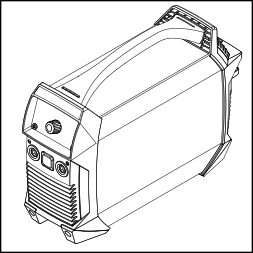
- Operation without mains electricity
- Compact dimensions
- Robust plastic housing
- Extremely reliable even under harsh operating conditions
- Carrying strap for easy transport on construction sites, etc.
- Protected controls
- Connection sockets with bayonet latch
During welding, an electronic regulator adapts the power source characteristic to suit the welding electrode. The result is a lightweight and compact device with excellent ignition and weld properties.
When cellulose electrodes (CEL) are used, a special operating mode can be selected to ensure perfect welding results.
TIG welding with touchdown ignition greatly extends the range of applications.
General
Device concept
- Operation without mains electricity
- Compact dimensions
- Robust plastic housing
- Extremely reliable even under harsh operating conditions
- Carrying strap for easy transport on construction sites, etc.
- Protected controls
- Connection sockets with bayonet latch
During welding, an electronic regulator adapts the power source characteristic to suit the welding electrode. The result is a lightweight and compact device with excellent ignition and weld properties.
When cellulose electrodes (CEL) are used, a special operating mode can be selected to ensure perfect welding results.
TIG welding with touchdown ignition greatly extends the range of applications.
Device concept
- Operation without mains electricity
- Compact dimensions
- Robust plastic housing
- Extremely reliable even under harsh operating conditions
- Carrying strap for easy transport on construction sites, etc.
- Protected controls
- Connection sockets with bayonet latch
During welding, an electronic regulator adapts the power source characteristic to suit the welding electrode. The result is a lightweight and compact device with excellent ignition and weld properties.
When cellulose electrodes (CEL) are used, a special operating mode can be selected to ensure perfect welding results.
TIG welding with touchdown ignition greatly extends the range of applications.
Warning notices on the device
The warning notices and safety symbols on the power source must not be removed or painted over. They warn against incorrect operation which can lead to serious injury and damage.
Meaning of safety symbols on the device:

Risk of serious injury and damage due to incorrect operation.

Do not use the functions described here until you have fully read and understood the following documents:
- these operating instructions
- all the operating instructions for the system components of the power source, especially the safety rules

Do not dispose of used devices with domestic waste. Dispose of them according to the safety rules.
Application areas
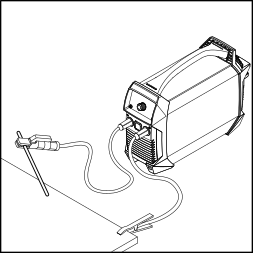
MMA welding
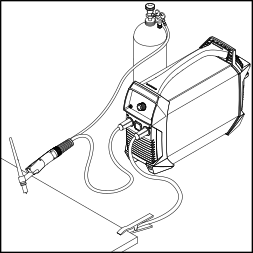
TIG welding with gas-valve torch
Using rechargeable devices
Safety
WARNING!
Danger due to improper handling of the lithium-ion battery.
This can result in severe injury or damage to property.
Never expose the power source to naked flames. Excessive heat can cause the battery to explode or burst.
Do not open the power source or remove the battery. If the battery becomes damaged due to improper handling, poisonous substances can escape which may be harmful to health.
Do not drop the power source into water. This can cause a short circuit, even if the power source is switched off. This in turn can cause the battery to become hot, ignite or burst.
WARNING!
Danger due to incorrect operation and incorrectly performed work.
This can result in severe injury or damage to property.
Do not open the power source.
The power source may only be opened by a Fronius service technician.
If you need a replacement battery, hand the power source over to a Fronius Service Partner.
Safety
WARNING!
Danger due to improper handling of the lithium-ion battery.
This can result in severe injury or damage to property.
Never expose the power source to naked flames. Excessive heat can cause the battery to explode or burst.
Do not open the power source or remove the battery. If the battery becomes damaged due to improper handling, poisonous substances can escape which may be harmful to health.
Do not drop the power source into water. This can cause a short circuit, even if the power source is switched off. This in turn can cause the battery to become hot, ignite or burst.
WARNING!
Danger due to incorrect operation and incorrectly performed work.
This can result in severe injury or damage to property.
Do not open the power source.
The power source may only be opened by a Fronius service technician.
If you need a replacement battery, hand the power source over to a Fronius Service Partner.
Storage and transport
When storing or transporting the power source, observe the environmental conditions in the Technical data section from page (→) .
Particularly if the power source is stored for long periods of time, observe the following points:- Only store the power source when it is charged. The state of charge should ideally be between 50 and 80%
- Optimum storage temperature: 0 °C to +20 °C (+32 °F to +68 °F)
- Recharge the power source at least every six months
Note the following safety data for transport:
- Dangerous goods class: 9
- Classification code: M4
- Packaging group: II
Service life of the battery
NOTE!
The service life of the battery is dependent entirely upon how it is handled.
The way in which the battery is operated and stored and the conditions under which this occurs are therefore extremely important.
The intelligent functions of the power source (see section Battery protection functions from page (→) ) play a significant role in increasing the service life of the battery.
However, the user must observe the following key points in order to guarantee maximum battery life:- Recharge the battery after every discharge
Do not wait until the battery is completely discharged before recharging it. - Protect the power source from extreme influences
- Optimal environmental conditions for operation:
- Temperature: +15 °C to +25 °C (+59 °F to +77 °F)
- Humidity: 50 %
- Surrounding air is free from dust and corrosive vapours or gases
- Charge power source regularly when not in use
- Check power source at least every 6 months and recharge if necessary
Battery protection functions
General
- Increase the service life of the battery
- Protect the battery from long-term damage
- Ensure the reliability of the power source
General
- Increase the service life of the battery
- Protect the battery from long-term damage
- Ensure the reliability of the power source
Deep discharge protector
The power source has a deep discharge protector to warn the user if the state of charge of the battery is too low. If this is the case, the power source switches off.
Function of the deep discharge protector:- When the battery capacity is exhausted
-
 all segments of the battery capacity indicator flash
 -
 "Lo" is shown on the display
 - welding is no longer possible
-
- The power source switches off automatically after three seconds
CAUTION!
Danger due to prolonged storage of the battery in a discharged state.
This can damage the battery.
If the deep discharge protector is triggered, charge the power source immediately!
Automatic switch-off
Automatic switch-off avoids unnecessary power consumption, thereby extending the effective period of operation with one battery charge.
If the power source is not operated for a specific length of time, it switches off automatically.
To reactivate the power source, press the On/Off button for at least two seconds.
NOTE!
The factory setting for the automatic switch-off time is 15 minutes (if no welding is performed for 15 minutes, the power source switches off automatically).
This value can be changed in the Setup menu using the tSd parameter.
Temperature monitoring
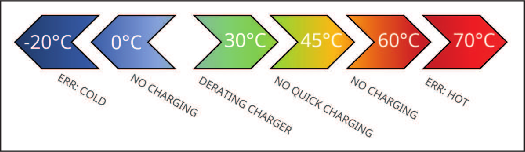
Temperature monitoring prevents the battery from being charged or discharged if the temperature of the battery is outside the permitted temperature range.
The battery charger has an internal temperature management function- From 30 °C: Protection against overheating of the charger by automatic reduction of the power (derating)
- From 45 °C: Only standard charging possible to increase battery life
- From 70 °C: Power source switched off
- Charging is not possible below 0 °C. Welding is conditionally possible depending on the current level.
- Two additional sensors directly on the power module
Undertemperature
If the battery falls below the permitted temperature range, neither welding nor charging is possible.
Overtemperature
Charging is only possible again at a battery temperature of less than +45 °C.
- the temperature indicator lights up and „hot“ is shown on the display
- neither welding nor charging is possible until the temperature indicator goes out (when the battery has cooled down)
Overcharging protection
Once the battery has been fully charged, the charger turns off automatically and switches to conservation charging mode.
More information on how the battery charger and the individual operating modes work can be found in the charger description on page (→) .
Before commissioning
Safety
WARNING!
Danger from incorrect operation and work that is not carried out properly.
This can result in serious personal injury and damage to property.
All the work and functions described in this document must only be carried out by technically trained and qualified personnel.
Read and understand this document in full.
Read and understand all safety rules and user documentation for this device and all system components.
Safety
WARNING!
Danger from incorrect operation and work that is not carried out properly.
This can result in serious personal injury and damage to property.
All the work and functions described in this document must only be carried out by technically trained and qualified personnel.
Read and understand this document in full.
Read and understand all safety rules and user documentation for this device and all system components.
Proper use
The power source is intended exclusively for MMA welding and TIG welding.
The integrated battery must only be charged with the Fronius ActiveCharger 1000.
Any other use is deemed improper.
The manufacturer is not liable for damage resulting from such use.
- carefully reading these operating instructions
- following all the instructions and safety rules in these operating instructions
- performing all stipulated inspection and maintenance work
Setup regulations
WARNING!
Danger from machines toppling over or falling.
This can result in serious personal injury and damage to property.
Set up the device securely on an even, solid surface.
Check all screw connections are tightly fastened after installation.
- Protection against penetration by solid foreign bodies with diameters > 12.5 mm (0.49 in.)
- Protected against spraywater at any angle up to 60° to the vertical
Cooling air
The device must be set up in such a way that cooling air can flow freely through the slots in the front and rear panels.
Dust
Ensure that metallic dust is not sucked into the system by the fan, when carrying out grinding for example.
Outdoor operation
The device can be set up and operated outdoors in accordance with IP23 degree of protection. Avoid direct wetting (e.g. from rain).
Power connection
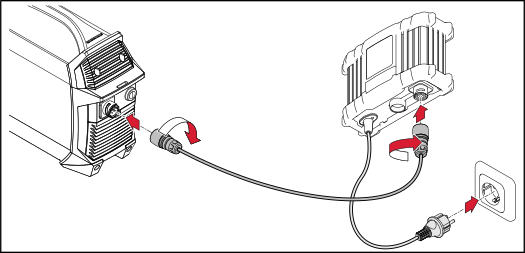
The device is designed to be connected to the mains using the Fronius ActiveCharger 1000 only (= hybrid mode, see Operating modes on page (→) ).
NOTE!
No warranty claims will be entertained if the device is operated with other chargers.
Before starting for the first time
-
 Once connected, the battery capacity indicator on the power source flashes to indicate the current state of charge; the battery is being charged
-
 The COMPLETED indicator lights up on the charger
 -
 On the power source, all segments of the battery capacity indicator are lit
 - The power source can be put into operation
Control elements and connections
Safety
WARNING!
Danger from incorrect operation and work that is not carried out properly.
This can result in serious personal injury and damage to property.
All the work and functions described in this document must only be carried out by technically trained and qualified personnel.
Read and understand this document in full.
Read and understand all safety rules and user documentation for this device and all system components.
As a result of software updates, you may find that there are functions available on your device that are not described in these Operating Instructions, or vice versa.
Certain illustrations may also differ slightly from the actual controls on your device, but these controls function in exactly the same way.
Safety
WARNING!
Danger from incorrect operation and work that is not carried out properly.
This can result in serious personal injury and damage to property.
All the work and functions described in this document must only be carried out by technically trained and qualified personnel.
Read and understand this document in full.
Read and understand all safety rules and user documentation for this device and all system components.
As a result of software updates, you may find that there are functions available on your device that are not described in these Operating Instructions, or vice versa.
Certain illustrations may also differ slightly from the actual controls on your device, but these controls function in exactly the same way.
Connections and mechanical components
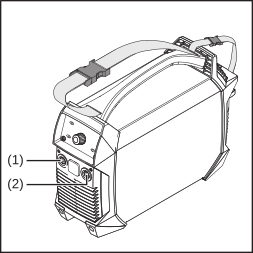
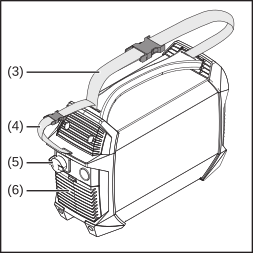
| (1) | (-) current socket with bayonet latch |
| (2) | (+) current socket with bayonet latch |
| (3) | Carrying strap |
| (4) | Cable strap for holding the mains cable and the welding power-leads Do not use to move the device! |
| (5) | Battery charger connection |
| (6) | Air filter |
- MMA welding (depending on electrode type)
(+) current socket for electrode holder or grounding cable
(-) current socket for electrode holder or grounding cable - TIG welding
(+) current socket for grounding (earthing) cable
(-) current socket for welding torch
Control panel
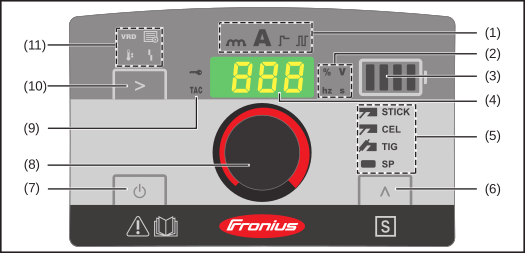
(1) | Setting value indicator shows which setting value is selected:
|
(2) | Unit indicator shows the unit of the value that is currently being changed using the adjusting dial (8):
|
(3) | Battery capacity indicator shows the state of charge of the battery:
|
(4) | Display |
(5) | Welding process indicator shows which welding process is selected:
|
(6) | Welding process button |
(7) | On/Off button |
(8) | Adjusting dial |
(9) | TAC indicator |
(10) | Setting value button |
(11) | Status indicators display various operating modes of the power source:
|


MMA welding
Preparatory work
1  Press the On/Off button for at least two seconds to turn off the power source
Press the On/Off button for at least two seconds to turn off the power source- the indicators go out
2Plug the grounding cable into the (+) or (-) current socket depending on which type of electrode is to be used and turn it clockwise to latch it in place
3Use the other end of the grounding cable to establish a connection to the workpiece
4Plug the electrode holder into the (+) or (-) current socket depending on which type of electrode is to be used and turn it clockwise to latch it in place
5Insert the rod electrode into the electrode holder
WARNING!
Danger from electrical current.
This can result in serious personal injury and damage to property.
As soon as the power source is switched on, the electrode in the electrode holder is live. Make sure the electrode does not touch any persons or electrically conductive or earthed parts (e.g. the housing, etc.).
6 Press the On/Off button for at least two seconds to turn on the power source
Press the On/Off button for at least two seconds to turn on the power source-
 the welding current indicator lights up
 - the display shows the specified welding current
Preparatory work
1 Press the On/Off button for at least two seconds to turn off the power source
Press the On/Off button for at least two seconds to turn off the power source- the indicators go out
2Plug the grounding cable into the (+) or (-) current socket depending on which type of electrode is to be used and turn it clockwise to latch it in place
3Use the other end of the grounding cable to establish a connection to the workpiece
4Plug the electrode holder into the (+) or (-) current socket depending on which type of electrode is to be used and turn it clockwise to latch it in place
5Insert the rod electrode into the electrode holder
WARNING!
Danger from electrical current.
This can result in serious personal injury and damage to property.
As soon as the power source is switched on, the electrode in the electrode holder is live. Make sure the electrode does not touch any persons or electrically conductive or earthed parts (e.g. the housing, etc.).
6 Press the On/Off button for at least two seconds to turn on the power source
Press the On/Off button for at least two seconds to turn on the power source- the welding current indicator lights up
- the display shows the specified welding current
MMA welding
1  Use the welding process button to select one of the following processes:
  MMA welding - the MMA welding indicator lights up after selection
  MMA welding with Cel electrode - the MMA welding with Cel electrode indicator lights up after selection
Use the welding process button to select one of the following processes: MMA welding - the MMA welding indicator lights up after selection MMA welding with Cel electrode - the MMA welding with Cel electrode indicator lights up after selection2  Press the setting value button until
the welding current indicator lights up
Press the setting value button until the welding current indicator lights up3  Select the amperage using the adjusting dial
Select the amperage using the adjusting dial- Power source is ready for welding
SoftStart / HotStart function
This function is used to set the starting current.
Setting range: 0 - 200%
Operating principle:
At the start of the welding process, the welding current is reduced (SoftStart) or increased (HotStart) for 0.5 seconds, depending on the setting.
The change is shown as a percentage from the set welding current.
The duration of the starting current can be changed in the Setup menu using the Hti parameter, see Parameters for MMA welding on page (→) .
Setting the starting current:
1 Press the setting value button until
 the SoftStart / HotStart indicator lights up
Press the setting value button until the SoftStart / HotStart indicator lights up2 Turn the adjusting dial until the desired value is reached
Turn the adjusting dial until the desired value is reached- Power source is ready for welding
NOTE!
The maximum HotStart current is limited to 180 A.
(set welding current = 100 A)
- 100%
 Starting current = 100 A Function deactivated
 - 80% Starting current = 80 A SoftStart
- 135% Starting current = 135 A HotStart
- 200% Starting current = 180 A HotStart (maximum current limit reached!)
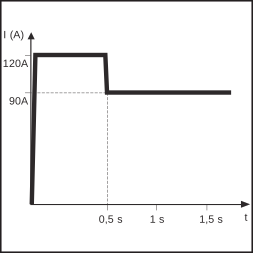
Example of HotStart function
Features of SoftStart function:- Reduced pore formation with certain electrode types
- Improved ignition properties, even when using electrodes with poor ignition properties
- Better fusion of the base material during the start-up phase, meaning fewer cold-shut defects
- Largely prevents slag inclusions
Arc-force dynamic
To obtain optimum welding results, it will sometimes be necessary to adjust the arc-force dynamic.
Setting range: 0 - 100 (corresponds to 0 - 200 A current increase)
Operating principle:
At the moment of droplet transfer or in the event of a short circuit, the amperage is briefly increased in order to obtain a stable arc.
If the rod electrode threatens to sink into the weld pool, this measure prevents the weld pool solidifying, as well as preventing a prolonged short-circuit of the arc. This largely prevents the rod electrode from sticking.
Setting the arc-force dynamic:
1 Press the setting value button until
 the arc-force dynamic indicator lights up
Press the setting value button until the arc-force dynamic indicator lights up2 Turn the adjusting dial until the desired correction value is reached
Turn the adjusting dial until the desired correction value is reached- Power source is ready for welding
NOTE!
The maximum arc-force dynamic current is limited to 180 A.
- Arc-force dynamic = 0
- arc-force dynamic deactivated
- soft, low-spatter arc
- Arc-force dynamic = 20
- arc-force dynamic with 40 A current increase
- harder, more stable arc
- Set welding current = 100 A / arc-force dynamic = 60
- arc-force dynamic theoretically with 120 A current increase
- actual increase is just 80 A as the maximum current limit has been reached!
TIG welding
General
NOTE!
Do not use pure tungsten electrodes (colour-coded green) if the TIG welding process has been selected.
General
NOTE!
Do not use pure tungsten electrodes (colour-coded green) if the TIG welding process has been selected.
Connecting the gas cylinder
WARNING!
Danger from falling gas cylinders.
This can result in serious injury and damage to property.
Place gas cylinders on a solid, level surface so that they remain stable. Secure gas cylinders to prevent them from falling over.
Observe the safety rules of the gas cylinder manufacturer.
1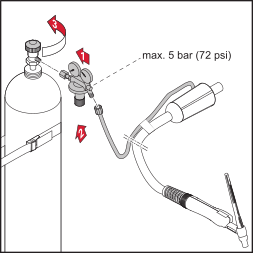
Preparatory work
1 Press the On/Off button for at least two seconds to turn off the power source
Press the On/Off button for at least two seconds to turn off the power source- the indicators go out
2Plug the TIG welding torch into the (-) current socket and turn it clockwise to latch it in place
3Set up the welding torch in accordance with the welding torch operating instructions
4Plug the grounding cable into the (+) current socket and turn it clockwise to latch it in place
5Use the other end of the grounding cable to establish a connection to the workpiece
CAUTION!
Risk of injury and damage from electric shock.
As soon as the power source is switched on, the electrode in the welding torch is live. Make sure the electrode does not touch any persons or electrically conductive or earthed parts (e.g. the housing, etc.).
6 Press the On/Off button for at least two seconds to turn on the power source
Press the On/Off button for at least two seconds to turn on the power source- the welding current indicator lights up
- the display shows the specified welding current
Setting the gas pressure
Welding torch with gas cut-off valve
1Open the gas cut-off valve of the welding torch
- Shielding gas flows
2Set the desired gas flow rate on the pressure regulator
3Close the gas cut-off valve of the welding torch
TIG welding
1 Select TIG welding with the welding process button  the TIG welding indicator lights up
Select TIG welding with the welding process button the TIG welding indicator lights up2 Press the setting value button until
the welding current indicator lights up
Press the setting value button until the welding current indicator lights up3 Adjust the welding current using the adjusting dial
Adjust the welding current using the adjusting dial4Place the gas nozzle down on the ignition location, ensuring there is a gap of approx. 2 to 3 mm (5/64 to 1/8 in.) between the tungsten electrode and the workpiece Gap exists
5Actuate gas cut-off valve
- Shielding gas flows
6Gradually tilt the welding torch up until the tungsten electrode touches the workpiece
7Raise the welding torch and rotate it into its normal position
- The arc ignites
8Carry out welding
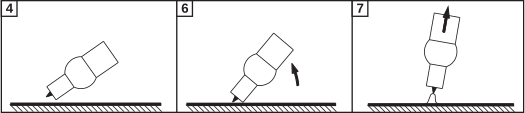
TIG Comfort Stop
For more information on activating and setting the TIG Comfort Stop function see Parameters for TIG welding on page (→).
Function and application of TIG Comfort Stop:
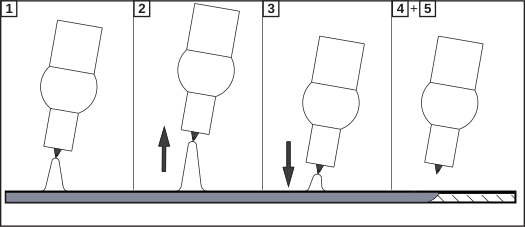
1Welding
2During welding, raise the welding torch
- The arc length is increased significantly
3Lower the welding torch
- The arc length is decreased significantly
- This triggers the TIG Comfort Stop function
4Keep the welding torch at the same height
- The welding current continually decreases (downslope) until the arc goes out
5Wait for the gas post-flow time to finish and lift the welding torch away from the workpiece
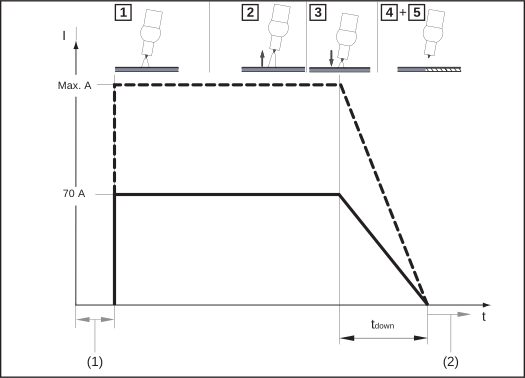
Welding current and gas flow curve with TIG Comfort Stop function activated
| (1) | Gas pre-flow |
| (2) | Gas post-flow |
Downslope:
The downslope time tdown is 0.5 seconds and cannot be adjusted.
Gas post-flow:
The gas post-flow must be carried out manually.
The Setup menu
Accessing the Setup menu
1 Use the welding process button to select the process for which the Setup parameters are to be changed: MMA welding MMA welding with Cel electrode TIG welding
Use the welding process button to select the process for which the Setup parameters are to be changed: MMA welding MMA welding with Cel electrode TIG welding
|
|  |
|
|  |
|
|  |
2 + Press the setting value and welding process buttons together
+ Press the setting value and welding process buttons together- After releasing the buttons, the code for the first parameter in the Setup menu is displayed
Accessing the Setup menu
1 Use the welding process button to select the process for which the Setup parameters are to be changed: MMA welding MMA welding with Cel electrode TIG welding
Use the welding process button to select the process for which the Setup parameters are to be changed: MMA welding MMA welding with Cel electrode TIG welding
|
| |
|
| |
|
| |
2 + Press the setting value and welding process buttons together
+ Press the setting value and welding process buttons together- After releasing the buttons, the code for the first parameter in the Setup menu is displayed
Changing welding parameters
1Turn the adjusting dial to select the required parameter |  |
2Press the adjusting dial to display the preset value of the parameter |  |
3Turn the adjusting dial to change the value - the new value becomes effective immediately - exception: when restoring the factory settings, press the adjusting dial after changing the value to activate the new value. | |
4Press the adjusting dial to return to the list of parameters | |
Exiting the Setup menu
1 Press the setting value or
welding process button to exit the Setup menu
Press the setting value or welding process button to exit the Setup menuParameters for MMA welding

Starting current duration
0,1 - 1,5 seconds
for the SoftStart / HotStart function
Factory setting: 0.5 seconds

Anti-Stick
On / OFF
When the anti-stick function is active, the arc is extinguished after 1.5 seconds in the event of a short circuit (sticking of the electrode)
Factory setting: ON (activated)

Break voltage (U cut off)
25 - 80 Volts
Used to specify at which arc length the welding process is to be completed.
The welding voltage increases as the length of the arc increases. The arc is extinguished when it reaches the voltage specified here.
Factory setting: 45 volts

Software version
The full version number of the currently installed software is spread across a number of displays and can be retrieved by turning the adjusting dial.

Automatic switch-off (time Shut down)
300 - 900 Seconds / OFF
If the power source is not operated for the specified length of time, it switches off automatically.
Factory setting: 900 seconds

Factory setting (FACtory)
The power source can be reset to its factory settings here.
no / YES / ALL
- Cancel reset
- Reset the parameters for the selected welding process to their factory settings
- Reset the parameters for all welding processes to their factory settings

Resetting of the selected value to its factory setting must be confirmed by pressing the adjusting dial.
Parameters for TIG welding

Comfort Stop Sensitivity
0.3 - 2.0 V/OFF
Factory setting: 0.5
For details see section TIG Comfort Stop from page (→).
Break voltage (U cut off)
12 - 35 V
Used to specify at which arc length the welding process is completed. The welding voltage increases as the length of the arc increases. The arc is extinguished when it reaches the voltage specified here.
This parameter is only available when the CSS parameter is set to OFF.
Factory setting: 15 volts
Software version
The full version number of the currently installed software is spread across a number of displays and can be retrieved by turning the adjusting dial.
Automatic shutdown (time Shut down)
300 - 9000 seconds/OFF
If the power source is not operated for the specified length of time, it switches off automatically.
Factory setting: 900 seconds
Factory setting (FACtory)
no/YES/ALL
The power source can be reset to its factory settings here.
- Cancel reset
- Reset the parameters for the selected welding process to their factory settings
- Reset the parameters for all welding processes to their factory settings
Resetting of the selected value to its factory setting must be confirmed by pressing the adjusting dial.
VRD safety device (optional)
General
VRD is an additional safety device that prevents, as far as possible, output voltages that may pose a danger to persons.
VRD = Voltage Reduction Device.
General
VRD is an additional safety device that prevents, as far as possible, output voltages that may pose a danger to persons.
VRD = Voltage Reduction Device.
Function
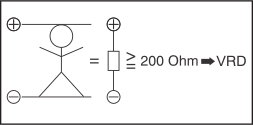
VRD is active
The welding circuit resistance is greater than the minimum human body resistance (greater than or equal to 200 Ohm):- VRD is active
- Open circuit voltage is limited to 14 V
-
 The VRD indicator lights up
 - Example: no risk ensues if both welding sockets are touched accidentally at the same time.
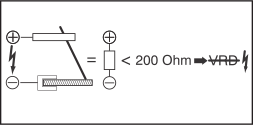
VRD is not active
The welding circuit resistance is less than the minimum human body resistance (less than 200 Ohm):- VRD is inactive
- Output voltage not limited in order to ensure sufficient welding power
- The VRD indicator does not light up
- Example: Start of welding
NOTE!
Within 0.
3 seconds of the end of welding:
VRD is active again
The output voltage is limited to 14 V again
Care and maintenance
Safety
WARNING!
Danger from incorrect operation and work that is not carried out properly.
This can result in serious personal injury and damage to property.
All the work and functions described in this document must only be carried out by technically trained and qualified personnel.
Read and understand this document in full.
Read and understand all safety rules and user documentation for this device and all system components.
WARNING!
Danger from electrical current.
This can result in serious personal injury and damage to property.
Before starting work, switch off all devices and components involved and disconnect them from the grid.
Secure all devices and components involved so they cannot be switched back on.
After opening the device, use a suitable measuring instrument to check that electrically charged components (such as capacitors) have been discharged.
WARNING!
Danger from incorrect operation and work that is not carried out properly.
This can result in serious personal injury and damage to property.
Do not open the power source. The power source may only be opened by a Fronius service engineer.
If you need a replacement battery, hand the power source over to a Fronius Service Partner.
Safety
WARNING!
Danger from incorrect operation and work that is not carried out properly.
This can result in serious personal injury and damage to property.
All the work and functions described in this document must only be carried out by technically trained and qualified personnel.
Read and understand this document in full.
Read and understand all safety rules and user documentation for this device and all system components.
WARNING!
Danger from electrical current.
This can result in serious personal injury and damage to property.
Before starting work, switch off all devices and components involved and disconnect them from the grid.
Secure all devices and components involved so they cannot be switched back on.
After opening the device, use a suitable measuring instrument to check that electrically charged components (such as capacitors) have been discharged.
WARNING!
Danger from incorrect operation and work that is not carried out properly.
This can result in serious personal injury and damage to property.
Do not open the power source. The power source may only be opened by a Fronius service engineer.
If you need a replacement battery, hand the power source over to a Fronius Service Partner.
General
Under normal operating conditions, the device requires only a minimum of care and maintenance. However, it is vital to observe some important points to ensure the device remains in a usable condition for many years.
At every start-up
- Check the charging lead, welding torch/electrode holder, welding power-lead and grounding (earthing) connection for damage. Replace any damaged components
- Check that there is an all-round clearance of 0.5 m (1 ft. 8 in.) around the power source to ensure that cooling air can flow in and out freely
NOTE!
Air inlets and outlets must never be covered, not even partially.
Every 2 months
Clean the air filter (if fitted):
1
Disposal
General
Dispose of in accordance with the applicable national and local regulations.
Always dispose of the device separately from the installed battery.
The following section explains how to remove the battery.
General
Dispose of in accordance with the applicable national and local regulations.
Always dispose of the device separately from the installed battery.
The following section explains how to remove the battery.
Safety
WARNING!
Danger due to incorrect operation and incorrectly performed work.
This can result in serious injury and damage to property.
All the work and functions described in this document must only be carried out by trained and qualified personnel.
Read and understand this document.
Read and understand all the Operating Instructions for the system components, especially the safety rules.
WARNING!
Danger from electric current.
An electric shock can be fatal.
Switch off the power source.
Disconnect the power source from the battery charger.
Ensure that the power source remains disconnected from the battery charger until all work has been completed.
After opening the device, use a suitable measuring instrument to check that electrically charged components (such as capacitors) have been discharged.
Removing the rechargeable battery pack
NOTE!
The following steps on removing the rechargeable battery pack must only be used when disposing of the device!
If the rechargeable battery pack needs to be repaired or replaced, contact After-Sales Service.
NOTE!
Before removing the rechargeable battery pack, the power source must be disconnected from the battery charger!
Ensure that the power source is completely discharged.
1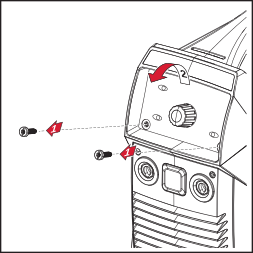
Remove the control panel
2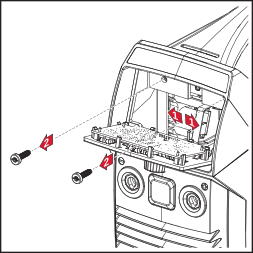
Disconnect the (+) power cable from the rechargeable battery pack, remove 2 TX25 screws
3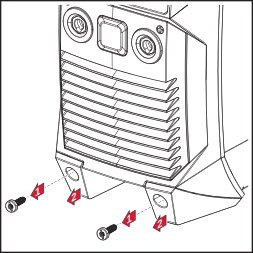
Remove 2 TX25 screws, remove device feet at the front
4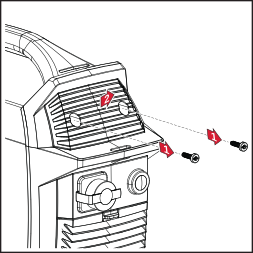
Remove 2 TX25 screws, remove the cover
5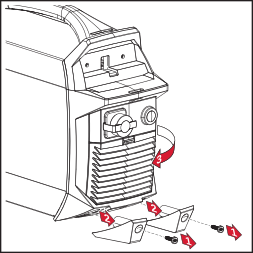
Remove 2 TX25 screws, remove device feet, fold rear to one side
6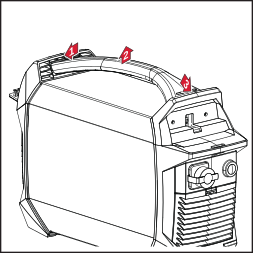
Press front and rear outwards, remove carrying handle
7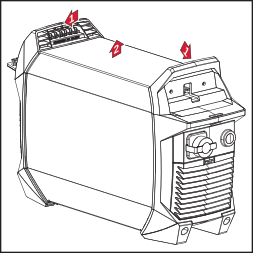
Press front and rear outwards, remove device casing
CAUTION!
Fire hazard due to short circuit of the battery!
If the battery is short-circuited, sparks may be generated and the battery may catch fire.
After terminating the (-) power cable, insulate it well (e.g. wrap it with insulating tape)!
8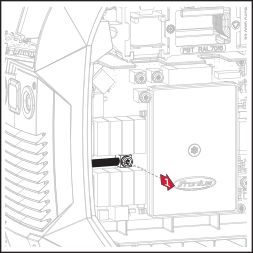
Remove TX25 screw and terminate (-) power cable of the rechargeable battery back;
IMPORTANT! Insulate the terminated cable lug well!
IMPORTANT! Insulate the terminated cable lug well!
9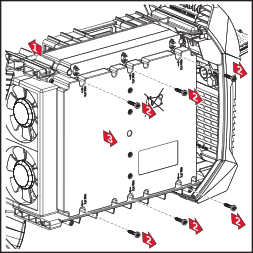
Disconnect 16-pin connector X1 from the battery pack, remove 6 TX 20 screws, remove the rechargeable battery pack
10Dispose of the device and rechargeable battery pack separately according to the local guidelines
Troubleshooting
Safety
WARNING!
Danger from incorrect operation and work that is not carried out properly.
This can result in serious personal injury and damage to property.
All the work and functions described in this document must only be carried out by technically trained and qualified personnel.
Read and understand this document in full.
Read and understand all safety rules and user documentation for this device and all system components.
WARNING!
Danger from electrical current.
This can result in serious personal injury and damage to property.
Before starting work, switch off all devices and components involved and disconnect them from the grid.
Secure all devices and components involved so they cannot be switched back on.
After opening the device, use a suitable measuring instrument to check that electrically charged components (such as capacitors) have been discharged.
WARNING!
Danger from incorrect operation and work that is not carried out properly.
This can result in serious personal injury and damage to property.
Do not open the power source. The power source may only be opened by a Fronius service engineer.
If you need a replacement battery, hand the power source over to a Fronius Service Partner.
Safety
WARNING!
Danger from incorrect operation and work that is not carried out properly.
This can result in serious personal injury and damage to property.
All the work and functions described in this document must only be carried out by technically trained and qualified personnel.
Read and understand this document in full.
Read and understand all safety rules and user documentation for this device and all system components.
WARNING!
Danger from electrical current.
This can result in serious personal injury and damage to property.
Before starting work, switch off all devices and components involved and disconnect them from the grid.
Secure all devices and components involved so they cannot be switched back on.
After opening the device, use a suitable measuring instrument to check that electrically charged components (such as capacitors) have been discharged.
WARNING!
Danger from incorrect operation and work that is not carried out properly.
This can result in serious personal injury and damage to property.
Do not open the power source. The power source may only be opened by a Fronius service engineer.
If you need a replacement battery, hand the power source over to a Fronius Service Partner.
Indicated errors
Overtemperature
"hot" appears on the display, the temperature indicator lights up
 +
+ 
+ | Cause: | Device is too hot |
| Remedy: | Check/reduce ambient temperature, allow power source to cool down |
Undertemperature
"cold" appears as scrolling text on the display, the temperature indicator lights up
 +
+
+ | Cause: | Device temperature too low |
| Remedy: | Check/increase ambient temperature, operate the power source in a warmer environment For more information see the Environmental conditions section on page (→) |
Deep discharge protector
"Lo" appears in the display, the "Battery capacity" indicator flashes
+
+ | Cause: | Battery discharged, deep discharge protection has been activated |
| Remedy: | Charge the battery now Battery operation is possible again above 25% capacity |
CAUTION!Danger due to prolonged storage of the battery in a discharged state. This can damage the battery. If the deep discharge protector is triggered, charge the power source promptly! | |
Service messages
When E and a 2 digit error number appear in the display (e.g. E02) and the "Error" indicator lights up, this is an internal power source service code.
Example:

It is also possible that several error numbers are present. These appear when turning the adjusting dial.
Make a note of the error numbers shown in the display, and of the serial number and configuration of the power source, and contact our after-sales service team with a detailed description of the error.
E02 / E03 / E05 / E06
| Cause: | Internal temperature sensor fault on ACCUPLT / ACCUPLT-TIG PC board |
| Remedy: | Contact after-sales service |
E07 / E72
| Cause: | Internal supply voltage 15 V outside the valid range |
| Remedy: | Contact After-Sales Service |
E09 / E10
| Cause: | Load too high on power source current sockets |
| Remedy: | Use power source correctly (welding) |
E11
| Cause: | No communication with the control panel |
| Remedy: | Contact after-sales service |
E12 / E13 /E14
| Cause: | Internal error on ACCUPLT / ACCUPLT-TIG PC board |
| Remedy: | Contact after-sales service |
E16
| Cause: | Communication error between battery and ACCUPLT / ACCUPLT-TIG PC board |
| Remedy: | Contact after-sales service |
E18
| Cause: | Wrong firmware (software) has been loaded |
| Remedy: | Contact after-sales service |
E19 / E22 / E30 / E53 / E83
| Cause: | Battery fault |
| Remedy: | Contact After-Sales Service |
E23
| Cause: | A voltage of > 113 V DC has been measured on the current sockets |
| Remedy: | Contact After-Sales Service |
No function
The power source cannot be switched on
| Cause: | The battery has entered a state of deep discharge as it has been stored for too long without being charged |
| Remedy: | Charge the battery now Battery operation is possible again above 25% capacity. If charging is no longer possible, contact After-Sales Service. |
| Cause: | Control panel defective |
| Remedy: | Contact After-Sales Service |
Battery is not charged
Power source is connected to the charger, charger is connected to the mains, no charging indicator on the power source
| Cause: | Device is too hot |
| Remedy: | Check/reduce ambient temperature, allow battery to cool down |
| Cause: | Device temperature too low |
| Remedy: | Check/increase ambient temperature, disconnect and reconnect battery charger |
| Cause: | Charging cable defective |
| Remedy: | Renew charging cable |
No welding current
Power source is switched on, indicator for the selected welding process is lit
| Cause: | Welding power-lead connections have been disconnected |
| Remedy: | Establish proper welding power-lead connections |
| Cause: | Poor or no earth |
| Remedy: | Establish a connection to the workpiece |
| Cause: | There is a break in the power cable in the welding torch or electrode holder |
| Remedy: | Replace welding torch or electrode holder |
No welding current
Power source is switched on, indicator for the selected welding process is lit, overtemperature indicator lit
| Cause: | Duty cycle exceeded - power source overloaded - fan running |
| Remedy: | Keep within duty cycle |
| Cause: | Thermostatic automatic circuit breaker has been tripped |
| Remedy: | Wait until the power source comes back on automatically at the end of the cooling phase |
| Cause: | The fan in the power source is faulty |
| Remedy: | Contact After-Sales Service |
| Cause: | Insufficient cooling air intake |
| Remedy: | Ensure adequate air supply |
| Cause: | Air filter is dirty |
| Remedy: | Clean air filter |
No welding current
Power source is switched on, indicator for the selected welding process is lit, overtemperature indicator lit
| Cause: | Power module error |
| Remedy: | Turn off the power source, then turn it on again. If the error occurs frequently, contact After-Sales Service |
Faulty operation
Poor ignition properties during MMA welding
| Cause: | Incorrect welding process selected |
| Remedy: | Select "MMA welding" or "MMA welding with Cel electrode" process |
| Cause: | Starting current too low; electrode sticking during ignition |
| Remedy: | Increase starting current using HotStart function |
| Cause: | Starting current too high; electrode consumed too quickly during ignition or is generating a lot of spatter |
| Remedy: | Reduce starting current using SoftStart function |
In some cases, arc breaks during welding
| Cause: | Electrode (e.g. grooved electrode) voltage too high |
| Remedy: | If possible, use alternative electrode or a power source with more welding power |
| Cause: | Break voltage (Uco) set too low |
| Remedy: | Increase break voltage (Uco) in Setup menu |
Rod electrode tends to stick
| Cause: | Value of arc-force dynamic parameter (MMA welding) set too low |
| Remedy: | Increase value of arc-force dynamic parameter |
Poor weld properties
(severe spattering)
| Cause: | Incorrect electrode polarity |
| Remedy: | Reverse electrode polarity (refer to manufacturer's instructions) |
| Cause: | Poor grounding (earthing) connection |
| Remedy: | Fasten earthing clamps directly to workpiece |
| Cause: | Setup parameters not ideal for selected welding process |
| Remedy: | Select the optimal settings in the Setup menu for the selected welding process |
Tungsten electrode melting
Tungsten inclusions in base metal during the ignition phase
| Cause: | Incorrect tungsten electrode polarity |
| Remedy: | Connect the TIG welding torch to the (-) current socket |
| Cause: | Incorrect (or no) shielding gas |
| Remedy: | Use inert shielding gas (argon) |
VRD does not light up even though no welding process is taking place
| Cause: | VRD option not present or internal device fault |
| Remedy: | Contact after-sales service |
Technical data
Environmental conditions
Transport, storage or operation of the device outside the stipulated range will be deemed improper. The manufacturer shall not be held liable for any damage arising from such usage.
Ambient air temperature range:- During operation: -10 °C to + 40 °C (14 °F to 104 °F)
- During transport: -20 °C to +55 °C (-4 °F to 131 °F)
- Recommended temperature range during charging:
+ 4 °C to + 40 °C (+ 39.2 °F to + 104 °F) - Recommended temperature range during storage:
0 °C to + 20 °C (+ 32 °F to + 68 °F)
When placing in storage, the state of charge should ideally be at 50 - 80% (corresponds to approx. 2 to 3 bars on the charging status indication).
- Up to 50% at 40 °C (104 °F)
- Up to 90 % at 20 °C (68 °F)
The surrounding air must be free from dust, acids, corrosive gases or substances, etc.
Can be used at altitudes up to 2000 m (6561 ft.)
Environmental conditions
Transport, storage or operation of the device outside the stipulated range will be deemed improper. The manufacturer shall not be held liable for any damage arising from such usage.
Ambient air temperature range:- During operation: -10 °C to + 40 °C (14 °F to 104 °F)
- During transport: -20 °C to +55 °C (-4 °F to 131 °F)
- Recommended temperature range during charging:
+ 4 °C to + 40 °C (+ 39.2 °F to + 104 °F) - Recommended temperature range during storage:
0 °C to + 20 °C (+ 32 °F to + 68 °F)
When placing in storage, the state of charge should ideally be at 50 - 80% (corresponds to approx. 2 to 3 bars on the charging status indication).
- Up to 50% at 40 °C (104 °F)
- Up to 90 % at 20 °C (68 °F)
The surrounding air must be free from dust, acids, corrosive gases or substances, etc.
Can be used at altitudes up to 2000 m (6561 ft.)
Explanation of the term "duty cycle"
Duty cycle (ED) is the proportion of time in a 10-minute cycle at which the device may be operated at its rated output without overheating.
NOTE!
The ED values specified on the rating plate are based on an ambient temperature of 40 °C.
If the ambient temperature is higher, either the ED or output must be reduced accordingly.
Example: Welding at 150 A at 60% ED
- Welding phase = 60% of 10 minutes = 6 minutes
- Cooling phase = remaining time = 4 minutes
- After the cooling phase, the cycle begins again.
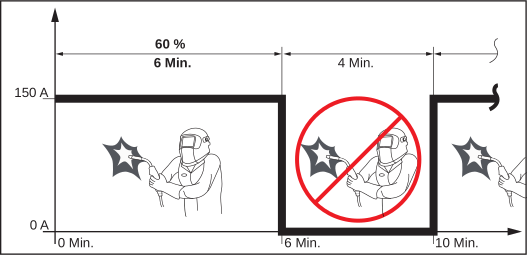
If the device is to be continuously operated without stopping:
1Look in the technical data for a ED value of 100% for the current ambient temperature.
2Reduce the output or amperage in line with this value so that the device can remain in use without observing a cooling phase.
Technical data
Rated battery voltage | 52.8 V | ||
Charging current | 10 A | ||
Rapid charging current |
| 18 A | |
Battery capacity | 7.5 Ah | ||
Battery type | Li-ion | ||
Standard charging | 50 min. | ||
Rapid charging | 30 min. | ||
Welding time | 2.5 mm2 | Electrode | 14 - 18 pc. |
| 3.25 mm2 | Electrode | 6 - 8 pc. |
Welding current range | Electrode DC | 10 - 140 A | |
|
| TIG DC | 3 - 150 A |
Welding current in hybrid mode (manual metal arc welding) | |||
| 40 °C (104 °F) | 18% D.C.1) | 140 A |
| 40 °C (104 °F) | 25% D.C.1) | 100 A |
| 40 °C (104 °F) | 100% D.C.1) | 40 A |
Welding current in hybrid mode (TIG welding) | |||
| 40 °C (104 °F) | 25% D.C.1) | 150 A |
40 °C (104 °F) | 50% D.C.1) | 100 A | |
| 40 °C (104 °F) | 100% D.C.1) | 65 A |
Open circuit voltage | 91 V | ||
Reduced open circuit voltage | 14 V | ||
Degree of protection | IP 23 | ||
Type of cooling | AF | ||
Mark of conformity | CE, S | ||
Dimensions l x w x h | 435 x 160 x 310 mm | ||
Weight | 10.9 kg (24.3 lb) | ||
1) D.C. = Duty cycle
Charger
General
Warning notices on the device
A number of safety symbols can be seen on the charger's rating plate. The safety symbols must not be removed or painted over.
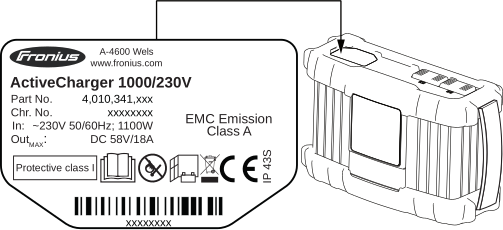

Do not use the functions described here until you have fully read and understood the following documents:
- these operating instructions
- all the operating instructions for the system components of the power source, especially the safety rules

Possible sources of ignition, such as fire, sparks and naked flames, must be kept away from the battery.

Ensure an adequate supply of fresh air during charging. Maintain a distance of at least 0.5 m (19.69 in.) between battery and charger during the charging procedure.

Do not dispose of used devices with domestic waste. Dispose of them according to the safety rules.
General
Warning notices on the device
A number of safety symbols can be seen on the charger's rating plate. The safety symbols must not be removed or painted over.
Do not use the functions described here until you have fully read and understood the following documents:
- these operating instructions
- all the operating instructions for the system components of the power source, especially the safety rules
Possible sources of ignition, such as fire, sparks and naked flames, must be kept away from the battery.
Ensure an adequate supply of fresh air during charging. Maintain a distance of at least 0.5 m (19.69 in.) between battery and charger during the charging procedure.
Do not dispose of used devices with domestic waste. Dispose of them according to the safety rules.
Warning notices on the device
A number of safety symbols can be seen on the charger's rating plate. The safety symbols must not be removed or painted over.
Do not use the functions described here until you have fully read and understood the following documents:
- these operating instructions
- all the operating instructions for the system components of the power source, especially the safety rules
Possible sources of ignition, such as fire, sparks and naked flames, must be kept away from the battery.
Ensure an adequate supply of fresh air during charging. Maintain a distance of at least 0.5 m (19.69 in.) between battery and charger during the charging procedure.
Do not dispose of used devices with domestic waste. Dispose of them according to the safety rules.
Warning notices inside the device

An electric shock can be fatal. Do not open the device!
The housing must never be opened by anyone other than a Fronius-trained service engineer. The device must be disconnected from the mains before starting any work with the housing open. A suitable measuring instrument must be used to ensure that electrically charged components (e.g. capacitors) are fully discharged. Ensure that the device remains disconnected from the mains until all work has been completed.
This warning sign is located inside the device. It must NOT be removed or painted over.
The discharge time of the capacitors is approx. one minute.
Intended use
The charger is designed to charge the power sources listed below. Any use above and beyond this purpose is deemed improper. The manufacturer shall not be liable for any damage resulting from such use. Proper use also includes:
- Carefully reading these Operating Instructions
- Following all the instructions and safety rules in these Operating Instructions
WARNING!
Charging any other devices can cause serious injury or damage, and is therefore prohibited.
The following power sources may be charged:
- Fronius AccuPocket 150/400
- Fronius AccuPocket 150/400 TIG
- Fronius Ignis 150 B /750
The charger is intended solely for commercial use.
Before commissioning
Mains connection
The rating plate, which is located on the housing, contains information about the permitted mains voltage. The device is designed for this mains voltage only. For details on the required fuse protection for the mains lead, see theTechnical data section on page (→) . If there is no mains cable or mains plug on your version of the appliance, fit one that conforms to national standards.
CAUTION!
Danger due to insufficiently dimensioned electrical installations.
This can result in serious damage to property.
The mains lead and its fuse must be dimensioned to suit the local power supply.
Read the technical data on the rating plate.
Mains connection
The rating plate, which is located on the housing, contains information about the permitted mains voltage. The device is designed for this mains voltage only. For details on the required fuse protection for the mains lead, see theTechnical data section on page (→) . If there is no mains cable or mains plug on your version of the appliance, fit one that conforms to national standards.
CAUTION!
Danger due to insufficiently dimensioned electrical installations.
This can result in serious damage to property.
The mains lead and its fuse must be dimensioned to suit the local power supply.
Read the technical data on the rating plate.
Generator-powered operation
The charger is completely generator-compatible, provided the maximum apparent power delivered by the generator is at least 2 kVA.
This also applies if the generator in question is an inverter.
NOTE!
The voltage delivered by the generator must never exceed the upper or lower limits of the mains voltage tolerance range.
Details on the mains voltage tolerance can be found in the Technical data section on page (→) .
Setup regulations
WARNING!
Danger from machines toppling over or falling.
This can result in serious personal injury and damage to property.
Set up the device securely on an even, solid surface.
Check all screw connections are tightly fastened after installation.
- Protection against penetration by solid foreign bodies with diameters > 1.0 mm (0.04 in.)
- Protection against spraywater at any angle up to 60° to the vertical when fan is not running.
Dust
Ensure that metallic dust is not sucked into the system by the fan, when carrying out grinding for example.
Outdoor operation
The device can be set up and operated outdoors in accordance with IP40 degree of protection. Avoid direct wetting (e.g. from rain).
Space requirements
If the charger is installed in a switch cabinet (or a similar sealed area), then forced-air ventilation must be provided to ensure adequate heat dissipation.
There should be an all-round clearance of 10 cm (3.9 in.) around the charger.
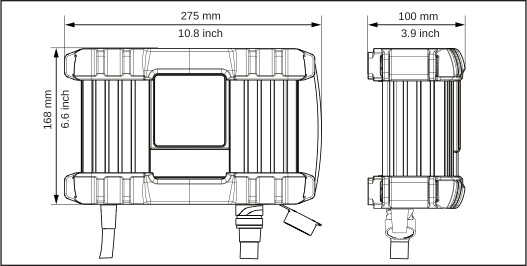
Control elements and connections
Safety
WARNING!
Danger from incorrect operation and work that is not carried out properly.
This can result in serious personal injury and damage to property.
All the work and functions described in this document must only be carried out by technically trained and qualified personnel.
Read and understand this document in full.
Read and understand all safety rules and user documentation for this device and all system components.
As a result of software updates, you may find that there are functions available on your device that are not described in these Operating Instructions, or vice versa.
Certain illustrations may also differ slightly from the actual controls on your device, but these controls function in exactly the same way.
Safety
WARNING!
Danger from incorrect operation and work that is not carried out properly.
This can result in serious personal injury and damage to property.
All the work and functions described in this document must only be carried out by technically trained and qualified personnel.
Read and understand this document in full.
Read and understand all safety rules and user documentation for this device and all system components.
As a result of software updates, you may find that there are functions available on your device that are not described in these Operating Instructions, or vice versa.
Certain illustrations may also differ slightly from the actual controls on your device, but these controls function in exactly the same way.
Connections and components
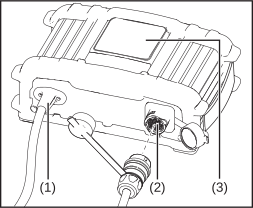
| (1) | Mains cable for connection to the mains |
| (2) | Connection P1 - charging lead socket to plug in the charging cable for connection to the power source |
| (3) | Control panel |
Control panel
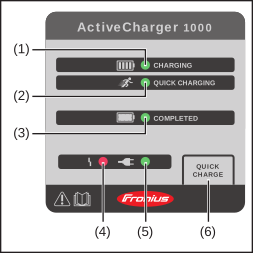
| (1) | CHARGING indicator (green) Charging in progress |
| (2) | QUICK CHARGING indicator (green) Quick charging in progress |
| (3) | COMPLETED indicator (green) Power source fully charged |
| (4) | Error indicator (red) See section Troubleshooting on page (→) |
| (5) | Mains indicator (green) Mains supply voltage available |
| (6) | QUICK CHARGE button Starts and stops quick charging |
Start-up
Safety
WARNING!
Danger from incorrect operation and work that is not carried out properly.
This can result in serious personal injury and damage to property.
All the work and functions described in this document must only be carried out by technically trained and qualified personnel.
Read and understand this document in full.
Read and understand all safety rules and user documentation for this device and all system components.
Safety
WARNING!
Danger from incorrect operation and work that is not carried out properly.
This can result in serious personal injury and damage to property.
All the work and functions described in this document must only be carried out by technically trained and qualified personnel.
Read and understand this document in full.
Read and understand all safety rules and user documentation for this device and all system components.
Commissioning
- Once connected, the battery capacity indicator on the power source flashes to indicate the current state of charge; the battery is being charged
2Select Quick Charge mode if required - details on the available operating modes can be found in the following section
- The COMPLETED indicator lights up on the charger
- On the power source, all segments of the battery capacity indicator are lit
NOTE!
The system includes the following features for maximum user-friendliness:
It does not matter in what order the devices are connected to the mains
The power source can even be connected to the charger while it is in use
Operating modes
Charging
Starts automatically when the battery charger is connected to the power source and the mains
-
 The CHARGING indicator is lit
 -
 Mains indicator lit
 - The power source is charged at optimum charging power
- The charging characteristic of this mode maximises the service life of the power source
- When the COMPLETED indicator lights up, the power source is fully charged and the battery charger switches to conservation charging mode
Quick charging
Activation:
1Press the QUICK CHARGING button
-
 The QUICK CHARGING indicator is lit
 - Mains indicator lit
- The power source is charged at the maximum possible charging power
- When the COMPLETED indicator lights up, the power source is fully charged and the battery charger switches to conservation charging mode
Deactivation:
1Press the QUICK CHARGING button again
- Charging mode resumes
Conservation charging
Starts automatically once the battery charger has fully charged the power source
- Mains indicator lit
- The COMPLETED indicator is lit
- The power source is charged at conservation charging power
- In this mode, the power source can remain connected to the charger without being damaged.
Hybrid mode
= the battery charger is charging the power source while the power source is in operation
Acivation:
1Start welding during charging
1or connect the power source to the charger while it is in operation
- The QUICK CHARGING indicator is lit (charging at the maximum possible charging power in hybrid mode)
- Mains indicator lit
- The power source is discharged according to its operating load and simultaneously re-charged by the charger
Options
Fitting the wall bracket
NOTE!
Depending on the underlying surface, different wall plugs and screws are needed to fit the wall bracket.
Wall plugs and screws are therefore not included in the scope of supply. The installer is responsible for selecting the correct wall plugs and screws.
1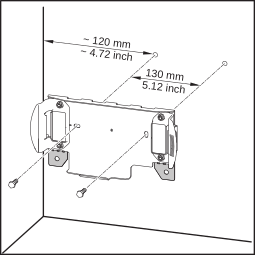
2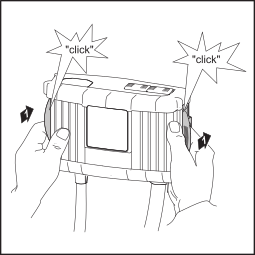
Fitting the wall bracket
NOTE!
Depending on the underlying surface, different wall plugs and screws are needed to fit the wall bracket.
Wall plugs and screws are therefore not included in the scope of supply. The installer is responsible for selecting the correct wall plugs and screws.
1
2
Troubleshooting
Safety
WARNING!
Danger from electric current.
An electric shock can be fatal.
Do not open the device.
Safety
WARNING!
Danger from electric current.
An electric shock can be fatal.
Do not open the device.
Indicated errors
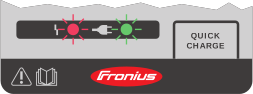
-
 Error indicator
 - Mains indicator
Error flashing, mains lit
| Cause: | Battery fault |
| Remedy: | Contact After-Sales Service |
Error flashing, mains flashing
| Cause: | Mains fault (overvoltage or undervoltage) |
| Remedy: | Check mains supply voltage (see Technical data) |
Error lit, mains lit
| Cause: | Charger fault |
| Remedy: | Contact After-Sales Service |
No function
Mains fuse or automatic circuit breaker trips
| Cause: | Mains fuse underrated/incorrect circuit breaker |
| Remedy: | Fuse mains correctly (see Technical data) |
| Cause: | Mains fuse trips in open circuit |
| Remedy: | Contact After-Sales Service |
Technical data
Environmental conditions
Transport, storage or operation of the device outside the stipulated range will be deemed improper. The manufacturer shall not be held liable for any damage arising from such usage.
Ambient air temperature range:- During operation: -10 °C to + 40 °C (14 °F to 104 °F)
- During transport: -20 °C to +55 °C (-4 °F to 131 °F)
- Recommended temperature range during charging:
+ 4 °C to + 40 °C (+ 39.2 °F to + 104 °F) - Recommended temperature range during storage:
0 °C to + 20 °C (+ 32 °F to + 68 °F)
When placing in storage, the state of charge should ideally be at 50 - 80% (corresponds to approx. 2 to 3 bars on the charging status indication).
- Up to 50% at 40 °C (104 °F)
- Up to 90 % at 20 °C (68 °F)
The surrounding air must be free from dust, acids, corrosive gases or substances, etc.
Can be used at altitudes up to 2000 m (6561 ft.)
Environmental conditions
Transport, storage or operation of the device outside the stipulated range will be deemed improper. The manufacturer shall not be held liable for any damage arising from such usage.
Ambient air temperature range:- During operation: -10 °C to + 40 °C (14 °F to 104 °F)
- During transport: -20 °C to +55 °C (-4 °F to 131 °F)
- Recommended temperature range during charging:
+ 4 °C to + 40 °C (+ 39.2 °F to + 104 °F) - Recommended temperature range during storage:
0 °C to + 20 °C (+ 32 °F to + 68 °F)
When placing in storage, the state of charge should ideally be at 50 - 80% (corresponds to approx. 2 to 3 bars on the charging status indication).
- Up to 50% at 40 °C (104 °F)
- Up to 90 % at 20 °C (68 °F)
The surrounding air must be free from dust, acids, corrosive gases or substances, etc.
Can be used at altitudes up to 2000 m (6561 ft.)
Technical data 230V
Mains voltage | ~ 230 V AC, ±15% |
Grid frequency | 50/60 Hz |
Mains current | max. 9.5 A eff. |
Mains fuse protection | max. 16 A |
Efficiency | max. 95 % |
Effective power | max. 1100 W |
Apparent power | max. 2370 VA |
Power input (stand-by) | max. 2.1 W |
Safety class | I (with ground conductor) |
Maximum permitted mains impedance at the interface (PCC) to the public grid | None |
EMC emission class | A |
Mark of conformity | CE |
|
|
Output voltage range | 30 - 58 V DC |
Output current | max. 18 A DC |
Output power | max. 1040 W |
|
|
Cooling | Convection and fan |
Dimensions L x W x H | 270 x 168 x 100 mm |
Weight (without cable) | Approx. 2 kg |
|
|
Protection class | IP43S |
Overvoltage category | II |
Standards 230V
EN 62477-1 |
|
EN 60974-10 | (Class A) |
Technical data 120V
Mains voltage | ~ 120 V AC, ±15% |
Grid frequency | 50/60 Hz |
Mains current | max. 15 A eff. |
Mains fuse protection | max. 20 A |
Efficiency | max. 94 % |
Effective power | max. 1100 W |
Apparent power | max. 1900 VA |
Power input (stand-by) | max. 1.6 W |
Safety class | I (with ground conductor) |
Maximum permitted mains impedance at the interface (PCC) to the public grid | None |
EMC emission class | A |
|
|
Output voltage range | 30 - 58 V DC |
Output current | max. 18 A DC |
Output power | max. 1000 W |
|
|
Cooling | Convection and fan |
Dimensions L x W x H | 270 x 168 x 100 mm |
Weight | Approx. 2 kg |
|
|
Protection class | IP43S |
Overvoltage category | II |
Standards 120V
UL 1012 |
|
C22.2 No.107.1-01 |
|
FCC CFR 47 Part 15 | (Class A) |
Technical data 100V
Mains voltage | ~ 100 - 110 V AC, +10% / -15% |
Grid frequency | 50/60 Hz |
Mains current | max. 15.7 A eff. |
Mains fuse protection | max. 16 A |
Efficiency | max. 92 % |
Effective power | max. 940 W |
Apparent power | max. 1600 VA |
Power input (stand-by) | max. 1.6 W |
Safety class | I (with ground conductor) |
Maximum permitted mains impedance at the interface (PCC) to the public grid | None |
EMC emission class | A |
|
|
Output voltage range | 30 - 58 V DC |
Output current | max. 15 A DC |
Output power | max. 840 W |
|
|
Cooling | Convection and fan |
Dimensions L x W x H | 270 x 168 x 100 mm |
Weight | Approx. 2 kg |
|
|
Protection class | IP43S |
Overvoltage category | II |
Standards 100V
EN 62477-1 |
|
EN 60974-10 | (Class A) |