

- Operating InstructionsTPS/i Robotics Push/Pull, CMT
- Safety rules
- Explanation of warnings and safety instructions
- General
- Intended use
- Environmental conditions
- Obligations of the operator
- Obligations of personnel
- Mains connection
- Protecting yourself and others
- Danger from toxic gases and vapours
- Danger from flying sparks
- Risks from mains current and welding current
- Meandering welding currents
- EMC Device Classifications
- EMC measures
- EMF measures
- Specific hazards
- Requirement for the shielding gas
- Danger from shielding gas cylinders
- Danger from escaping shielding gas
- Safety measures at the installation location and during transport
- Safety measures in normal operation
- Commissioning, maintenance and repair
- Safety inspection
- Disposal
- Safety symbols
- Data security
- Copyright
- Description of the warning notices on the device
- System configurations
- System configurations - conventional robot
- PowerDrive with wire drum
- PowerDrive with wire drum and external wirefeeding hose
- PushPull with 4-roller unreeling wirefeeder and wire drum
- PushPull with 4-roller unreeling wirefeeder and wirespool
- PushPull with SB 60i, 4-roller unreeling wirefeeder and wirespool
- PushPull with 2-roller unreeling wirefeeder, wire drum and external wirefeeding hose
- CMT with SB 60i, 4-roller unreeling wirefeeder and wire drum
- CMT with SB 500i, 4-roller unreeling wirefeeder, wire drum and external wirefeeding hose
- CMT with SB 60i, 4-roller unreeling wirefeeder and wire spool
- System configurations - PAP
- PowerDrive with wire drum
- PushPull with 4-roller unreeling wirefeeder and wire drum
- PushPull with 4-roller unreeling wirefeeder and wirespool
- PushPull with 2-roller unreeling wirefeeder and wire drum
- PushPull with wire buffer, 4-roller unreeling wirefeeder and wire drum
- PushPull with wire buffer, 4-roller unreeling wirefeeder and wirespool
- CMT with SB 60i, 4-roller unreeling wirefeeder and wire drum
- CMT with SB 500i, 4-roller unreeling wirefeeder and wire drum
- CMT with SB 500i, 4-roller unreeling wirefeeder and wire spool
- System configurations - conventional robot
- System components
- Controls, connections and mechanical components
- Assembling system components - conventional robot
- Assembling system components - PAP robot
- Assembling further system components
- Fitting the SplitBox SB 60i R
- Fitting the TPSi wire buffer
- Fitting the unreeling wirefeeder
- Connecting the extension hosepack
- Fitting the torch body to the WF Robacta Drive
- Fitting the OPT/i camera mount
- Fitting the inner liner
- Draht-Führungsseele montieren (Abspul Drahtvorschub - SplitBox SB 500i R)
- Draht-Führungsseele montieren (Abspul Drahtvorschub - WF Robacta Drive mit externem Drahtförder-Schlauch)
- Fitting the PowerLiner (unreeling wirefeeder - WF Robacta Drive with external wirefeeding hose)
- Fitting the inner liner (unreeling wirefeeder - wire buffer)
- Draht-Führungsseele montieren (SplitBox SB 500i - WF Robacta Drive mit interner Draht-Führungsseele)
- Draht-Führungsseele montieren (Drahtpuffer - SplitBox SB 500i für WF Robacta Drive mit internem Drahtförder-Schlauch)
- Draht-Führungsseele montieren (Drahtpuffer - WF Robacta Drive mit externem Drahtförder-Schlauch)
- Draht-Führungsseele im Schweißbrenner-Schlauchpaket montieren
- Start-up
- Fault diagnosis, troubleshooting, maintenance
- Troubleshooting
- Care and maintenance
- General
- Sicherheit
- Every start-up
- Special care of O-rings
- Whenever the welding torch or torch hosepack is changed
- Schweißbrenner-Schlauchpaket wechseln, Verbindungs-Schlauchpaket wechseln
- Every 6 months
- "Stop" coolant pump service position - Working mode 17
- Recognising faulty wearing parts
- Replacing the WF 25i Robacta Drive clamping lever
- Replacing the WF 60i Robacta Drive CMT clamping lever
- Replacing the WF Robacta Drive gas-saver nozzle
- Replacing the SB 60i R inner liner
- Drahtpuffer TPSi Draht-Führungseinsatz wechseln
- Arbeitsrichtung Drahtpuffer TPSi wechseln
- Replacing the TPSi wire buffer lever
- Fitting wearing parts to the torch body
- MTG d, MTW d, MTB - Fitting wearing parts to the torch body
- Fitting wearing parts to the torch body - MTW 700 i
- CrashBox PAP am Roboter demontieren
- Technical data
031-29092026
Safety rules
Explanation of warnings and safety instructions
Warnings are intended to warn people of possible injury and to prevent personal injury and damage to the product. They relate to individual actions performed with and on the product.
DANGER!
Indicates an immediately dangerous situation.
Serious injury or death will result if the hazard is not avoided.
Action step to escape the situation.
WARNING!
Indicates a potentially dangerous situation.
Serious injury or death will potentially result if the hazard is not avoided.
Action step to escape the situation.
CAUTION!
Indicates a potentially dangerous situation.
Minor or moderate injury may result if the hazard is not avoided.
Action step to escape the situation.
NOTE!
Indicates a situation which may result in damage to property.
Failure to avoid the situation may result in impaired work results and material damage to the product or other property.
Action step to avoid the situation.
Safety instructions are intended to ensure safe use of the product. They are preventive and help to inform users about basic risks when using the product. They do not refer specifically to individual actions performed with and on the product.
General
- injury or death to the operator or a third party,
- damage to the device and other material assets belonging to the operating company,
- inefficient operation of the device.
- be suitably qualified,
- have sufficient knowledge of automated welding, and
- read and carefully follow these operating instructions as well as the operating instructions for all system components.
The operating instructions must always be at hand wherever the device is being used. In addition to the operating instructions, attention must also be paid to any generally applicable and local regulations regarding accident prevention and environmental protection.
All safety and danger notices on the device- must be in a legible state,
- must not be damaged,
- must not be removed,
- must not be covered, pasted or painted over.
For the location of the safety and danger notices on the device, refer to the section headed "General" in the operating instructions for the device.
Before commissioning the device, rectify any faults that could compromise safety.
This is for your personal safety!
Intended use
The devices and components described in these operating instructions are intended exclusively for automated MIG/MAG applications in conjunction with Fronius components.
Any use above and beyond this purpose is deemed improper.
- Carefully reading and following all the instructions given in the operating instructions
- Studying and obeying all safety instructions and danger notices carefully
- Performing all stipulated inspection and servicing work
The manufacturer likewise accepts no liability for inadequate or incorrect results.
Environmental conditions
Operation or storage of the device outside the stipulated area will be deemed as not in accordance with the intended purpose.
Ambient temperature range:- during operation: -10 °C to + 40 °C (14 °F to 104 °F)
- during transport and storage: -20 °C to +55 °C (-4 °F to 131 °F)
- up to 50% at 40 °C (104 °F)
- up to 90% at 20 °C (68 °F)
The surrounding air must be free from dust, acids, corrosive gases or substances, etc.
Can be used at altitudes of up to 2000 m (6561 ft. 8.16 in.)
Obligations of the operator
- are familiar with the fundamental instructions regarding safety at work and accident prevention and have been instructed in how to use the device
- have read and understood these operating instructions, especially the section "safety rules", and have confirmed as much with their signatures
- are trained to produce the required results.
Checks must be carried out at regular intervals to ensure that operators are working in a safety-conscious manner.
Obligations of personnel
- observe the basic instructions regarding safety at work and accident prevention; and
- read these operating instructions (especially the "Safety rules" section) and sign to confirm that they have understood them and will follow them.
Before leaving the workplace, ensure that people or property cannot come to any harm in your absence.
Mains connection
Devices with a higher rating may affect the energy quality of the mains due to their current consumption.
This may affect a number device types in terms of:- Connection restrictions
- Criteria with regard to the maximum permissible mains impedance *)
- Criteria with regard to the minimum short-circuit power requirement *)
*) at the interface with the public grid
see "Technical data"
In this case, the plant operator or the person using the device should check whether the device may be connected, where appropriate by discussing the matter with the power supply company.
IMPORTANT! Ensure that the mains connection is earthed properly
Protecting yourself and others
- flying sparks and hot pieces of metal
- Arc radiation, which can damage eyes and skin
- Hazardous electromagnetic fields, which can endanger the lives of those using cardiac pacemakers
- Risk of electrocution from mains current and welding current
- Greater noise pollution - the noise level may exceed 85 dB
- Harmful welding fumes and gases
- Flame-resistant
- Insulating and dry
- Covers the whole body, is undamaged and in good condition
- Safety helmet
- Trousers with no turn-ups
- Protect eyes and face from UV rays, heat and sparks using a protective visor and regulation filter
- Wear regulation protective goggles with side protection behind the protective visor
- Wear stout footwear that provides insulation even in wet conditions
- Protect the hands with suitable gloves (electrically insulated and providing protection against heat)
- Wear ear protection to reduce the harmful effects of noise and to prevent injury
- Make them aware of all the dangers (risk of dazzling by the arc, injury from flying sparks, harmful welding fumes, noise, possible risks from mains current and welding current, etc.)
- Provide suitable protective equipment
- Alternatively, erect suitable safety screens/curtains.
Danger from toxic gases and vapours
The fumes produced during welding contain harmful gases and vapours.
Welding fumes contain substances that cause cancer, as stated in Monograph 118 of the International Agency for Research on Cancer.
Use at-source extraction and a room extraction system.
If necessary, use a welding torch with an integrated extraction device.
Keep your face away from welding fumes and gases.
Fumes and hazardous gases- must not be breathed in
- must be extracted from the working area using appropriate methods.
Ensure an adequate supply of fresh air. Ensure that there is a ventilation rate of at least 20 m³ per hour at all times.
Otherwise, a welding helmet with an air supply must be worn.
If there is any doubt about whether the extraction capacity is sufficient, the measured toxic emission values should be compared with the permissible limit values.
The following components are responsible, amongst other things, for the degree of toxicity of welding fumes:- Metals used for the workpiece
- Electrodes
- Coatings
- Cleaners, degreasers, etc.
- Welding process used
The relevant material safety data sheets and manufacturer's specifications for the listed components should therefore be studied carefully.
Recommendations for trade fair scenarios, risk management measures and for identifying working conditions can be found on the European Welding Association website under Health & Safety (https://european-welding.org).
Flammable vapours (e.g. solvent fumes) should be kept away from the arc's radiation area.
Close the shielding gas cylinder valve or main gas supply if no welding is taking place.
Danger from flying sparks
Flying sparks may cause fires or explosions.
Never weld close to flammable materials.
Flammable materials must be at least 11 metres (36 ft. 1.07 in.) away from the arc, or alternatively covered with an approved cover.
A suitable, tested fire extinguisher must be available and ready for use.
Sparks and pieces of hot metal may also get into adjacent areas through small gaps or openings. Take appropriate precautions to prevent any danger of injury or fire.
Welding must not be performed in areas that are subject to fire or explosion or near sealed tanks, vessels or pipes unless these have been prepared in accordance with the relevant national and international standards.
Do not carry out welding on containers that are being or have been used to store gases, propellants, mineral oils or similar products. Residues pose an explosive hazard.
Risks from mains current and welding current
An electric shock is potentially life threatening and can be fatal.
Do not touch live parts either inside or outside the device.
During MIG/MAG welding and TIG welding, the welding wire, the wire spool, the feed rollers and all pieces of metal that are in contact with the welding wire are live.
Always set the wirefeeder up on a sufficiently insulated surface or use a suitable, insulated wirefeeder holder.
Make sure that you and others are protected with an adequately insulated, dry base or cover for the earth or ground potential. This base or cover must extend over the entire area between the body and the earth or ground potential.
All cables and leads must be secured, undamaged, insulated and adequately dimensioned. Replace loose connections and scorched, damaged, or inadequately dimensioned cables and leads immediately.
Use the handle to ensure the power connections are tight before every use.
In the case of power cables with a bayonet connector, rotate the power cable around the longitudinal axis by at least 180° and pretension.
Do not wrap cables or leads around the body or parts of the body.
The electrode (rod electrode, tungsten electrode, welding wire, etc.) must- never be immersed in liquid for cooling
- never be touched when the welding system is switched on.
Double the open circuit voltage of a welding system can occur between the welding electrodes of two welding systems. Touching the potentials of both electrodes at the same time may be fatal under certain circumstances.
Arrange for the mains cable to be checked regularly by a qualified electrician to ensure the ground conductor is functioning properly.
Protection class I devices require a mains supply with ground conductor and a connector system with ground conductor contact for proper operation.
Operation of the device on a mains supply without ground conductor and on a socket without ground conductor contact is only permitted if all national regulations for protective separation are observed.
Otherwise, this is considered gross negligence.
If necessary, provide adequate earthing for the workpiece.
Switch off unused devices.
Wear a safety harness if working at height.
Before working on the device, switch it off and pull out the mains plug.
Attach a clearly legible and easy-to-understand warning sign to the device to prevent anyone from plugging the mains plug back in and switching it on again.
After opening the device:- Discharge all live components
- Ensure that all components in the device are de-energised.
If work on live parts is required, have a second person switch off the main switch at the right moment.
Meandering welding currents
- Fire hazard
- Overheating of parts connected to the workpiece
- Damage to ground conductors
- Damage to device and other electrical equipment
Ensure that the workpiece is held securely by the workpiece clamp.
Attach the workpiece clamp as close as possible to the area that is to be welded.
Position the device with sufficient insulation against electrically conductive environments, such as insulation against conductive floor or insulation to conductive racks.
If power distribution boards, twin-head mounts, etc., are being used, note the following: The electrode of the welding torch / electrode holder that is not used is also live. Make sure that the welding torch / electrode holder that is not used is kept sufficiently insulated.
In the case of automated MIG/MAG applications, ensure that only an insulated wire electrode is routed from the welding wire drum, large wirefeeder spool or wirespool to the wirefeeder.
EMC Device Classifications
- Are only designed for use in industrial settings
- Can cause line-bound and radiated interference in other areas
- Satisfy the emissions criteria for residential and industrial areas. This is also true for residential areas in which the energy is supplied from the public low-voltage mains.
EMC device classification as per the rating plate or technical data.
EMC measures
In certain cases, even though a device complies with the standard limit values for emissions, it may affect the application area for which it was designed (e.g. when there is sensitive equipment at the same location, or if the site where the device is installed is close to either radio or television receivers).
If this is the case, then the operator is obliged to take appropriate action to rectify the situation.
- Safety devices
- Network, signal and data transfer lines
- IT and telecommunications devices
- Measuring and calibrating devices
- Mains supply
- If electromagnetic interference arises despite the correct mains connection, additional measures are necessary (e.g. use of a suitable line filter)
- Welding power-leads
- must be kept as short as possible
- must be laid close together (to avoid EMF problems)
- must be kept well apart from other leads
- Equipotential bonding
- Earthing of the workpiece
- If necessary, establish an earth connection using suitable capacitors.
- Shield, if necessary
- Shield other devices nearby
- Shield the entire welding installation
EMF measures
- Effects on the health of persons in the vicinity, e.g. those with pacemakers and hearing aids
- Individuals with pacemakers must seek advice from their doctor before approaching the device or any welding that is in progress
- For safety reasons, maintain as large a distance as possible between the welding power-leads and the head/torso of the welder
- Do not carry welding power-leads and hosepacks over the shoulders or wind them around any part of the body
Specific hazards
- Fans
- Cogs
- Rollers
- Shafts
- Wire spools and welding wires
Do not reach into the rotating cogs of the wire drive or into rotating drive components.
Covers and side panels may only be opened/removed while maintenance or repair work is being carried out.
During operation- Ensure that all covers are closed and all side panels are fitted properly.
- Keep all covers and side panels closed.
The welding wire emerging from the welding torch poses a high risk of injury (piercing of the hand, injuries to the face and eyes, etc.).
Therefore, always keep the welding torch facing away from the body (devices with wirefeeder) and wear suitable protective goggles.
Never touch the workpiece during or after welding - risk of burns.
Slag can jump off cooling workpieces. The specified protective equipment must therefore also be worn when reworking workpieces, and steps must be taken to ensure that other people are also adequately protected.
Welding torches and other parts with a high operating temperature must be allowed to cool down before handling.
Special provisions apply in areas at risk of fire or explosion
- observe relevant national and international regulations.
Welding machines for work in areas with increased electrical risk (e.g. near boilers) must carry the 'Safety' sign. However, the welding machine must not be located in such areas.
Risk of scalding from escaping coolant. Switch off cooling unit before disconnecting coolant flow or return lines.
Observe the information on the coolant safety data sheet when handling coolant. The coolant safety data sheet may be obtained from your service centre or downloaded from the manufacturer's website.
Use only suitable load-carrying equipment supplied by the manufacturer when transporting devices by crane.
- Hook chains or ropes onto all suspension points provided on the suitable load-carrying equipment.
- Chains or ropes must be at the smallest angle possible to the vertical.
- Remove gas cylinder and wirefeeder (MIG/MAG and TIG devices).
If the wirefeeder is attached to a crane holder during welding, always use a suitable, insulated wirefeeder hoisting attachment (MIG/MAG and TIG devices).
Welding with the device during crane transport is only permitted if this is clearly stated in the intended use of the device.
If the device has a carrying strap or handle, this is intended solely for carrying by hand. The carrying strap is not to be used if transporting with a crane, counterbalanced lift truck or other mechanical hoist.
All lifting tackle (straps, handles, chains, etc.) used in connection with the device or its components must be tested regularly (e.g. for mechanical damage, corrosion or changes caused by other environmental factors).
The testing interval and scope of testing must comply with applicable national standards and directives as a minimum.
Odourless and colourless shielding gas may escape unnoticed if an adapter is used for the shielding gas connection. Prior to assembly, seal the device-side thread of the adapter for the shielding gas connection using suitable Teflon tape.
Requirement for the shielding gas
Meet the following requirements regarding shielding gas quality:
- Solid particle size < 40 µm
- Pressure condensation point < -20 °C
- Max. oil content < 25 mg/m³
Use filters if necessary.
Danger from shielding gas cylinders
Shielding gas cylinders contain gas under pressure and can explode if damaged. As the shielding gas cylinders are part of the welding equipment, they must be handled with the greatest of care.
Protect shielding gas cylinders containing compressed gas from excessive heat, mechanical impact, slag, naked flames, sparks and arcs.
Mount the shielding gas cylinders vertically and secure according to instructions to prevent them falling over.
Keep the shielding gas cylinders well away from any welding or other electrical circuits.
Never hang a welding torch on a shielding gas cylinder.
Never touch a shielding gas cylinder with an electrode.
Risk of explosion - never attempt to weld a pressurised shielding gas cylinder.
Only use shielding gas cylinders suitable for the application in hand, along with the correct and appropriate accessories (regulator, hoses and fittings). Only use shielding gas cylinders and accessories that are in good condition.
Turn your face to one side when opening the valve of a shielding gas cylinder.
Close the shielding gas cylinder valve if no welding is taking place.
If the shielding gas cylinder is not connected, leave the valve cap in place on the cylinder.
The manufacturer's instructions must be observed as well as applicable national and international regulations for shielding gas cylinders and accessories.
Danger from escaping shielding gas
Risk of suffocation from the uncontrolled escape of shielding gas
Shielding gas is colourless and odourless and, in the event of a leak, can displace the oxygen in the ambient air.
- Ensure an adequate supply of fresh air with a ventilation rate of at least 20 m³/hour.
- Observe safety and maintenance instructions on the shielding gas cylinder or the main gas supply.
- Close the shielding gas cylinder valve or main gas supply if no welding is taking place.
- Check the shielding gas cylinder or main gas supply for uncontrolled gas leakage before every start-up.
Safety measures at the installation location and during transport
- The maximum permissible tilt angle is 10°.
- Observe relevant national and international regulations.
Use internal directives and checks to ensure that the workplace environment is always clean and clearly laid out.
Only set up and operate the device in accordance with the degree of protection shown on the rating plate.
When setting up the device, ensure there is an all-round clearance of 0.5 m (1 ft. 7.69 in.) to ensure that cooling air can flow in and out freely.
When transporting the device, observe the relevant national and local guidelines and accident prevention regulations. This applies especially to guidelines regarding the risks arising during transport.
Do not lift or transport operational devices. Switch off and disconnect devices from the grid before transport or lifting.
After transporting the device, the device must be visually inspected for damage before commissioning. Any damage must be repaired by trained service technicians before commissioning the device.
Safety measures in normal operation
- serious or fatal injury to the operator or third parties;
- damage to the device and other material assets belonging to the operating company; and
- inefficient operation of the device.
Any safety devices that are not functioning properly must be repaired before switching on the device.
Never bypass or disable safety devices.
Before switching on the device, ensure that no one is likely to be endangered.
Check the device at least once a week for obvious damage and proper functioning of safety devices.
Always fasten the shielding gas cylinder securely and remove it beforehand if the device is to be transported by crane.
Only Fronius original coolant is suitable for use with our devices due to its properties (electrical conductibility, anti-freeze agent, material compatibility, flammability, etc.).
Only use suitable original coolant from Fronius.
Do not mix Fronius original coolant with other coolants.
Only connect Fronius system components to the cooling circuit.
Cooling Liquid FCL 10/20 is not flammable. The ethanol-based coolant can ignite under certain. Transport the coolant only in its original, sealed containers and keep well away from any sources of ignition.
Used coolant must be disposed of properly in accordance with the relevant national and international regulations. The coolant safety data sheet may be obtained from the service centre or downloaded from the manufacturer's website.
Check the coolant level before starting to weld while the system is still cool.
Commissioning, maintenance and repair
It is impossible to guarantee that bought-in parts are designed and manufactured to meet the demands made of them, or that they satisfy safety requirements.
- Use only original spare and wearing parts (also applies to standard parts).
- Do not carry out any modifications, alterations, etc. to the device without the manufacturer's consent.
- Components that are not in perfect condition must be replaced immediately.
- When ordering, please give the exact designation and part number as shown in the spare parts list, as well as the serial number of your device.
The housing screws provide the ground conductor connection for earthing the housing parts.
Only use original housing screws in the correct number and tightened to the specified torque.
Safety inspection
The manufacturer recommends that a safety inspection of the device be performed at least once every 12 months.
The manufacturer recommends that the welding machines be calibrated at the same 12-monthly interval.
A safety inspection should be carried out by a qualified electrician:- after any modifications or installation of additional parts;
- following repair, care and maintenance.
For safety inspections, follow the appropriate national and international standards and directives.
Further details on the safety inspection and calibration can be obtained from a Fronius branch or Fronius Service Partner.
Disposal
- Waste electrical and electronic equipment
- Used batteries (portable batteries, industrial batteries)
Used equipment and batteries must be returned to the distributor or an authorised local collection system. Do not dispose of batteries in domestic waste. Protect batteries from high temperatures, direct sunlight, moisture and corrosive environments.
Arrange for the safe collection and proper disposal of damaged, leaking or decommissioned batteries by a battery recycling company or the Fronius Service Partner.
It should also be noted that batteries contain substances that, if disposed of improperly, can have a significant negative impact on the environment as well as on human health and the safety of persons, in particular due to the leakage of hazardous substances, such as heavy metals or electrolytes, which can contaminate the soil, water and air.
This ensures environmental protection and the sustainable use of natural resources.Packaging materials- Collect separately
- Observe locally valid regulations
- Compress the cardboard box to reduce volume
Safety symbols
- Directive 2014/30/EU on Electromagnetic Compatibility
- Directive 2014/35/EU Low Voltage Directive
- Directive 2014/53/EU Radio Equipment Directive
- EN IEC 60974 Arc welding equipment
- And so on
The full text of the EU Declaration of Conformity can be found at
https://www.fronius.com .
Devices with the CSA mark satisfy the requirements of the relevant standards in Canada and the USA.
Data security
- backing up any changes made to the factory settings
- saving and retaining personal settings
Copyright
Copyright of this document remains with Fronius International GmbH.
Text, illustrations and other media correspond to the technical state of the art at the time of publication. Fronius reserves the right to make changes. If you have any suggestions for improvement, or can point out any inconsistencies in this document, we will be most grateful for your comments.
Description of the warning notices on the device
For certain device versions, warning notices are affixed to the device.
The arrangement of the symbols may vary.

| ! | Warning! Attention! The symbols represent possible dangers. |
| A | Feed rollers can injure fingers. |
| B | The welding wire and drive parts are live during operation. Keep hands and metal objects away! |

| 1. | An electric shock can be fatal. |
| 1.1 | Wear dry, insulating gloves. Do not touch the wire electrode with bare hands. Do not wear wet or damaged gloves. |
| 1.2 | Use a base that is insulated from the floor and work area to protect against electric shock. |
| 1.3 | Before working on the device, switch off the device and pull out the mains plug or disconnect it from the power supply. |

| 2. | Inhalation of welding fumes can be harmful to health. |
| 2.1 | Keep your face away from any welding fumes. |
| 2.2 | Use forced-air ventilation or a local extraction system to remove welding fumes. |
| 2.3 | Remove welding fumes with a fan. |

| 3 | Welding sparks can cause an explosion or fire. |
| 3.1 | Keep flammable materials away from the welding process. Never weld close to flammable materials. |
| 3.2 | Welding sparks can cause a fire. Have fire extinguishers to hand. If necessary, have a supervisor ready who can operate the fire extinguisher. |
| 3.3 | Do not weld on drums or closed containers. |

| 4. | Arc rays can burn the eyes and injure the skin. |
| 4.1 | Wear headgear and protective goggles. Use ear protection and wear a shirt collar with button. Use a welding helmet with the correct tinting. Wear suitable protective clothing over the entire body. |

| 5. | Before working on the system or welding: undertake training on the device and read the instructions! |
| 6. | Do not remove or paint over the warning sticker. |
| * | Manufacturer order number of the sticker |
System configurations
System configurations - conventional robot
PowerDrive with wire drum

| (1) | Wirefeeding hose with inner liner |
| (2) | TPSi welding machine |
| (3) | CU cooling unit |
| (4) | Upright console |
| (5) | HP interconnecting hosepack |
| (6) | SplitBox SB 500i R |
| (7) | MHP /i R torch hosepack |
| (8) | WF 25i Robacta Drive |
| (9) | MTB /i R robot welding torch |
Maximum wirefeed length:
max. 6 m between wire drum and drive unit
(max. 8 m with PowerLiner)
Possible wire diameters:
0.8 - 1.2 mm
Welding process:
Standard, Pulse, LSC, PMC, PMC-MIX-DRIVE
IMPORTANT! Do not use a wire straightening section or guide roller in this configuration.
| * | Use the largest inner liner (incl. basic kit) |
| ** | Use the inner liner corresponding to the wire diameter (incl. basic kit) |
System configurations - conventional robot
PowerDrive with wire drum
| (1) | Wirefeeding hose with inner liner |
| (2) | TPSi welding machine |
| (3) | CU cooling unit |
| (4) | Upright console |
| (5) | HP interconnecting hosepack |
| (6) | SplitBox SB 500i R |
| (7) | MHP /i R torch hosepack |
| (8) | WF 25i Robacta Drive |
| (9) | MTB /i R robot welding torch |
Maximum wirefeed length:
max. 6 m between wire drum and drive unit
(max. 8 m with PowerLiner)
Possible wire diameters:
0.8 - 1.2 mm
Welding process:
Standard, Pulse, LSC, PMC, PMC-MIX-DRIVE
IMPORTANT! Do not use a wire straightening section or guide roller in this configuration.
| * | Use the largest inner liner (incl. basic kit) |
| ** | Use the inner liner corresponding to the wire diameter (incl. basic kit) |
PowerDrive with wire drum and external wirefeeding hose

| (1) | Wirefeeding hose with inner liner |
| (2) | TPSi welding machine |
| (3) | CU cooling unit |
| (4) | Upright console |
| (5) | HP interconnecting hosepack |
| (6) | SplitBox SB 500i R |
| (7) | MHP /i R welding torch hosepack with external wirefeeding hose |
| (8) | WF 25i Robacta Drive |
| (9) | MTB /i R robot welding torch |
Maximum wirefeed length:
max. 6 m between wire drum and drive unit
(max. 8 m with PowerLiner)
Possible wire diameters:
0.8 - 1.2 mm
Welding process:
Standard, Pulse, LSC, PMC, PMC-MIX-DRIVE
IMPORTANT! Do not use a wire straightening section or guide roller in this configuration.
| * | Use the largest inner liner (incl. basic kit) |
| ** | Use the inner liner corresponding to the wire diameter (incl. basic kit) |
PushPull with 4-roller unreeling wirefeeder and wire drum

| (1) | Wirefeeding hose with inner liner |
| (2) | SpeedNet cable COM |
| (3) | Unreeling wirefeeder WF 25i REEL 4R |
| (4) | TPSi welding machine |
| (5) | CU cooling unit |
| (6) | Upright console |
| (7) | HP interconnecting hosepack |
| (8) | SplitBox SB 500i R |
| (9) | MHP /i R torch hosepack |
| (10) | WF 25i Robacta Drive |
| (11) | MTB /i R robot welding torch |
- max. 15 m between drive unit and unreeling wirefeeder
(max. 20 m with PowerLiner) - max. 8 m between unreeling wirefeeder and wire drum
(max. 10 m with PowerLiner)
Minimum length between unreeling wirefeeder and drive unit:
4 m
Possible wire diameters:
0.8 - 2.0 mm
Welding process:
Standard, Puls, LSC, PMC
| * | Use the largest inner liner (incl. basic kit) |
| ** | Use the inner liner corresponding to the wire diameter (incl. basic kit) |
PushPull with 4-roller unreeling wirefeeder and wirespool

| (1) | SpeedNet cable COM |
| (2) | Unreeling wirefeeder WF 25i REEL 4R + OPT/i WF Reel carriage D300 |
| (3) | TPSi welding machine |
| (4) | CU cooling unit |
| (5) | Upright console |
| (6) | HP interconnecting hosepack |
| (7) | Wirefeeding hose with inner liner |
| (8) | SplitBox SB 500i R |
| (9) | MHP /i R welding torch hosepack with external wirefeeding hose |
| (10) | WF 25i Robacta Drive |
| (11) | MTB /i R robot welding torch |
Maximum wirefeed length:
max. 15 m between drive unit and unreeling wirefeeder
(max. 20 m with PowerLiner)
Possible wire diameters:
0.8 - 2.0 mm
Welding process:
Standard, Puls, LSC, PMC
| * | Use the largest inner liner (incl. basic kit) |
| ** | Use the inner liner corresponding to the wire diameter (incl. basic kit) |
PushPull with SB 60i, 4-roller unreeling wirefeeder and wirespool

| (1) | SpeedNet cable COM |
| (2) | Unreeling wirefeeder WF 25i REEL 4R + OPT/i WF Reel carriage D300 |
| (3) | TPSi welding machine |
| (4) | CU cooling unit |
| (5) | Upright console |
| (6) | HP interconnecting hosepack SB 60i |
| (7) | Wirefeeding hose with inner liner |
| (8) | SplitBox SB 60i R |
| (9) | MHP /i R torch hosepack |
| (10) | WF 25i Robacta Drive |
| (11) | MTB /i R robot welding torch |
- max. 4 m between drive unit and SB 60i R
- max. 6 m between SB 60i R and unreeling wirefeeder
Minimum length between SB 60i R and drive unit:
1 m
Possible wire diameters:
0.8 - 1.6 mm
Welding process:
Standard, Pulse, LSC, PMC, PMC-MIX-DRIVE
| * | Use the largest inner liner (incl. basic kit) |
| ** | Use the inner liner corresponding to the wire diameter (incl. basic kit) |
PushPull with 2-roller unreeling wirefeeder, wire drum and external wirefeeding hose

| (1) | Unreeling wirefeeder WF 30i REEL 2R + WF Mounting Drum |
| (2) | SpeedNet cable COM |
| (3) | TPSi welding machine |
| (4) | CU cooling unit |
| (5) | Upright console |
| (6) | HP interconnecting hosepack |
| (7) | Wirefeeding hose with inner liner |
| (8) | SplitBox SB 500i R |
| (9) | MHP /i R welding torch hosepack with external wirefeeding hose |
| (10) | WF 25i Robacta Drive |
| (11) | MHP /i R robot welding torch |
Maximum wirefeed length:
max. 8 m between drive unit and unreeling wirefeeder
(max. 10 m with PowerLiner)
Possible wire diameters:
0.8 - 1.6 mm
Welding process:
Standard, Pulse, LSC, PMC, PMC-MIX-DRIVE
IMPORTANT!
- This configuration is only possible with a wire drum. A wirespool cannot be used.
- Do not use a wire straightening section or guide roller in this configuration.
| * | Use the largest inner liner (incl. basic kit) |
| ** | Use the inner liner corresponding to the wire diameter (incl. basic kit) |
CMT with SB 60i, 4-roller unreeling wirefeeder and wire drum

| (1) | Wirefeeding hose with inner liner |
| (2) | SpeedNet cable COM |
| (3) | Unreeling wirefeeder WF 25i REEL 4R |
| (4) | TPSi welding machine |
| (5) | CU cooling unit |
| (6) | Upright console |
| (7) | HP interconnecting hosepack SB 60i |
| (8) | SplitBox SB 60i R |
| (9) | MHP /i R torch hosepack |
| (10) | WF 60i Robacta Drive CMT |
| (11) | MTB /i R robot welding torch |
- max. 4 m between drive unit and SB 60i R
- max. 6 m between SB 60i R and unreeling wirefeeder
- max. 8 m between unreeling wirefeeder and wire drum
(max. 10 m with PowerLiner)
Minimum length between wirefeeder and drive unit:
1 m
Possible wire diameters:
0.8 - 1.6 mm aluminium, 0.8 - 1.4 mm steel
Welding process:
Standard, Pulse, LSC, PMC, PMC-MIX-DRIVE, PMC-RIPPLE-DRIVE, CMT
| * | Use the largest inner liner (incl. basic kit) |
| ** | Use the inner liner corresponding to the wire diameter (incl. basic kit) |
CMT with SB 500i, 4-roller unreeling wirefeeder, wire drum and external wirefeeding hose

| (1) | Wirefeeding hose with inner liner |
| (2) | SpeedNet cable COM |
| (3) | Unreeling wirefeeder WF 25i REEL 4R |
| (4) | TPSi welding machine |
| (5) | CU cooling unit |
| (6) | Upright console |
| (7) | HP interconnecting hosepack |
| (8) | Wire buffer |
| (9) | SplitBox SB 500i R |
| (10) | MHP /i R welding torch hosepack with external wirefeeding hose |
| (11) | WF 60i Robacta Drive CMT |
| (12) | MTB /i R robot welding torch |
- max. 4 m between drive unit and wire buffer
- max. 6 m between wire buffer and unreeling wirefeeder
- max. 8 m between unreeling wirefeeder and wire drum
(max. 10 m with PowerLiner)
Minimum length between wirefeeder and drive unit:
1 m
Possible wire diameters:
0.8 - 1.6 mm aluminium, 0.8 - 1.4 mm steel
Welding process:
Standard, Pulse, LSC, PMC, CMT
| * | Use the largest inner liner (incl. basic kit) |
| ** | Use the inner liner corresponding to the wire diameter (incl. basic kit) |
CMT with SB 60i, 4-roller unreeling wirefeeder and wire spool

| (1) | SpeedNet cable COM |
| (2) | Unreeling wirefeeder WF 25i REEL 4R + OPT/i WF Reel carriage D300 |
| (3) | TPSi welding machine |
| (4) | CU cooling unit |
| (5) | Upright console |
| (6) | HP interconnecting hosepack SB 60i |
| (7) | Wirefeeding hose with inner liner |
| (8) | SplitBox SB 60i R |
| (9) | MHP /i R torch hosepack |
| (10) | WF 60i Robacta Drive CMT |
| (11) | MTB /i R robot welding torch |
- max. 4 m between drive unit and SB 60i R
- max. 6 m between SB 60i R and unreeling wirefeeder
Minimum length between wirefeeder and drive unit:
1 m
Possible wire diameters:
0.8 - 1.6 mm aluminium, 0.8 - 1.4 mm steel
Welding process:
Standard, Pulse, LSC, PMC, CMT
| * | Use the largest inner liner (incl. basic kit) |
| ** | Use the inner liner corresponding to the wire diameter (incl. basic kit) |
System configurations - PAP
PowerDrive with wire drum

| (1) | Wirefeeding hose with inner liner |
| (2) | TPSi welding machine |
| (3) | CU cooling unit |
| (4) | Upright console |
| (5) | HP interconnecting hosepack |
| (6) | SplitBox SB 500i R |
| (7) | MHP /i R torch hosepack |
| (8) | WF 25i Robacta Drive |
| (9) | MTB /i R robot welding torch |
Maximum wirefeed length:
max. 6 m between wire drum and drive unit
(max. 8 m with PowerLiner)
Possible wire diameters:
0.8 - 1.2 mm
Welding process:
Standard, Pulse, LSC, PMC, PMC-MIX-DRIVE
IMPORTANT! Do not use a wire straightening section or guide roller in this configuration.
| * | Use the largest inner liner (incl. basic kit) |
| ** | Use the inner liner corresponding to the wire diameter (incl. basic kit) |
PowerDrive with wire drum
| (1) | Wirefeeding hose with inner liner |
| (2) | TPSi welding machine |
| (3) | CU cooling unit |
| (4) | Upright console |
| (5) | HP interconnecting hosepack |
| (6) | SplitBox SB 500i R |
| (7) | MHP /i R torch hosepack |
| (8) | WF 25i Robacta Drive |
| (9) | MTB /i R robot welding torch |
Maximum wirefeed length:
max. 6 m between wire drum and drive unit
(max. 8 m with PowerLiner)
Possible wire diameters:
0.8 - 1.2 mm
Welding process:
Standard, Pulse, LSC, PMC, PMC-MIX-DRIVE
IMPORTANT! Do not use a wire straightening section or guide roller in this configuration.
| * | Use the largest inner liner (incl. basic kit) |
| ** | Use the inner liner corresponding to the wire diameter (incl. basic kit) |
PushPull with 4-roller unreeling wirefeeder and wire drum

| (1) | Wirefeeding hose with inner liner |
| (2) | SpeedNet cable COM |
| (3) | Unreeling wirefeeder WF 25i REEL 4R |
| (4) | TPSi welding machine |
| (5) | CU cooling unit |
| (6) | Upright console |
| (7) | HP interconnecting hosepack |
| (8) | SplitBox SB 500i R |
| (9) | MHP /i R torch hosepack |
| (10) | WF 25i Robacta Drive |
| (11) | MTB /i R robot welding torch |
- max. 15 m between drive unit and unreeling wirefeeder
(max. 20 m with PowerLiner) - max. 8 m between unreeling wirefeeder and wire drum
(max. 10 m with PowerLiner)
Minimum length between wirefeeder and drive unit:
4 m
Possible wire diameters:
0.8 - 2.0 mm
Welding process:
Standard, Puls, LSC, PMC
| * | Use the largest inner liner (incl. basic kit) |
| ** | Use the inner liner corresponding to the wire diameter (incl. basic kit) |
PushPull with 4-roller unreeling wirefeeder and wirespool

| (1) | SpeedNet cable COM |
| (2) | Unreeling wirefeeder WF 25i REEL 4R + OPT/i WF Reel carriage D300 |
| (3) | TPSi welding machine |
| (4) | CU cooling unit |
| (5) | Upright console |
| (6) | HP interconnecting hosepack |
| (7) | Wirefeeding hose with inner liner |
| (8) | SplitBox SB 500i R |
| (9) | MHP /i R torch hosepack |
| (10) | WF 25i Robacta Drive |
| (11) | MTB /i R robot welding torch |
Maximum wirefeed length:
max. 15 m between drive unit and unreeling wirefeeder
(max. 20 m with PowerLiner)
Minimum length between wirefeeder and drive unit:
4 m
Possible wire diameters:
0.8 - 2.0 mm
Welding process:
Standard, Puls, LSC, PMC
| * | Use the largest inner liner (incl. basic kit) |
| ** | Use the inner liner corresponding to the wire diameter (incl. basic kit) |
PushPull with 2-roller unreeling wirefeeder and wire drum

| (1) | Unreeling wirefeeder WF 30i REEL 2R + WF Mounting Drum |
| (2) | SpeedNet cable COM |
| (3) | Wirefeeding hose with inner liner |
| (4) | TPSi welding machine |
| (5) | CU cooling unit |
| (6) | Upright console |
| (7) | HP interconnecting hosepack |
| (8) | SplitBox SB 500i R |
| (9) | MHP /i R torch hosepack |
| (10) | WF 25i Robacta Drive |
| (11) | MHP /i R robot welding torch |
Maximum wirefeed length:
max. 8 m between drive unit and unreeling wirefeeder
(max. 10 m with PowerLiner)
Minimum length between wirefeeder and drive unit:
4 m
Possible wire diameters:
0.8 - 1.6 mm
Welding process:
Standard, Pulse, LSC, PMC, PMC-MIX-DRIVE
IMPORTANT! This configuration is only possible with a wire drum. A wirespool cannot be used.
| * | Use the largest inner liner (incl. basic kit) |
| ** | Use the inner liner corresponding to the wire diameter (incl. basic kit) |
PushPull with wire buffer, 4-roller unreeling wirefeeder and wire drum

| (1) | Wirefeeding hose with inner liner |
| (2) | SpeedNet cable COM |
| (3) | Unreeling wirefeeder WF 25i REEL 4R |
| (4) | TPSi welding machine |
| (5) | CU cooling unit |
| (6) | Upright console |
| (7) | HP interconnecting hosepack |
| (8) | SplitBox SB 500i R |
| (9) | Wire buffer |
| (10) | MHP /i R torch hosepack |
| (11) | WF 25i Robacta Drive |
| (12) | MTB /i R robot welding torch |
- max. 4 m between drive unit and wire buffer
- max. 6 m between wire buffer and unreeling wirefeeder
- max. 8 m between unreeling wirefeeder and wire drum
(max. 10 m with PowerLiner)
Possible wire diameters:
0.8 - 2.0 mm aluminium, 0.8 - 1.6 mm steel
Welding process:
Standard, Pulse, LSC, PMC, PMC-MIX-DRIVE
| * | Use the largest inner liner (incl. basic kit) |
| ** | Use the inner liner corresponding to the wire diameter (incl. basic kit) |
PushPull with wire buffer, 4-roller unreeling wirefeeder and wirespool

| (1) | SpeedNet cable COM |
| (2) | Unreeling wirefeeder WF 25i REEL 4R + OPT/i WF Reel carriage D300 |
| (3) | TPSi welding machine |
| (4) | CU cooling unit |
| (5) | Upright console |
| (6) | HP interconnecting hosepack |
| (7) | Wirefeeding hose with inner liner |
| (8) | Wire buffer |
| (9) | SplitBox SB 500i R |
| (10) | MHP /i R torch hosepack |
| (11) | WF 25i Robacta Drive |
| (12) | MTB /i R robot welding torch |
- max. 4 m between drive unit and wire buffer
- max. 6 m between wire buffer and unreeling wirefeeder
Minimum length between wirefeeder and drive unit:
1 m
Possible wire diameters:
0.8 - 1.6 mm
Welding process:
Standard, Pulse, LSC, PMC, PMC-MIX-DRIVE
| * | Use the largest inner liner (incl. basic kit) |
| ** | Use the inner liner corresponding to the wire diameter (incl. basic kit) |
CMT with SB 60i, 4-roller unreeling wirefeeder and wire drum

| (1) | Wirefeeding hose with inner liner |
| (2) | SpeedNet cable COM |
| (3) | Unreeling wirefeeder WF 25i REEL 4R |
| (4) | TPSi welding machine |
| (5) | CU cooling unit |
| (6) | Upright console |
| (7) | HP interconnecting hosepack SB 60i |
| (8) | SplitBox SB 60i R |
| (9) | MHP /i R torch hosepack |
| (10) | WF 60i Robacta Drive CMT |
| (11) | MTB /i R robot welding torch |
- max. 4 m between drive unit and SB 60i R
- max. 6 m between SB 60i R and unreeling wirefeeder
- max. 8 m between unreeling wirefeeder and wire drum
(max. 10 m with PowerLiner)
Minimum length between wirefeeder and drive unit:
1 m
Possible wire diameters:
0.8 - 1.6 mm aluminium, 0.8 - 1.4 mm steel
Welding process:
Standard, Pulse, LSC, PMC, CMT
| * | Use the largest inner liner (incl. basic kit) |
| ** | Use the inner liner corresponding to the wire diameter (incl. basic kit) |
CMT with SB 500i, 4-roller unreeling wirefeeder and wire drum

| (1) | Wirefeeding hose with inner liner |
| (2) | SpeedNet cable COM |
| (3) | Unreeling wirefeeder WF 25i REEL 4R |
| (4) | TPSi welding machine |
| (5) | CU cooling unit |
| (6) | Upright console |
| (7) | HP interconnecting hosepack |
| (8) | SplitBox SB 500i R |
| (9) | Wire buffer |
| (10) | MHP /i R torch hosepack |
| (11) | WF 60i Robacta Drive CMT |
| (12) | MTB /i R robot welding torch |
- max. 4 m between drive unit and wire buffer
- max. 6 m between wire buffer and unreeling wirefeeder
- max. 8 m between unreeling wirefeeder and wire drum
(max. 10 m with PowerLiner)
Minimum length between wirefeeder and drive unit:
1 m
Possible wire diameters:
0.8 - 1.6 mm aluminium, 0.8 - 1.4 mm steel
Welding process:
Standard, Pulse, LSC, PMC, CMT
| * | Use the largest inner liner (incl. basic kit) |
| ** | Use the inner liner corresponding to the wire diameter (incl. basic kit) |
CMT with SB 500i, 4-roller unreeling wirefeeder and wire spool

| (1) | SpeedNet cable COM |
| (2) | Unreeling wirefeeder WF 25i REEL 4R + OPT/i WF Reel carriage D300 |
| (3) | TPSi welding machine |
| (4) | CU cooling unit |
| (5) | Upright console |
| (6) | HP interconnecting hosepack |
| (7) | Wirefeeding hose with inner liner |
| (8) | SplitBox SB 500i R |
| (9) | MHP /i R torch hosepack |
| (10) | WF 60i Robacta Drive CMT |
| (11) | MTB /i R robot welding torch |
- max. 4 m between drive unit and wire buffer
- max. 6 m between wire buffer and unreeling wirefeeder
Minimum length between wirefeeder and drive unit:
1 m
Possible wire diameters:
0.8 - 1.6 mm aluminium, 0.8 - 1.4 mm steel
Welding process:
Standard, Pulse, LSC, PMC, CMT
| * | Use the largest inner liner (incl. basic kit) |
| ** | Use the inner liner corresponding to the wire diameter (incl. basic kit) |
System components
SplitBox SB 500i R
Device concept
The SplitBox (SB) 500i R, SB 500i R / L and SB 500i R PAP devices bring together the welding media for automated MIG/MAG welding and have been specially designed for mounting onto the robot. Two versions of the devices are available:
- R = for applications in which the hosepack is externally mounted on the robot
- PAP = for applications in which the hosepack is mounted in the robot arm
Intended use
The device is intended exclusively for combining the welding media during automated MIG/MAG welding in combination with Fronius system components. Any other use shall be deemed to be not in accordance with the intended use.
Intended use also means:
- Reading these operating instructions in their entirety
- Following all instructions and safety rules in these operating instructions
- Carrying out all the specified inspection and maintenance work
Warnhinweise am Gerät
Das Gerät ist mit Sicherheitssymbolen und einem Leistungsschild ausgestattet. Die Sicherheitssymbole und das Leistungsschild dürfen weder entfernt noch übermalt werden. Die Sicherheitssymbole warnen vor Fehlbedienung, woraus schwerwiegende Personen- und Sachschäden resultieren können.

 | Schweißen ist gefährlich. Für das ordnungsgemäße Arbeiten mit dem Gerät müssen folgende Grundvoraussetzungen erfüllt sein:
|
 | Ausgediente Geräte nicht in den Hausmüll geben, sondern entsprechend den Sicherheitsvorschriften entsorgen. |
 | Beschriebene Funktionen erst anwenden, wenn folgende Dokumente vollständig gelesen und verstanden wurden:
|
 | Hände, Haare, Kleidungsstücke und Werkzeuge von beweglichen Teilen fernhalten, wie z. B.:
Nicht in rotierende Antriebsteile greifen. Abdeckungen und Seitenteile dürfen nur für die Dauer von Wartungs- und Reparaturarbeiten geöffnet / entfernt werden. Während des Betriebes
|
SplitBox SB 60i R
Device concept
The SB 60i R and SB 60i R /L are devices for bringing together the welding media in automated MIG/MAG welding and are specially designed for mounting on robots.
SB 60i R:
Right version of the appliance, for fitting to the right side of the robot
SB 60i R /L:
Left version of the appliance, for fitting to the left side of the robot
Intended use
The device is intended exclusively for combining the welding media during automated MIG/MAG welding in combination with Fronius system components. Any other use shall be deemed to be not in accordance with the intended use.
Intended use also means:
- Reading these operating instructions in their entirety
- Following all instructions and safety rules in these operating instructions
- Carrying out all the specified inspection and maintenance work
Warnhinweise am Gerät
Das Gerät ist mit Sicherheitssymbolen und einem Leistungsschild ausgestattet. Die Sicherheitssymbole und das Leistungsschild dürfen weder entfernt noch übermalt werden. Die Sicherheitssymbole warnen vor Fehlbedienung, woraus schwerwiegende Personen- und Sachschäden resultieren können.

| Schweißen ist gefährlich. Für das ordnungsgemäße Arbeiten mit dem Gerät müssen folgende Grundvoraussetzungen erfüllt sein:
|
| Beschriebene Funktionen erst anwenden, wenn folgende Dokumente vollständig gelesen und verstanden wurden:
|
| Ausgediente Geräte nicht in den Hausmüll geben, sondern entsprechend den Sicherheitsvorschriften entsorgen. |
TPSi wire buffer
General

As its name implies, the wire buffer acts as a buffer zone for the rapid reversing movements of the wire electrode needed during the CMT welding process.
The wire buffer can also be used to help coordinate two drive systems that work in different ways. The rear drive system steadily feeds the wire electrode into the wire buffer, while the front highly dynamic drive motor moves it to and fro up to 70 times per second.
The wire electrode is therefore fed to the front drive unit with hardly any force being applied, thus guaranteeing a high-quality welding process.
The wire buffer is suitable for mounting on the side arm or on the balancer.
General
As its name implies, the wire buffer acts as a buffer zone for the rapid reversing movements of the wire electrode needed during the CMT welding process.
The wire buffer can also be used to help coordinate two drive systems that work in different ways. The rear drive system steadily feeds the wire electrode into the wire buffer, while the front highly dynamic drive motor moves it to and fro up to 70 times per second.
The wire electrode is therefore fed to the front drive unit with hardly any force being applied, thus guaranteeing a high-quality welding process.
The wire buffer is suitable for mounting on the side arm or on the balancer.
CrashBox /i
General

A CrashBox Drive /i PAP mounted onto the robot arm with Robacta Drive and MTB

A CrashBox Drive /i mounted onto the robot arm with clamp system, Robacta Drive und MTB
The CrashBox Drive /i is a protection device for the torch body, the drive unit and the welding torch interchangeable coupling. In the event of a collision, the CrashBox sends a signal to the robot control, which stops the robot immediately.
The clamp system is used to hold the drive unit on conventional robots.
NOTE!
Always adjust the holding force of the CrashBox to the system weight.
Select the CrashBox size according to the following criteria:
L:
for push systems with a torch body length of up to 249 mm.
XL:
for push systems with a torch body length of up to 249 mm and with extension;
for push systems with a torch body length of 250–391 mm;
for push/pull systems with a torch body length of up to 249 mm.
XXL:
for push/pull systems with a torch body length of 250–391 mm;
for push/pull systems with a torch body length of up to 249 mm and with extension.
If there is a TX/i torch-neck changeover system or WireBrake in the welding system, select the next larger CrashBox.
When cleaning the welding torch with the TC 2000, also select the next larger CrashBox.
A robot-specific, isolated robot flange is necessary for fitting the CrashBox Drive /i.
General
A CrashBox Drive /i PAP mounted onto the robot arm with Robacta Drive and MTB
A CrashBox Drive /i mounted onto the robot arm with clamp system, Robacta Drive und MTB
The CrashBox Drive /i is a protection device for the torch body, the drive unit and the welding torch interchangeable coupling. In the event of a collision, the CrashBox sends a signal to the robot control, which stops the robot immediately.
The clamp system is used to hold the drive unit on conventional robots.
NOTE!
Always adjust the holding force of the CrashBox to the system weight.
Select the CrashBox size according to the following criteria:
L:
for push systems with a torch body length of up to 249 mm.
XL:
for push systems with a torch body length of up to 249 mm and with extension;
for push systems with a torch body length of 250–391 mm;
for push/pull systems with a torch body length of up to 249 mm.
XXL:
for push/pull systems with a torch body length of 250–391 mm;
for push/pull systems with a torch body length of up to 249 mm and with extension.
If there is a TX/i torch-neck changeover system or WireBrake in the welding system, select the next larger CrashBox.
When cleaning the welding torch with the TC 2000, also select the next larger CrashBox.
A robot-specific, isolated robot flange is necessary for fitting the CrashBox Drive /i.
Note on the correct operation of CrashBoxes
NOTE!
To avoid damage to the welding torch or the torch hosepack, or to prevent false triggering of the CrashBox, consider the following points:
Avoid strong accelerations and maximum speeds during robot movements.
Ensure the free movement of the torch hosepack during all robot movements;
The torch hosepack must not tighten in any position and thus exert a strain on the CrashBox.
The torch hosepack must not whip around or get stuck when moving.
If possible, clarify all movement situations with Fronius system components in a simulation as early as the concept phase.
Also required for installation

- 1 x robot flange with screws
Robot flange as per price list
Device concept
The CrashBox Drive /i is designed specifically for fitting to the robot arm and for holding gas-cooled and water-cooled robot hosepacks with robot drive units. For PAP systems, the torch hosepack runs through the CrashBox and then through the robot arm. In conventional robot systems the torch hosepack runs along the robot arm and is attached to the clamp. In the event of a crash, the magnetic coupling smoothly deflects the forces along a large deflection path.
Areas of utilisation
The clamp system can be used for the following PushPull robot hosepacks:
- MHP /i G/W RD hosepacks
Information on repairing CrashBoxes
NOTE!
Only send complete CrashBoxes for repair!
Incomplete CrashBoxes (e.g. without a magnetic ring) cannot be checked in the course of a repair.
Scope of supply

CrashBox Drive /i PAP scope of supply

Conventional CrashBox /i scope of supply
| (1) | CrashBox Drive /i holder |
| (2) | 1-ear clamp * |
| (3) | Locking ring, 2-part * |
| (4) | Bellows |
| (5) | Cheese-head screws, M4 x 16 mm |
| (6) | Magnetic ring |
| * | A two-part locking ring and a 1-ear clamp are supplied fitted to the bellows (4). |
Do not fit the CrashBox Drive /i holder (1) and magnetic ring (4) together before fitting to the robot. The components become even more difficult to release due to the strong magnetism.
WF Robacta Drive
General

The WF 25i Robacta Drive and WF 60i Robacta Drive CMT are designed for gas or water-cooled systems. The built-in motor ensures precise wirefeeding (pull system). The torch body is fitted to the Robacta Drive.
General
The WF 25i Robacta Drive and WF 60i Robacta Drive CMT are designed for gas or water-cooled systems. The built-in motor ensures precise wirefeeding (pull system). The torch body is fitted to the Robacta Drive.
Warnhinweise am Gerät
Das Gerät ist mit Sicherheitssymbolen und einem Leistungsschild ausgestattet. Die Sicherheitssymbole und das Leistungsschild dürfen weder entfernt noch übermalt werden. Die Sicherheitssymbole warnen vor Fehlbedienung, woraus schwerwiegende Personen- und Sachschäden resultieren können.

Leistungsschild WF 25i Robacta Drive

Leistungsschild WF 60i Robacta Drive CMT
| Schweißen ist gefährlich. Für das ordnungsgemäße Arbeiten mit dem Gerät müssen folgende Grundvoraussetzungen erfüllt sein:
|
| Beschriebene Funktionen erst anwenden, wenn folgende Dokumente vollständig gelesen und verstanden wurden:
|
PushPull hosepack
General
The Robacta MHPi RD hosepack is designed for gas-cooled and water-cooled robot applications. It connects the SplitBox to the wirefeeder.
The length of the hosepack depends on the robot.
- Robacta MHPi RD conventional
- SB500i -> WF 25i Robacta Drive
- SB60i -> WF 60i Robacta Drive CMT
- Robacta MHPi RD PAP
- SB500i -> WF 25i Robacta Drive
- SB500i -> WF 60i Robacta Drive CMT
- SB60i -> WF 60i Robacta Drive CMT
- Robacta MHPi RD conventional with external wirefeeding hose
- SB500i -> WF 25i Robacta Drive
- SB500i -> WF 60i Robacta Drive CMT
Scope of supply

Robacta MHPi RD conventional hosepack

Robacta MHPi RD PAP hosepack

Robacta MHPi RD hosepack with external wirefeeding hose
Not supplied:- Inner liners
- Inlet nozzles
Robot welding torch
General
- MTB 250i / 320i / 400i / 500i / 700i: 22–36°
- MTB 330i: 22°
- MTB 250i / 320i / 400i / 500i / 700i: 45°
- MTB 330i: 36°

*Optional (no torch body)
The robot welding torch transmits the arc power to the workpiece. The gas-cooled or water-cooled TPS /i welding torch is designed for use with the CrashBox /i.
The torch body has an integrated lead for gas nozzle touch sensing.
Standard:
With wearing parts, without contact tip
OVT:
Without wearing parts
TXi:
Automatic torch body changeover
TXM:
Manual torch body changeover
OPT CAM:
Prepared for the camera recording option
General
- MTB 250i / 320i / 400i / 500i / 700i: 22–36°
- MTB 330i: 22°
- MTB 250i / 320i / 400i / 500i / 700i: 45°
- MTB 330i: 36°
*Optional (no torch body)
The robot welding torch transmits the arc power to the workpiece. The gas-cooled or water-cooled TPS /i welding torch is designed for use with the CrashBox /i.
The torch body has an integrated lead for gas nozzle touch sensing.
Standard:
With wearing parts, without contact tip
OVT:
Without wearing parts
TXi:
Automatic torch body changeover
TXM:
Manual torch body changeover
OPT CAM:
Prepared for the camera recording option
WF 25i REEL R /4R, WF 30i REEL R /2R
Safety
WARNING!
Danger due to incorrect operation and incorrectly performed work.
This can result in serious personal injury and damage to property.
Fully read and understand these operating instructions before commissioning the unreeling wirefeeder.
Fully read and understand the operating instructions of the welding machine being used.
Fully read and understand the operating instructions for all other system components.
Read and adhere to all safety rules and safety instructions in the above-mentioned documents.
CAUTION!
Danger from rotating drive parts if covers are open.
This can result in injuries.
When performing maintenance or set-up work, make sure that the drive components of the unreeling wirefeeder cannot be started by the welding machine, by a wirefeeder or by any other system extensions.
Device concept
The unreeling wirefeeder is an extra drive unit for ensuring constant and precision wirefeeding over large wirefeeding distances between the welding wire drum and the robot wirefeeder.
While in operation, the unreeling wirefeeder is synchronised with the welding machine.
It is supplied with power and controlled by the welding machine in the welding system.
- WF 25i REEL R /4R
Integrated version with 4-roller drive - WF 30i REEL R /2R
Integrated version with 2-roller drive - not permitted in conjunction with a basket-type spool
Application area
All indoor and automated MIG/MAG applications.
Proper use
The device has been manufactured in line with the state of the art and according to recognised safety standards.
The device is designed exclusively for wirefeeding in automated MIG/MAG welding applications in conjunction with Fronius system components. Any use above and beyond this purpose is deemed improper.
Utilisation in accordance with the intended purpose also comprises:
- carefully reading these operating instructions
- following all the instructions and safety rules in these operating instructions
- performing all stipulated inspection and maintenance work
Warnhinweise am Gerät
Das Gerät ist mit Sicherheitssymbolen und einem Leistungsschild ausgestattet. Die Sicherheitssymbole und das Leistungsschild dürfen weder entfernt noch übermalt werden. Die Sicherheitssymbole warnen vor Fehlbedienung, woraus schwerwiegende Personen- und Sachschäden resultieren können.

Bsp.: WF 30i REEL R /2R/G/W
| Ausgediente Geräte nicht in den Hausmüll geben, sondern entsprechend den Sicherheitsvorschriften entsorgen. |
| Schweißen ist gefährlich. Für das ordnungsgemäße Arbeiten mit dem Gerät müssen folgende Grundvoraussetzungen erfüllt sein:
|
| Beschriebene Funktionen erst anwenden, wenn folgende Dokumente vollständig gelesen und verstanden wurden:
|
| Hände, Haare, Kleidungsstücke und Werkzeuge von beweglichen Teilen fernhalten, wie zum Beispiel:
Nicht in rotierende Zahnräder des Drahtantriebes oder in rotierende Antriebsteile greifen. Abdeckungen und Seitenteile dürfen nur für die Dauer von Wartungs- und Reparaturarbeiten geöffnet / entfernt werden. |
 | Augenschutz benutzen |
Interconnecting hosepack
General

The interconnecting hosepack connects the welding machine to the wirefeeder. With the TPS/i welding system the interconnecting hosepack is available in two versions - one split and one standard variant.
- 3 / 5 / 10 / 15 m (extension - split variant)
- CON hosepacks 4 / 5.5 / 8 / 10 / 15 / 16 m (continuous variant)
General

The interconnecting hosepack connects the welding machine to the SplitBox SB 60i R.
The interconnecting hosepack is fixed in position on the SplitBox SB 60i R and is available in the following preconfigured lengths:
- 3 m (extension - split variant)
- 4 / 6 / 8 m (connection - continuous variant)
PowerLiner
General

The PowerLiner is a wirefeeder system for all standard wire types. Wire diameters of 0.6 mm to 1.6 mm may be used.
The PowerLiner does not need an inner liner. The wire electrode is guided by rollers set at an angle of 90 degrees. Seventy-six rollers are used for each metre of wirefeeding hose. As a result, rolling friction rather than slip friction occurs during wirefeeding.
The PowerLiner can be made up to any length. For Robacta Drive applications, lengths of up to 10 m can be realised. For CMT applications, lengths of up to 6 m can be realised between the unreeling wirefeeder and wire buffer and 4 m between the wire buffer and drive unit.
A connection can be established to large spool systems, wire drums, welding torches or wirefeeders using QuickConnect.
Pay attention to the wirefeeding direction when fitting the PowerLiner.
NOTE!
Use of the PowerLiner between the unreeling wirefeeder and SplitBox or between the unreeling wirefeeder and wire buffer does not produce any advantages in terms of wirefeeding, but is technically feasible.
General
The PowerLiner is a wirefeeder system for all standard wire types. Wire diameters of 0.6 mm to 1.6 mm may be used.
The PowerLiner does not need an inner liner. The wire electrode is guided by rollers set at an angle of 90 degrees. Seventy-six rollers are used for each metre of wirefeeding hose. As a result, rolling friction rather than slip friction occurs during wirefeeding.
The PowerLiner can be made up to any length. For Robacta Drive applications, lengths of up to 10 m can be realised. For CMT applications, lengths of up to 6 m can be realised between the unreeling wirefeeder and wire buffer and 4 m between the wire buffer and drive unit.
A connection can be established to large spool systems, wire drums, welding torches or wirefeeders using QuickConnect.
Pay attention to the wirefeeding direction when fitting the PowerLiner.
NOTE!
Use of the PowerLiner between the unreeling wirefeeder and SplitBox or between the unreeling wirefeeder and wire buffer does not produce any advantages in terms of wirefeeding, but is technically feasible.
WireSense
General
If OPT/i WireSense software activation is available on the welding machine, the surface, edges and weld seams of a workpiece can be measured with the wire electrode.
The wire electrode functions as a sensor that can precisely scan a component by means of high-frequency reversing wire movement.
Component geometries are recorded and the position of the individual sheets in relation to one another is precisely determined.
- Quick and easy reaction to real component deviations
- No re-training - time and cost savings
- No additional hardware and a cost-effective alternative to laser sensors or other optical measuring systems
- No need to calibrate TCP and sensor
- Robust and compact measuring system without additional space requirements
Requirements
- With automated applications
- In conjunction with CMT system components WF 60i Robacta Drive CMT, SB 500i R with wire buffer or SB 60i R and WFi Reel.
The CMT Welding Package is not required for the WireSense function.
How it works
A sensor voltage with limited current is applied to the wire electrode. If the wire electrode touches the component, a short circuit is created without welding. The short circuit is broken again by lifting the wire electrode.
The change in position of the wire electrode up to the short circuit is analysed by the welding machine and sent as a height measurement signal to the robot control.
The height measurement signal is compared with the current robot controller position data.
If there are differences, the robot can correct the Tool Center Point (TCP) or the respective coordinate system and compensate for component position changes accordingly.
WireSense - edge detection
- WireSense edge detection is activated and an edge height between 0.5 and 20 mm is selected.
- The touch signal is output when the defined edge height is detected. In this way the position of the edge can be recorded.
- The WireSense Position signal indicates the height of the edge.
- The air gap detection can also be calculated based on the height value.
- The robot sets the minimum edge height from which edge detection is triggered
(WireSense Edge Detection) - Signal from robot to start or stop WireSense
(WireSense Start) - Signal from the welding machine for detected short circuit after contact
(ArcStable) - Signal from the welding machine for the detected edge position
(Touch signal) - Signal from the welding machine for edge height measurement
(WireSense Position)
NOTE!
Detailed information on the signals can be found in the "Signal descriptions for TPS/i interface" (42.0426.0227.xx) operating instructions.
WireSense - contour detection
- WireSense contour detection is active when WireSense edge detection = OFF or < 0.5 mm.
- The touch signal is not active.
- The WireSense Position signal provides the actual height values (live values).
- The additional WireSense Break signal stops the forward movement of the wire electrode and stores the zero reference value.
(The zero reference value is useful for overcoming the distance to the component without wirefeeding if the reference value is not set directly on the component).
- For contour detection, WireSense edge detection must be disabled
(WireSense Edge Detection = OFF or < 0.5 mm) - Signal from the robot to start or stop contour detection
(WireSense Start) - Signal from the welding machine for detected short circuit after contact
(ArcStable) - When contour detection is active, no touch signal is output from the welding machine
(no touch signal) - When contour detection is active, the WireSense Position signal always transmits the current position of the wire electrode (live values)
(WireSense Position)
NOTE!
Detailed information on the signals can be found in the "Signal descriptions for TPS/i interface" (42.0426.0227.xx) operating instructions.
Technical details
| Edge detection | Contour detection |
|---|---|---|
| Edge detection and actual height signal | Height signals |
| The system outputs a touch signal when the edge is detected and provides the height value of the detected edge. | The system supplies the height information as actual values of the sampled path. |
Sampling rate | approx. 100 Hz | approx. 100 Hz |
Min. sheet thickness: | 0.5 mm | - |
Max. sheet thickness | 20 mm | - |
Height measurement accuracy | 0.3 mm | 0.3 mm |
Reproducibility | max. +/-0.2 mm | max. +/-0.2 mm |
Robot speed | 50 cm/min up to 3 m/min | - |
Recommended sense time | - | max. 30 s |
OPT/i camera mount
General

Application example of a mounted OPT/i camera mount (44,0350,0080)
The OPT/i camera mount can be used to mount seam tracking systems, cameras or similar on the robot welding torch.
The camera mount is fitted instead of the torch body union nut; the TCP remains the same.
The seam tracking system or camera is protected by the CrashBox.
The position of the mounted seam tracking system or camera is reproducible, as it is positioned with a dowel pin.
Seam tracking system or camera can be mounted in six different places.
The scope of supply of the OPT/i camera mount includes a mounting key (size 60 mm).
General
Application example of a mounted OPT/i camera mount (44,0350,0080)
The OPT/i camera mount can be used to mount seam tracking systems, cameras or similar on the robot welding torch.
The camera mount is fitted instead of the torch body union nut; the TCP remains the same.
The seam tracking system or camera is protected by the CrashBox.
The position of the mounted seam tracking system or camera is reproducible, as it is positioned with a dowel pin.
Seam tracking system or camera can be mounted in six different places.
The scope of supply of the OPT/i camera mount includes a mounting key (size 60 mm).
Drilling template
- 4 M4 threaded holes with a depth of 9 mm
- 2 holes Ø 4 mm G7, depth = 6 mm

Controls, connections and mechanical components
General
General
NOTE!
Depending on the system configuration, either the unreeling wirefeeder or the robot hosepack drive unit is controlled by the gas-test, wire retract and wire threading buttons.
General
General
NOTE!
Depending on the system configuration, either the unreeling wirefeeder or the robot hosepack drive unit is controlled by the gas-test, wire retract and wire threading buttons.
General
NOTE!
Depending on the system configuration, either the unreeling wirefeeder or the robot hosepack drive unit is controlled by the gas-test, wire retract and wire threading buttons.
SplitBox SB 500i R / SB 500i R PAP
Controls, connections, and mechanical components of the SB 500i R

Front of SB 500i R, right-hand version

Back of SB 500i R, right-hand version

Front of SB 500i R, left-hand version

Back of SB 500i R, left-hand version
| No. | Function |
|---|---|
| (1) | Dummy cover for option 3 |
| (2) | Dummy cover for option 4 |
| (3) | Dummy cover for option 1 |
| (4) | Welding torch connection |
| (5) | SpeedNet connection For connecting the SpeedNet cable from the interconnecting hosepack |
| (6) | Dummy cover for option 5 |
| (7) | Shielding gas connection |
| (8) | (+) current socket For connecting the power cable from the interconnecting hosepack |
| (9) | Dummy cover for option 2 |
| (10) | Wire infeed tube |

Side view (right-hand version)
| No. | Function |
|---|---|
| (11) | Cover |
| (12) | Feed-through |
| (13) | Operating status LED + gas-test / wire threading / wire return buttons (option) |
For a functional description of the wire return, wire threading, and gas-test buttons, see page (→) onwards.
Controls, connections, and mechanical components of the SB 500i R
Front of SB 500i R, right-hand version
Back of SB 500i R, right-hand version
Front of SB 500i R, left-hand version
Back of SB 500i R, left-hand version
| No. | Function |
|---|---|
| (1) | Dummy cover for option 3 |
| (2) | Dummy cover for option 4 |
| (3) | Dummy cover for option 1 |
| (4) | Welding torch connection |
| (5) | SpeedNet connection For connecting the SpeedNet cable from the interconnecting hosepack |
| (6) | Dummy cover for option 5 |
| (7) | Shielding gas connection |
| (8) | (+) current socket For connecting the power cable from the interconnecting hosepack |
| (9) | Dummy cover for option 2 |
| (10) | Wire infeed tube |
Side view (right-hand version)
| No. | Function |
|---|---|
| (11) | Cover |
| (12) | Feed-through |
| (13) | Operating status LED + gas-test / wire threading / wire return buttons (option) |
For a functional description of the wire return, wire threading, and gas-test buttons, see page (→) onwards.
Controls, connections, and mechanical components of the SB 500i R PAP

Front

Back
| No. | Function |
|---|---|
| (1) | (+) current socket For connecting the power cable from the interconnecting hosepack |
| (2) | Shielding gas connection |
| (3) | SpeedNet connection For connecting the SpeedNet cable from the interconnecting hosepack |
| (4) | Dummy cover for option 1 |
| (5) | Welding torch connection |
| (6) | Dummy cover for option 3 |
| (7) | Dummy cover for option 4 |
| (8) | Dummy cover for option 5 |
| (9) | Dummy cover for option 2 |
| (10) | Wire infeed tube |

Side view
| No. | Function |
|---|---|
| (11) | Cover |
| (12) | Feed-through |
| (13) | Operating status LED + gas-test / wire threading / wire return buttons (option) |
For a functional description of the wire return, wire threading, and gas-test buttons, see page (→) onwards.
SplitBox SB 60i R
SB 60i R:
control elements, connections and mechanical components

Front
| (1) | Hole for fitting to robot |
| (2) | Cover |
| (3) | Hole for fitting to robot |
| (4) | Blanking cover or Operating status LED + Gas-test / wire threading / wire retract buttons (option) |
The function of the wire retract, wire threading and gas-test buttons is described from page (→) onwards.

A - Welding torch end
| (5) | Welding torch connection |
| (6) | Coolant hoses to welding torch |
| (7) | Blanking cover (SpeedNet or external sensor option) |

B - Welding machine end
| (8) | Wire infeed (via QuickConnect and inner liner) |
| (9) | 16 bar gas purging (option) |
| (10) | Hosepack (fixed) preconfigured for gas / water-cooled applications 3 / 4 / 8 m |
SB 60i R:
control elements, connections and mechanical components
Front
| (1) | Hole for fitting to robot |
| (2) | Cover |
| (3) | Hole for fitting to robot |
| (4) | Blanking cover or Operating status LED + Gas-test / wire threading / wire retract buttons (option) |
The function of the wire retract, wire threading and gas-test buttons is described from page (→) onwards.
A - Welding torch end
| (5) | Welding torch connection |
| (6) | Coolant hoses to welding torch |
| (7) | Blanking cover (SpeedNet or external sensor option) |
B - Welding machine end
| (8) | Wire infeed (via QuickConnect and inner liner) |
| (9) | 16 bar gas purging (option) |
| (10) | Hosepack (fixed) preconfigured for gas / water-cooled applications 3 / 4 / 8 m |
SB 60i R /L:
control elements, connections and mechanical components

Front
| (1) | Hole for fitting to robot |
| (2) | Cover |
| (3) | Hole for fitting to robot |
| (4) | Blanking cover or Operating status LED + Gas-test / wire threading / wire retract buttons (option) |
The function of the wire retract, wire threading and gas-test buttons is described from page (→) onwards.

A - Welding torch end
| (5) | Welding torch connection |
| (6) | Coolant hoses to welding torch |
| (7) | Blanking cover (SpeedNet or external sensor option) |

B - Welding machine end
| (8) | Wire infeed (via QuickConnect and inner liner) |
| (9) | 16 bar gas purging (option) |
| (10) | Hosepack (fixed) preconfigured for gas / water-cooled applications 3 / 4 / 8 m |
WF 25i Robacta Drive / WF 60i Robacta Drive CMT
Control panel WF 25i Robacta Drive / WF 60i Robacta Drive CMT

| No. | Function |
|---|---|
| (1) | Gas-test button* |
| No. | Function |
|---|---|
| (2) | F1 key No function at present |
| (3) | Wire return button* |
| (4) | Wire threading button* |
| (5) | Display Status indicator The status indicators are described in the following section |
| * | For a functional description of the wire return, wire threading, and gas-test buttons, see page (→) onwards. |
Control panel WF 25i Robacta Drive / WF 60i Robacta Drive CMT
| No. | Function |
|---|---|
| (1) | Gas-test button* |
| No. | Function |
|---|---|
| (2) | F1 key No function at present |
| (3) | Wire return button* |
| (4) | Wire threading button* |
| (5) | Display Status indicator The status indicators are described in the following section |
| * | For a functional description of the wire return, wire threading, and gas-test buttons, see page (→) onwards. |
Status indicators
The following statuses may be indicated on the display of the WF 25i Robacta Drive / WF 60i Robacta Drive CMT:
 | Normal operation |
 | Error in |
 | Gas testing is active |
 | No connection to the control |
 | Teach mode active |
 | Wire threading active |
 | Wire retract active |
 | In applications with a double-head wirefeeder, when process line 1 is selected. |
 | In applications with a double-head wirefeeder, when process line 2 is selected. |
 | In applications with a double-head wirefeeder, when process line 3 is selected. |
 | For applications with WireSwitch, when process line 1 is active |
 | For applications with WireSwitch, when process line 2 is active |
WF 25i REEL R /4R, WF 30i REEL R /2R
Control elements, connections and mechanical components

Front of WF 25i REEL R /4R/G/W

Front of WF 30i REEL R /2R/G/W

Left side

Rear

Top/underside
| No. | Function |
|---|---|
| (1) | Cover |
| (2) | Protective cover for the 4-roller drive |
| (3) | 4-roller drive |
| (4) | Protective cover for the 2-roller drive |
| (5) | 2-roller drive |
| (6) | Opening for optional sash lock |
| (7) | Operating status LED + Gas-test / wire threading / wire retract buttons The function of the wire retract, wire threading and gas-test buttons is described from page (→) onwards. |
| (8) | SpeedNet connection |
| (9) | Blanking cover for optional component |
| (10) | Blanking cover for optional component |
| (11) | Blanking cover for optional component |
| (12) | M20 thread for connecting QuickConnect option |
| (13) | Wire infeed/outfeed tube Wire infeed (underside) Wire outfeed (upper side) |
Control elements, connections and mechanical components
Front of WF 25i REEL R /4R/G/W
Front of WF 30i REEL R /2R/G/W
Left side
Rear
Top/underside
| No. | Function |
|---|---|
| (1) | Cover |
| (2) | Protective cover for the 4-roller drive |
| (3) | 4-roller drive |
| (4) | Protective cover for the 2-roller drive |
| (5) | 2-roller drive |
| (6) | Opening for optional sash lock |
| (7) | Operating status LED + Gas-test / wire threading / wire retract buttons The function of the wire retract, wire threading and gas-test buttons is described from page (→) onwards. |
| (8) | SpeedNet connection |
| (9) | Blanking cover for optional component |
| (10) | Blanking cover for optional component |
| (11) | Blanking cover for optional component |
| (12) | M20 thread for connecting QuickConnect option |
| (13) | Wire infeed/outfeed tube Wire infeed (underside) Wire outfeed (upper side) |
Function of the gas-test, wire retract and wire threading buttons
Function of the gas-test, wire retract and wire threading buttons
Operating status LED
Shows steady green when the device is ready for use
Gas-test button
After pressing the gas-test button, gas flows out for 30 seconds. Press the button again to stop the gas flow prematurely.
Wire retract button
The wire electrode can be retracted using one of two methods:
Method 1
Retracting the wire electrode at the preset wire retract speed:
- Press and hold the wire retract button
- The wire electrode will be retracted 1 mm (0.039 in.) after the wire retract button is pressed
- After a short pause, the wirefeeder continues to retract the wire electrode. If the wire retract button remains pressed, the speed will increase every second at a rate of 10 m/min (393.70 ipm) until the preset wire retract speed is reached
Method 2
Retracting the wire electrode in 1 mm increments (0.039 in. increments)
- Do not hold the wire retract button for more than 1 second (tap it)
NOTE!
Do not allow long lengths of wire electrode to be retracted, as the wire electrode is not wound onto the wirespool when retracted.
NOTE!
If there was a ground earth connection with the contact tip before the wire retract button was pressed, the wire electrode will be retracted when the button is pressed until it is short-circuit-free - it retracts by no more 10 mm (0.39 in.) with each press of the button.
If the wire electrode still needs to be retracted, press the wire retract button again.
Wire threading button
Wire threading can be performed using one of two methods:
Method 1
Threading the wire electrode using the preset feeder inching speed:
- Press and hold the wire threading button
- The wire electrode will be threaded 1 mm (0.039 in.) after the wire threading button is pressed
- After a short pause, the wirefeeder continues to thread the wire electrode. If the wire threading button remains pressed, the speed will increase every second at a rate of 10 m/min (393.70 ipm) until the preset feeder inching speed is reached
- If the wire electrode comes into contact with a ground earth connection, the wirefeeding will be stopped and the wire electrode will be retracted again by 1 mm (0.039 in.)
Method 2
Threading the wire electrode in 1 mm increments (0.039 in. increments)
- Do not press the wire threading button for more than 1 second (tap it)
- If the wire electrode comes into contact with a ground earth connection, the wirefeeding will be stopped and the wire electrode will be retracted again by 1 mm (0.039 in.)
NOTE!
If there is a ground earth connection with the contact tip before the wire threading button is pressed, the wire electrode will be retracted when the button is pressed until it is short-circuit-free – it retracts by no more than 10 mm (0.39 in.) with each press of the button.
If there is still a ground earth connection with the contact tip after 10 mm (0.39 in.) of wire retraction, pressing the wire threading button again will cause the wire electrode to be retracted again by a maximum of 10 mm (0.39 in.). The process will be repeated until there is no longer a ground earth connection with the contact tip.
Assembling system components - conventional robot
General
Sicherheit
WARNING!
Gefahr durch fehlerhaft durchgeführte Arbeiten.
Schwere Personen- und Sachschäden können die Folge sein.
Nachfolgend beschriebene Tätigkeiten dürfen nur von geschultem Fachpersonal durchgeführt werden!
Die Bedienungsanleitungen der Systemkomponenten, insbesondere das Kapitel „Sicherheitsvorschriften“ beachten.
WARNING!
Gefahr durch elektrischen Schlag.
Schwere Personenschäden und Tod können die Folge sein.
Vor Beginn der nachfolgend beschriebenen Arbeiten den Netzschalter des Schweißgeräts in Stellung - O - schalten.
Schweißgerät vom Netz trennen.
Sicherstellen, dass das Schweißgerät bis zum Abschluss aller Arbeiten vom Netz getrennt bleibt.
WARNING!
Gefahr durch herabfallende Gegenstände.
Schwere Personen- und Sachschäden können die Folge sein.
Alle nachfolgend beschriebenen Schraubverbindungen nach der Montage auf festen Sitz überprüfen.
Nach außergewöhnlichen Betriebssituationen auf festen Sitz überprüfen (z.B. nach einem Crash).
Schraubverbindungen in regelmäßigen Abständen auf festen Sitz überprüfen.
WARNING!
Gefahr durch elektrischen Strom infolge von schadhaften Systemkomponenten und Fehlbedienung.
Schwere Personen- und Sachschäden können die Folge sein.
Sämtliche Kabel, Leitungen und Schlauchpakete müssen immer fest angeschlossen, unbeschädigt, und korrekt isoliert sein.
Nur ausreichend dimensionierte Kabel, Leitungen und Schlauchpakete verwenden.
CAUTION!
Gefahr durch heiße Systemkomponenten und / oder Betriebsmittel.
Verbrennungen und Verbrühungen können die Folge sein.
Vor Beginn der Arbeiten alle heißen Systemkomponenten und / oder Betriebsmittel auf +25 °C / +77 °F abkühlen lassen (z. B. Kühlmittel, wassergekühlte Systemkomponenten, Antriebsmotor des Drahtvorschubes, ...).
Geeignete Schutzausrüstung tragen, wenn ein Abkühlen nicht möglich ist (z. B. hitzebeständige Schutzhandschuhe, Schutzbrille, ...).
NOTE!
Gefahr durch austretendes Kühlmittel.
Sachschäden können die Folge sein.
Das Kühlgerät bei Wartungstätigkeiten oder beim Tausch von Komponenten und Verschleißteilen abschalten.
Das Kühlsystem muss während der Tätigkeiten drucklos sein.
NOTE!
Wartungstätigkeiten am aktiven Roboter-Schweißsystem sind nur im Working mode 17 zulässig.
Roboter in eine geeignete Position fahren, die das Wechseln von wassergekühlten Komponenten und Verschleißteilen ermöglicht.
Sicherheit
WARNUNG!
Gefahr durch fehlerhaft durchgeführte Arbeiten.
Schwere Personen- und Sachschäden können die Folge sein.
Nachfolgend beschriebene Tätigkeiten dürfen nur von geschultem Fachpersonal durchgeführt werden!
Die Bedienungsanleitungen der Systemkomponenten, insbesondere das Kapitel „Sicherheitsvorschriften“ beachten.
WARNUNG!
Gefahr durch elektrischen Schlag.
Schwere Personenschäden und Tod können die Folge sein.
Vor Beginn der nachfolgend beschriebenen Arbeiten den Netzschalter des Schweißgeräts in Stellung - O - schalten.
Schweißgerät vom Netz trennen.
Sicherstellen, dass das Schweißgerät bis zum Abschluss aller Arbeiten vom Netz getrennt bleibt.
WARNUNG!
Gefahr durch herabfallende Gegenstände.
Schwere Personen- und Sachschäden können die Folge sein.
Alle nachfolgend beschriebenen Schraubverbindungen nach der Montage auf festen Sitz überprüfen.
Nach außergewöhnlichen Betriebssituationen auf festen Sitz überprüfen (z.B. nach einem Crash).
Schraubverbindungen in regelmäßigen Abständen auf festen Sitz überprüfen.
WARNUNG!
Gefahr durch elektrischen Strom infolge von schadhaften Systemkomponenten und Fehlbedienung.
Schwere Personen- und Sachschäden können die Folge sein.
Sämtliche Kabel, Leitungen und Schlauchpakete müssen immer fest angeschlossen, unbeschädigt, und korrekt isoliert sein.
Nur ausreichend dimensionierte Kabel, Leitungen und Schlauchpakete verwenden.
VORSICHT!
Gefahr durch heiße Systemkomponenten und / oder Betriebsmittel.
Verbrennungen und Verbrühungen können die Folge sein.
Vor Beginn der Arbeiten alle heißen Systemkomponenten und / oder Betriebsmittel auf +25 °C / +77 °F abkühlen lassen (z. B. Kühlmittel, wassergekühlte Systemkomponenten, Antriebsmotor des Drahtvorschubes, ...).
Geeignete Schutzausrüstung tragen, wenn ein Abkühlen nicht möglich ist (z. B. hitzebeständige Schutzhandschuhe, Schutzbrille, ...).
HINWEIS!
Gefahr durch austretendes Kühlmittel.
Sachschäden können die Folge sein.
Das Kühlgerät bei Wartungstätigkeiten oder beim Tausch von Komponenten und Verschleißteilen abschalten.
Das Kühlsystem muss während der Tätigkeiten drucklos sein.
HINWEIS!
Wartungstätigkeiten am aktiven Roboter-Schweißsystem sind nur im Working mode 17 zulässig.
Roboter in eine geeignete Position fahren, die das Wechseln von wassergekühlten Komponenten und Verschleißteilen ermöglicht.
Assembly sequence, conventional robot
- Robot holder(s) must have already been fitted first
- SplitBox
- Only for CMT applications and for highly dynamic processes in combination with a 4-roller unreeling wirefeeder: Wire buffer
- CrashBox /i
- WF Robacta Drive
- Torch hosepack
- Interconnecting hosepack
Fitting the SplitBox SB 500i R
Fitting the wirefeeder holder
NOTE!
Depending on the robot, please also note the instructions and information on installing the wirefeeder in the User Information.
Fitting the wirefeeder holder
NOTE!
Depending on the robot, please also note the instructions and information on installing the wirefeeder in the User Information.
Fitting the SB 500i R
1
2
3
Fitting the CrashBox /i to the robot
Fitting the CrashBox /i to the robot
1
Observe the torques when fitting the robot flange:
Tightening torque for screws of strength class 8.8
| M4 | 2,3 - 3,3 Nm 1,70 - 2,43 lb·ft |
| M5 | 4,4 - 6,5 Nm 3,25 - 4,79 lb·ft |
| M6 | 7,70 - 11,3 Nm 5,68 - 8,33 lb·ft |
| M8 | 18,5 - 27,3 Nm 13,65 - 20,14 lb·ft |
| M10 | 36,0 - 54,0 Nm 26,55 - 39,83 lb·ft |
| M12 | 63,0 - 93,0 Nm 46,47 - 68,60 lb·ft |
2
3
4
5
6
7
8
Installing the CrashBox/i Dummy on the robot
1
Observe the torques when fitting the robot flange:
Tightening torque for screws of strength class 8.8
| M4 | 2,3 - 3,3 Nm 1,70 - 2,43 lb·ft |
| M5 | 4,4 - 6,5 Nm 3,25 - 4,79 lb·ft |
| M6 | 7,70 - 11,3 Nm 5,68 - 8,33 lb·ft |
| M8 | 18,5 - 27,3 Nm 13,65 - 20,14 lb·ft |
| M10 | 36,0 - 54,0 Nm 26,55 - 39,83 lb·ft |
| M12 | 63,0 - 93,0 Nm 46,47 - 68,60 lb·ft |
2
3
Fitting the WF Robacta Drive to a conventional robot
Mounting the hosepack on the WF Robacta Drive (conventional)
IMPORTANT! Only mount the drive unit when the welding machine is switched off.
CAUTION!
Risk of damage to property from dirty or wet coupling point!
When removing or attaching the hosepack, ensure that the coupling point is clean and dry.
Remove any coolant that has escaped from the coupling point.
NOTE!
Follow the assembly sequence!
This can result in damage to property.
Mount the drive unit on the hosepack first
Then mount the hosepack as a complete unit on the robot
Disassemble in the reverse order
1
2
| * | IMPORTANT! Do not damage the control plug with the gas pin. Hand-tighten the union nut. The union nut must screw onto the hosepack easily. |
3
Fitting the WF Robacta Drive to the robot (conventional)
1
2
3
4
Fitting the WF Robacta Drive to the robot
1
Mount the index disk 45° from the scope of delivery of the extension
NOTE!
CB (for CrashBox) is stamped on one side of the extension.
This side must be fitted to the index disk that has already been fitted.
2
Fit the extension to the index disc that has already been fitted in such a way that the stamped ‘CB’ on the extension points to the index disc!
3
Optimale Schlauchpaketverlegung
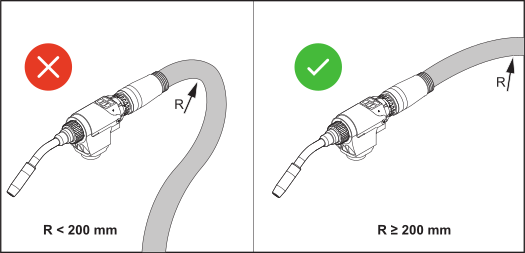
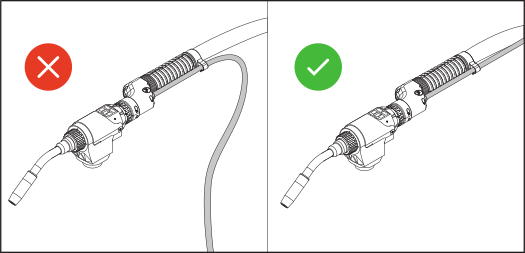
Fitting the interconnecting hosepack
Fitting the Standard interconnecting hosepack to the robot
1
2
Fitting the Standard interconnecting hosepack to the robot
1
2
Connecting the MHP W hosepack
Schlauchpaket MHP W anschließen
WICHTIG! Bei jeder Demontage oder Montage des Schweißbrenner-Schlauchpaketes darauf achten, dass die Kupplungsstelle sauber und trocken ist. Eventuell ausgetretenes Kühlmittel von der Kupplungsstelle entfernen.
1
2
3
4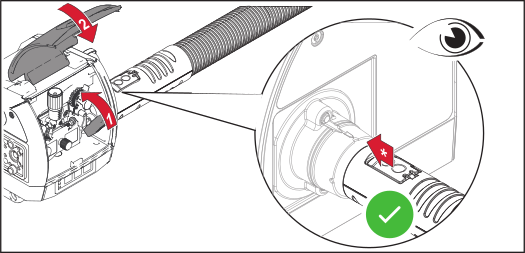
* Schlauchpaket bis auf Anschlag anstecken
5
6
WICHTIG! Kühlmittelschläuche immer unterhalb des Schlauchpaketes verlegen und dann zum Steckanschluss führen:

WFi R / SB 500i

SB 60i
7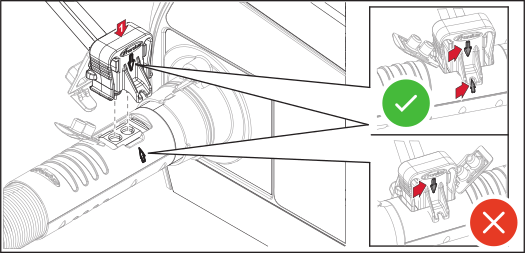

| (1) | Kühlmittel-Rücklauf (rot) |
| (2) | Kühlmittel-Vorlauf (blau) |
WICHTIG! Kühlmittel-Schläuche richtig am Kühlgerät anschließen!
Kühlmittel-Schläuche abstecken
1
2
3
Schlauchpaket MHP W anschließen
WICHTIG! Bei jeder Demontage oder Montage des Schweißbrenner-Schlauchpaketes darauf achten, dass die Kupplungsstelle sauber und trocken ist. Eventuell ausgetretenes Kühlmittel von der Kupplungsstelle entfernen.
1
2
3
4
* Schlauchpaket bis auf Anschlag anstecken
5
6
WICHTIG! Kühlmittelschläuche immer unterhalb des Schlauchpaketes verlegen und dann zum Steckanschluss führen:
WFi R / SB 500i
SB 60i
7
| (1) | Kühlmittel-Rücklauf (rot) |
| (2) | Kühlmittel-Vorlauf (blau) |
WICHTIG! Kühlmittel-Schläuche richtig am Kühlgerät anschließen!
Kühlmittel-Schläuche abstecken
1
2
3
Connecting the SplitBox SB 500i R to the system components
General
NOTE!
Also follow the instructions and information in the documents 42,0410,1946 and 42,0410,2010 when connecting the wirefeeder to the system components.
General
NOTE!
Also follow the instructions and information in the documents 42,0410,1946 and 42,0410,2010 when connecting the wirefeeder to the system components.
Connecting the SplitBox SB 500i R to the system components
IMPORTANT! Whenever the torch hosepack is fitted or removed, ensure that the coupling point is clean and dry. Remove any coolant that has escaped from the coupling point.
1
SB 500i R (right variant)
1
SB 500i R (left variant)
2
NOTE!
If present, lead the coolant hoses from the interconnecting hosepack under the SB 500i R and connect them to the torch hosepack.
Assembling system components - PAP robot
Axis rotation and service life of the torch hosepack
General
In addition to environmental and operating conditions, the service life of the PAP welding torch hosepack is heavily influenced by the axis rotation in the fifth and sixth robot axis.
For details, see the following sections:
- Recommended axis rotation
- Maximum axis rotation
- Hosepack service life depending on the axis rotation in the fifth and sixth robot axis
Recommended axis rotation
NOTE!
The PAP welding torch hosepack reaches its optimal service life when operated within the recommended axis rotations.
Any axis rotation beyond these limits accelerates wear and thus reduces the service life of the PAP torch hosepack.
The expected hosepack service life is shown in the diagram "Hosepack service life depending on the axis rotation in the fifth and sixth robot axis" starting on page (→).

| (4) | Fourth robot axis: +/- 175° |
| (5) | Fifth robot axis: +/- 90° |
| (6) | Sixth robot axis: +/- 200° |
| (4)+(6) | Fourth + sixth robot axis: +/- 360° in total. |
Maximum axis rotation
NOTE!
Operating at the maximum values of the axis rotations reduces the service life of the PAP welding torch hosepack.
The expected hosepack service life is shown in the diagram "Hosepack service life depending on the axis rotation in the fifth and sixth robot axis" starting on page (→).
Operating outside the limits invalidates any warranty claim.

 Maximum axis rotations reduce the hosepack service life.
| (4) | Fourth robot axis: +/- 175° |
| (5) | Fifth robot axis: +/- 120° |
| (6) | Sixth robot axis: +/- 360° |
| (4)+(6) | Fourth + sixth robot axis: max. +/- 535° in total. |
Hosepack service life depending on the axis rotation in the fifth and sixth robot axis

RLT = relative service life [%], ± AR6 = axis rotation in the sixth robot axis [°]
 = recommended axis rotation in the sixth robot axis
Example:
With an axis rotation in the sixth robot axis of 280° and at a tilt angle of 90° in the fifth robot axis, the relative service life of the hosepack is 76-77%.
IMPORTANT! The values specified in the diagram are standard values that may vary depending on the environmental and operating conditions.
The values were determined at an axis rotation of 0° in the fourth robot axis.
General
Sicherheit
WARNING!
Gefahr durch fehlerhaft durchgeführte Arbeiten.
Schwere Personen- und Sachschäden können die Folge sein.
Nachfolgend beschriebene Tätigkeiten dürfen nur von geschultem Fachpersonal durchgeführt werden!
Die Bedienungsanleitungen der Systemkomponenten, insbesondere das Kapitel „Sicherheitsvorschriften“ beachten.
WARNING!
Gefahr durch elektrischen Schlag.
Schwere Personenschäden und Tod können die Folge sein.
Vor Beginn der nachfolgend beschriebenen Arbeiten den Netzschalter des Schweißgeräts in Stellung - O - schalten.
Schweißgerät vom Netz trennen.
Sicherstellen, dass das Schweißgerät bis zum Abschluss aller Arbeiten vom Netz getrennt bleibt.
WARNING!
Gefahr durch herabfallende Gegenstände.
Schwere Personen- und Sachschäden können die Folge sein.
Alle nachfolgend beschriebenen Schraubverbindungen nach der Montage auf festen Sitz überprüfen.
Nach außergewöhnlichen Betriebssituationen auf festen Sitz überprüfen (z.B. nach einem Crash).
Schraubverbindungen in regelmäßigen Abständen auf festen Sitz überprüfen.
WARNING!
Gefahr durch elektrischen Strom infolge von schadhaften Systemkomponenten und Fehlbedienung.
Schwere Personen- und Sachschäden können die Folge sein.
Sämtliche Kabel, Leitungen und Schlauchpakete müssen immer fest angeschlossen, unbeschädigt, und korrekt isoliert sein.
Nur ausreichend dimensionierte Kabel, Leitungen und Schlauchpakete verwenden.
CAUTION!
Gefahr durch heiße Systemkomponenten und / oder Betriebsmittel.
Verbrennungen und Verbrühungen können die Folge sein.
Vor Beginn der Arbeiten alle heißen Systemkomponenten und / oder Betriebsmittel auf +25 °C / +77 °F abkühlen lassen (z. B. Kühlmittel, wassergekühlte Systemkomponenten, Antriebsmotor des Drahtvorschubes, ...).
Geeignete Schutzausrüstung tragen, wenn ein Abkühlen nicht möglich ist (z. B. hitzebeständige Schutzhandschuhe, Schutzbrille, ...).
NOTE!
Gefahr durch austretendes Kühlmittel.
Sachschäden können die Folge sein.
Das Kühlgerät bei Wartungstätigkeiten oder beim Tausch von Komponenten und Verschleißteilen abschalten.
Das Kühlsystem muss während der Tätigkeiten drucklos sein.
NOTE!
Wartungstätigkeiten am aktiven Roboter-Schweißsystem sind nur im Working mode 17 zulässig.
Roboter in eine geeignete Position fahren, die das Wechseln von wassergekühlten Komponenten und Verschleißteilen ermöglicht.
Sicherheit
WARNUNG!
Gefahr durch fehlerhaft durchgeführte Arbeiten.
Schwere Personen- und Sachschäden können die Folge sein.
Nachfolgend beschriebene Tätigkeiten dürfen nur von geschultem Fachpersonal durchgeführt werden!
Die Bedienungsanleitungen der Systemkomponenten, insbesondere das Kapitel „Sicherheitsvorschriften“ beachten.
WARNUNG!
Gefahr durch elektrischen Schlag.
Schwere Personenschäden und Tod können die Folge sein.
Vor Beginn der nachfolgend beschriebenen Arbeiten den Netzschalter des Schweißgeräts in Stellung - O - schalten.
Schweißgerät vom Netz trennen.
Sicherstellen, dass das Schweißgerät bis zum Abschluss aller Arbeiten vom Netz getrennt bleibt.
WARNUNG!
Gefahr durch herabfallende Gegenstände.
Schwere Personen- und Sachschäden können die Folge sein.
Alle nachfolgend beschriebenen Schraubverbindungen nach der Montage auf festen Sitz überprüfen.
Nach außergewöhnlichen Betriebssituationen auf festen Sitz überprüfen (z.B. nach einem Crash).
Schraubverbindungen in regelmäßigen Abständen auf festen Sitz überprüfen.
WARNUNG!
Gefahr durch elektrischen Strom infolge von schadhaften Systemkomponenten und Fehlbedienung.
Schwere Personen- und Sachschäden können die Folge sein.
Sämtliche Kabel, Leitungen und Schlauchpakete müssen immer fest angeschlossen, unbeschädigt, und korrekt isoliert sein.
Nur ausreichend dimensionierte Kabel, Leitungen und Schlauchpakete verwenden.
VORSICHT!
Gefahr durch heiße Systemkomponenten und / oder Betriebsmittel.
Verbrennungen und Verbrühungen können die Folge sein.
Vor Beginn der Arbeiten alle heißen Systemkomponenten und / oder Betriebsmittel auf +25 °C / +77 °F abkühlen lassen (z. B. Kühlmittel, wassergekühlte Systemkomponenten, Antriebsmotor des Drahtvorschubes, ...).
Geeignete Schutzausrüstung tragen, wenn ein Abkühlen nicht möglich ist (z. B. hitzebeständige Schutzhandschuhe, Schutzbrille, ...).
HINWEIS!
Gefahr durch austretendes Kühlmittel.
Sachschäden können die Folge sein.
Das Kühlgerät bei Wartungstätigkeiten oder beim Tausch von Komponenten und Verschleißteilen abschalten.
Das Kühlsystem muss während der Tätigkeiten drucklos sein.
HINWEIS!
Wartungstätigkeiten am aktiven Roboter-Schweißsystem sind nur im Working mode 17 zulässig.
Roboter in eine geeignete Position fahren, die das Wechseln von wassergekühlten Komponenten und Verschleißteilen ermöglicht.
Assembly sequence, PAP robot
- Robot holder(s) must have already been fitted first
- SplitBox PAP
- Only for CMT applications and for highly dynamic processes in combination with a 4-roller unreeling wirefeeder: Wire buffer
- CrashBox Drive /i PAP
- WF Robacta Drive
- Torch hosepack PAP
- Interconnecting hosepack
Fitting the SplitBox SB 500i R PAP
Fitting the SB 500i R PAP
1
2
Fitting the SB 500i R PAP
1
2
Installing the CrashBox Drive /i PAP on the robot
CrashBox Drive /i PAP am Roboter aufbauen
1
| * | Pass-Stift im Roboterflansch |
Drehmomente beim Montieren des Roboterflansches beachten:
Max. Anzugsmoment für Schrauben mit Festigkeitsklasse 8.8:
| M4 | 3,3 Nm / 2,43 lb-ft |
| M5 | 5,0 Nm / 3,69 lb-ft |
| M6 | 6,0 Nm / 4,43 lb-ft |
| M8 | 27,3 Nm / 20,14 lb-ft |
| M10 | 54 Nm / 39,83 lb-ft |
| M12 | 93 Nm / 68,60 lb-ft |
2
3
4
5
6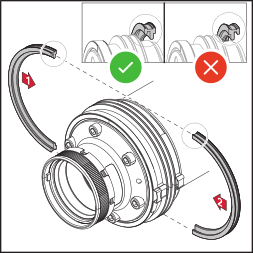
7
8
CrashBox Drive /i PAP am Roboter aufbauen
1
| * | Pass-Stift im Roboterflansch |
Drehmomente beim Montieren des Roboterflansches beachten:
Max. Anzugsmoment für Schrauben mit Festigkeitsklasse 8.8:
| M4 | 3,3 Nm / 2,43 lb-ft |
| M5 | 5,0 Nm / 3,69 lb-ft |
| M6 | 6,0 Nm / 4,43 lb-ft |
| M8 | 27,3 Nm / 20,14 lb-ft |
| M10 | 54 Nm / 39,83 lb-ft |
| M12 | 93 Nm / 68,60 lb-ft |
2
3
4
5
6
7
8
Installing the CrashBox Drive /i PAP Dummy on the robot
1
| * | Dowel pin in the robot flange |
Observe the torques when fitting the robot flange:
Max. tightening torque for screws of strength class 8.8:
| M4 | 3.3 Nm / 2.43 lb-ft |
| M5 | 5.0 Nm / 3.69 lb-ft |
| M6 | 6.0 Nm / 4.43 lb-ft |
| M8 | 27.3 Nm / 20.14 lb-ft |
| M10 | 54 Nm / 39.83 lb-ft |
| M12 | 93 Nm / 68.60 lb-ft |
2
3
Fitting the WF Robacta Drive to a PAP robot
Mounting the hosepack on the WF Robacta Drive (PAP)
IMPORTANT! Only mount the drive unit when the welding machine is switched off.
CAUTION!
Risk of damage to property from dirty or wet coupling point!
When removing or attaching the hosepack, ensure that the coupling point is clean and dry.
Remove any coolant that has escaped from the coupling point.
NOTE!
Follow the assembly sequence!
This can result in damage to property.
Mount the drive unit on the hosepack first
Then mount the hosepack as a complete unit on the robot
Disassemble in the reverse order
1
2
| * | IMPORTANT! Do not damage the control plug with the gas pin. Hand-tighten the union nut. The union nut must screw onto the hosepack easily. |
3
WF Robacta Drive auf Roboter montieren (PAP)
1
2
3
4
5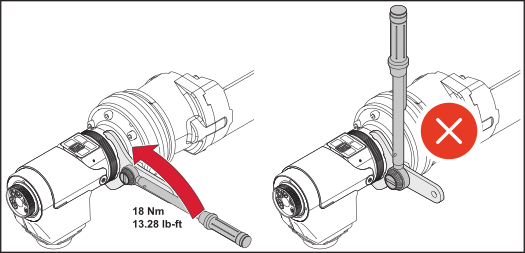
6
Fitting the interconnecting hosepack
Fitting the PAP interconnecting hosepack to the robot
NOTE!
The mounting of the holder for the interconnecting hosepack depends on the robot manufacturer and robot type.
Mount the holder for the interconnecting hosepack according to the Installation Instructions for the respective robot.
1
2
3Lay the interconnecting hosepack in the clamps
4Close the clamps
Connecting the SplitBox SB 500i R PAP to the system components
General
NOTE!
Also follow the instructions and information in the documents 42,0410,1946 and 42,0410,2010 when connecting the wirefeeder to the system components.
General
NOTE!
Also follow the instructions and information in the documents 42,0410,1946 and 42,0410,2010 when connecting the wirefeeder to the system components.
Connecting the SplitBox SB 500i R PAP to the system components
IMPORTANT! Whenever the torch hosepack is fitted or removed, ensure that the coupling point is clean and dry. Remove any coolant that has escaped from the coupling point.
1
2
3
4
Assembling further system components
Fitting the SplitBox SB 60i R
Fitting the SB 60i R to the robot
NOTE!
Depending on the robot, please also note the instructions and information in the User Information on installing the holding plate for the SplitBox.
The installation of the SplitBox SB 60i R is illustrated using the right version of the appliance. The left version of the appliance should be installed the other way around.
1
2
SB 60i R am Balancer montieren
- Balancer mit einer Tragkraft von min. 18 kg verwenden.
- Für Schlauchpakete ab einer Länge > 1,75 m einen zweiten Balancer verwenden. Balancer bei der halben Schlauchpaket-Länge positionieren.
1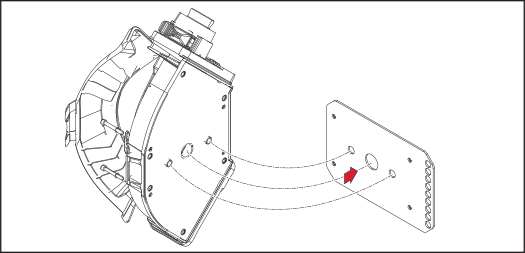
2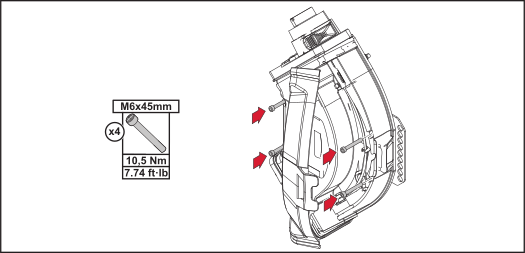
3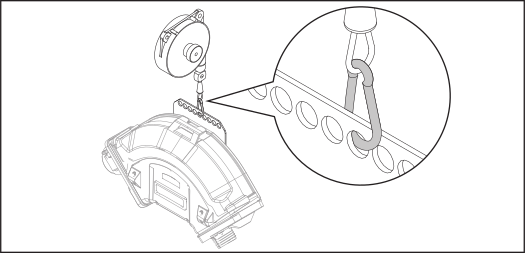
Mounting the SB 60i R on the wall
1
2
* = Depending on the surface, different fixings are required for fitting the wall bracket.
The installer is responsible for selecting the correct fixings.
3
NOTE!
Use a balancer for hosepacks longer than 1.75 m.
Position the balancer halfway along the length of the hosepack.
Connecting the torch hosepack to the SplitBox SB 60i R
IMPORTANT! Whenever the torch hosepack is fitted or removed, ensure that the coupling point is clean and dry. Remove any coolant that has escaped from the coupling point.
The connection of the torch hosepack to the SplitBox SB 60i R is illustrated using the right version of the appliance.
The left version of the appliance should be connected to the torch hosepack the other way around.
1
2
Fitting the TPSi wire buffer
Montage Drahtpuffer TPSi
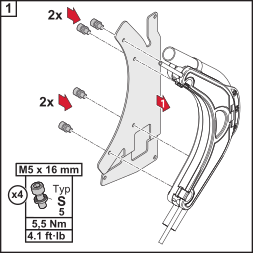
Montage am Roboter
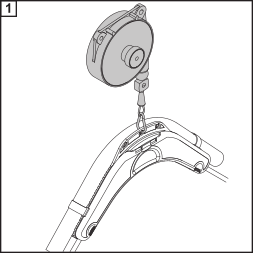
Montage auf einem Balancer
Montage Drahtpuffer TPSi
Montage am Roboter
Montage auf einem Balancer
Connecting the control line to the wire buffer
NOTE!
Carefully place the control line in the strain-relief device provided (Figure 2).
1
2
3
Fitting the unreeling wirefeeder
Fitting the unreeling wirefeeder
WARNING!
Danger from electric current.
This can result in serious injury and damage to property.
Before starting the work described below, turn the mains switch on the welding machine to the "O" position.
Disconnect the welding machine from the grid.
Ensure that the welding machine remains disconnected from the grid until all work has been completed.

Ensure that the unreeling wirefeeder is fitted in the correct direction. The threading direction of the wire electrode is marked with an arrow.
The unreeling wirefeeder is designed exclusively for vertical installation on the following mounts:
- WF Mounting WALL 4,100,846
- WF Mounting Drum 4,100,845
Operating a 2-roller WF30i REEL R /2R unreeling wirefeeder with a basket-type spool is not permitted.
1In accordance with the installation instructions, mount the unreeling wirefeeder onto the wall bracket or the wire drum mount
2Use the QuickConnect option to connect the wirefeeding hose to the unreeling wirefeeder
3Use Fronius SpeedNet to connect the unreeling wirefeeder to the welding machine in the welding system
Fitting the unreeling wirefeeder
WARNING!
Danger from electric current.
This can result in serious injury and damage to property.
Before starting the work described below, turn the mains switch on the welding machine to the "O" position.
Disconnect the welding machine from the grid.
Ensure that the welding machine remains disconnected from the grid until all work has been completed.
Ensure that the unreeling wirefeeder is fitted in the correct direction. The threading direction of the wire electrode is marked with an arrow.
The unreeling wirefeeder is designed exclusively for vertical installation on the following mounts:
- WF Mounting WALL 4,100,846
- WF Mounting Drum 4,100,845
Operating a 2-roller WF30i REEL R /2R unreeling wirefeeder with a basket-type spool is not permitted.
1In accordance with the installation instructions, mount the unreeling wirefeeder onto the wall bracket or the wire drum mount
2Use the QuickConnect option to connect the wirefeeding hose to the unreeling wirefeeder
3Use Fronius SpeedNet to connect the unreeling wirefeeder to the welding machine in the welding system
Connecting the extension hosepack
Verlängerungs-Schlauchpaket anschließen
WARNING!
Gefahr durch elektrischen Strom infolge von schadhaften Systemkomponenten und Fehlbedienung.
Schwere Personen- und Sachschäden können die Folge sein.
Sämtliche Kabel, Leitungen und Schlauchpakete müssen immer fest angeschlossen, unbeschädigt, und korrekt isoliert sein.
Nur ausreichend dimensionierte Kabel, Leitungen und Schlauchpakete verwenden.
Mindestens alle drei Monate auf festen Sitz überprüfen.
1
| * | nur bei wassergekühltem Schlauchpaket |
| CON | = Verbindungs-Schlauchpaket |
| EXT | = Verlängerungs-Schlauchpaket |
Alle Verbindungen handfest miteinander verbinden.
Auf festen Sitz überprüfen!
Stromanschluss handfest montieren entspricht 7 - 8 Nm.
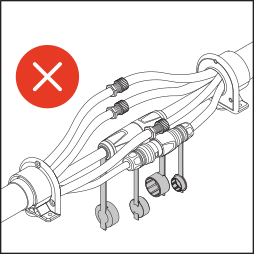
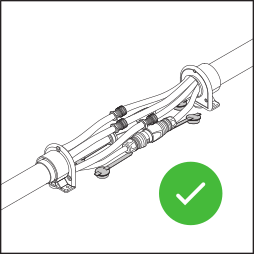
2
Wenn die Komponenten nicht in der Schutztasche gebündelt werden, müssen alle Kuppelstellen unbeweglich fixiert werden.
NOTE!
Reduzierte Lebensdauer bei einem Biegeradius von r < 200 mm.
Biegeradius beachten!
Keinen kleineren Biegeradius als r = 200 mm verwenden!

NOTE!
Strombelastung beachten!
Dimensionierung des richtigen Schlauchpakets lt. folgender Tabelle:
Schweißstrom | Querschnitt bis 10 m | Querschnitt bis 50 m |
|---|---|---|
150 A | 16 mm² | 25 mm² |
200 A | 25 mm² | 35 mm² |
250 A | 35 mm² | 50 mm² |
300 A | 50 mm² | 70 mm² |
400 A | 70 mm² | 95 mm² |
500 A | 95 mm² | 120 mm² |
600 A | 120 mm² | 120 mm² |
Verlängerungs-Schlauchpaket anschließen
WARNUNG!
Gefahr durch elektrischen Strom infolge von schadhaften Systemkomponenten und Fehlbedienung.
Schwere Personen- und Sachschäden können die Folge sein.
Sämtliche Kabel, Leitungen und Schlauchpakete müssen immer fest angeschlossen, unbeschädigt, und korrekt isoliert sein.
Nur ausreichend dimensionierte Kabel, Leitungen und Schlauchpakete verwenden.
Mindestens alle drei Monate auf festen Sitz überprüfen.
1
| * | nur bei wassergekühltem Schlauchpaket |
| CON | = Verbindungs-Schlauchpaket |
| EXT | = Verlängerungs-Schlauchpaket |
Alle Verbindungen handfest miteinander verbinden.
Auf festen Sitz überprüfen!
Stromanschluss handfest montieren entspricht 7 - 8 Nm.
2
Wenn die Komponenten nicht in der Schutztasche gebündelt werden, müssen alle Kuppelstellen unbeweglich fixiert werden.
HINWEIS!
Reduzierte Lebensdauer bei einem Biegeradius von r < 200 mm.
Biegeradius beachten!
Keinen kleineren Biegeradius als r = 200 mm verwenden!
HINWEIS!
Strombelastung beachten!
Dimensionierung des richtigen Schlauchpakets lt. folgender Tabelle:
Schweißstrom | Querschnitt bis 10 m | Querschnitt bis 50 m |
|---|---|---|
150 A | 16 mm² | 25 mm² |
200 A | 25 mm² | 35 mm² |
250 A | 35 mm² | 50 mm² |
300 A | 50 mm² | 70 mm² |
400 A | 70 mm² | 95 mm² |
500 A | 95 mm² | 120 mm² |
600 A | 120 mm² | 120 mm² |
Fitting the torch body to the WF Robacta Drive
Fitting the gas-saver nozzle
1
2
3
4
Fitting the gas-saver nozzle
1
2
3
4
Draht-Führungsseele im Brennerkörper montieren
WICHTIG! Beim Schweißbrenner MTB 330i wird die Kunststoff Draht-Führungsseele von vorne montiert.
Kunststoff Draht-Führungsseele:
1
2
3
Stahl Draht-Führungsseele:
1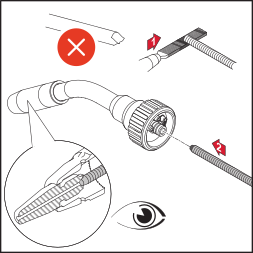
2
3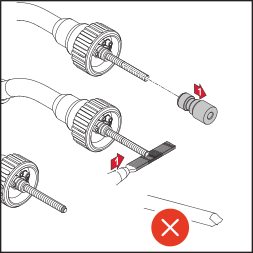
Brennerkörper auf WF Robacta Drive montieren
HINWEIS!
Gefahr von Sachschäden durch verschmutzte oder nasse Kupplungsstelle!
Bei jeder Demontage oder Montage des Brennerkörpers darauf achten, dass die Kupplungsstelle sauber und trocken ist.
Eventuell ausgetretenes Kühlmittel von der Kupplungsstelle entfernen.
HINWEIS!
Wartungstätigkeiten am aktiven Roboter-Schweißsystem sind nur im Working mode 17 zulässig.
Roboter in eine geeignete Position fahren, die das Wechseln von wassergekühlten Komponenten und Verschleißteilen ermöglicht.
1
2
3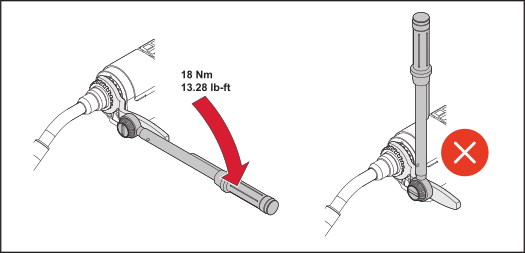
Fitting the OPT/i camera mount
Load-bearing capacity of the OPT/i camera mount
CAUTION!
Danger due to mechanical overload of the system components
This can result in injury and damage to property.
Load the OPT/i camera mount with a maximum of 1.5 kg.
Always observe the relationship between weight and mounting distance shown below.
Fitting the OPT/i camera mount
1
2
3
4
Fitting the inner liner
Draht-Führungsseele montieren (Abspul Drahtvorschub - SplitBox SB 500i R)
1
2
3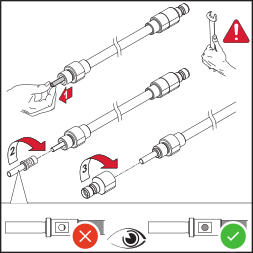
4
Draht-Führungsseele montieren (Abspul Drahtvorschub - SplitBox SB 500i R)
1
2
3
4
Draht-Führungsseele montieren (Abspul Drahtvorschub - WF Robacta Drive mit externem Drahtförder-Schlauch)
1
2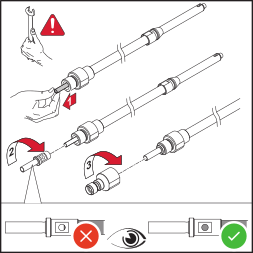
3
Fitting the PowerLiner (unreeling wirefeeder - WF Robacta Drive with external wirefeeding hose)
1
* Fasten screw only slightly (do not tighten)
2
3
4
5
6
Fitting the inner liner (unreeling wirefeeder - wire buffer)
1
2
3
4
5
Draht-Führungsseele montieren (SplitBox SB 500i - WF Robacta Drive mit interner Draht-Führungsseele)
1
2
3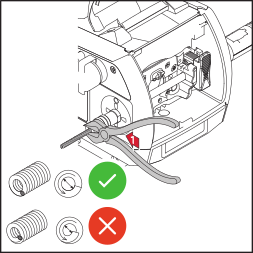
4
Draht-Führungsseele montieren (Drahtpuffer - SplitBox SB 500i für WF Robacta Drive mit internem Drahtförder-Schlauch)
1
2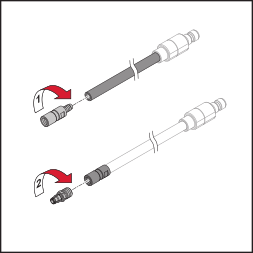
3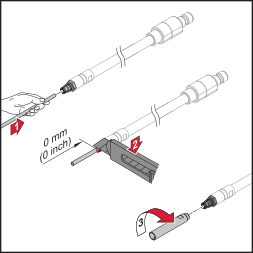
4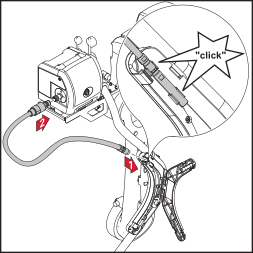
Draht-Führungsseele montieren (Drahtpuffer - WF Robacta Drive mit externem Drahtförder-Schlauch)
1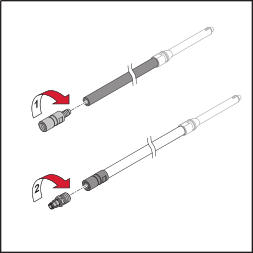
2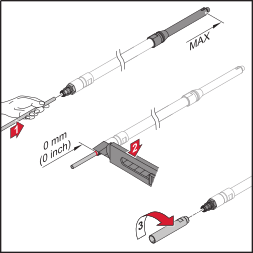
3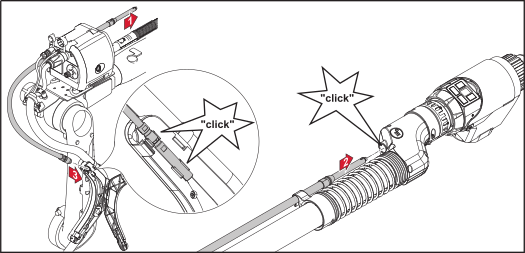
Draht-Führungsseele im Schweißbrenner-Schlauchpaket montieren
HINWEIS!
Damit die Draht-Führungsseele richtig montiert werden kann, das Schlauchpaket bei der Montage der Draht-Führungsseele gerade auslegen.
1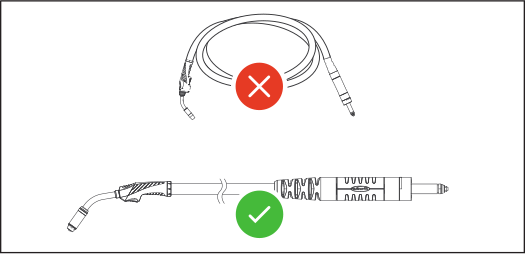
2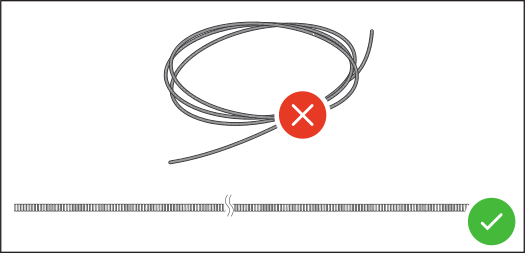
3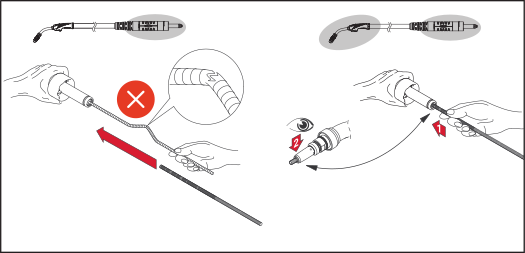
4
5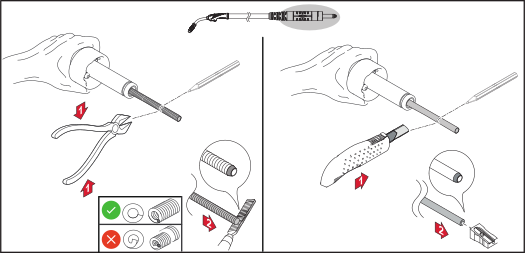
Start-up
Safety
WARNING!
Danger due to incorrect operation and incorrectly performed work.
This can result in serious injury and damage to property.
All the work and functions described in this document must only be carried out by technically trained and qualified personnel.
Fully read and understand this document.
Read and understand all safety rules and user documentation for this device and all system components.
Inserting/replacing feed rollers
General
The feed rollers are not installed in the device when it is first delivered.
In order to achieve optimum wire electrode feed, the feed rollers must be suitable for the diameter and alloy of the wire being welded.
NOTE!
Risk from inadequate feed rollers.
This can result in poor weld properties.
Only use feed rollers that match the wire electrode.
An overview of the feed rollers available and their possible areas of use can be found in the Spare Parts Lists.
WF 25i Reel 4R: inserting/replacing feed rollers for the 4-roller drive
CAUTION!
Risk of injury if the feed roller holders fly upwards.
When unlocking the clamping lever, keep fingers away from the area to the left and right of the lever.
1
2
CAUTION!
Risk of crushing due to exposed feed rollers.
Always fit the protective cover of the 4-roller drive after changing feed rollers.
3
4
WF 30i Reel 2R: Vorschubrollen beim 2-Rollenantrieb einsetzen / wechseln
1
2
3
4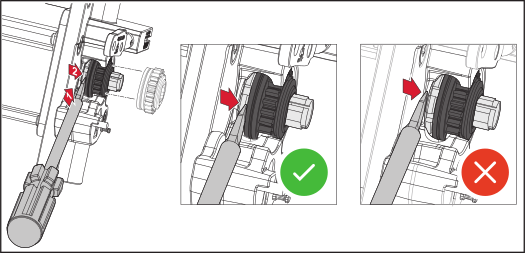
5
6
7
VORSICHT!
Gefahr durch offenliegende Vorschubrollen.
Quetschungen können die Folge sein.
Nach einem Wechsel der Vorschubrollen immer die Schutzabdeckung des 2-Rollenantriebes montieren.
Inserting/replacing the WF 25i Robacta Drive feed rollers
1
2
3
* If the roller holder is opened as far as it will go beyond the slight resistance, the roller holder remains in this position.
4
5
6
7
8
9
10
11
12
Inserting/replacing the WF 60i Robacta Drive CMT feed rollers
1
2
3
* If the roller holder is opened as far as it will go beyond the slight resistance, the roller holder remains in this position.
4
5
6
7
8
9
10
11
12
Feeding in the wire electrode
Insulated routing of wire electrode to wirefeeder
CAUTION!
Danger due to uninsulated wire electrode.
This can result in personal injury, damage to property and impaired welding results.
In the case of automated applications, ensure that only an insulated wire electrode is routed from the welding wire drum, large wirefeeder spool or wire spool to the wirefeeder (e.g. by using a wirefeeding hose).
An earth contact or short-circuit can be caused by:
- a non-insulated, exposed length of wire electrode coming into contact with a conductive object during the welding process
- missing insulation between the wire electrode and the earthed enclosure of a robot cell
- chafed wirefeeding hoses, exposing the wire electrode
To avoid earth contact or short-circuit:
- Use wirefeeding hoses for insulated routing of wire electrode to the wirefeeder
- To prevent chafing, do not route the wirefeeding hoses over sharp edges
- Use hose holders or hose protectors where necessary
- Coupling pieces and hoods for welding wire drums are recommended to ensure safe transport of the wire electrode
Drahtelektrode einlaufen lassen
VORSICHT!
Gefahr von Personen- und Sachschäden durch Schweißstrom und unbeabsichtigtes Zünden eines Lichtbogens.
Vor Beginn der Arbeiten die Masseverbindung zwischen Schweißsystem und Werkstück trennen.
VORSICHT!
Gefahr von Personen- und Sachschäden durch austretende Drahtelektrode.
Während der Arbeiten
Schweißbrenner so halten, dass die Schweißbrenner-Spitze von Gesicht und Körper weg zeigt
eine geeignete Schutzbrille verwenden
Schweißbrenner nicht auf Personen richten
darauf achten, dass die Drahtelektrode keine elektrisch leitenden oder geerdeten Teile berührt (z.B. Gehäuse, etc.)
Sämtliche Abdeckungen müssen geschlossen, sämtliche Seitenteile montierte, sämtliche Sicherheitseinrichtungen intakt und an dem dafür vorgesehenen Ort angebracht sein (beispielsweise Schutzeinrichtungen).
VORSICHT!
Beschädigungsgefahr des Schweißbrenners durch scharfkantiges Ende der Drahtelektrode.
Das Ende der Drahtelektrode vor dem Einführen gut entgraten.
VORSICHT!
Verletzungsgefahr durch Federwirkung der aufgespulten Drahtelektrode.
Beim Einschieben der Drahtelektrode in den 4-Rollenantrieb das Ende der Drahtelektrode gut festhalten, um Verletzungen durch zurückschnellende Drahtelektrode zu vermeiden.
VORSICHT!
Verletzungsgefahr durch sich bewegende oder rotierende Teile im Schweißsystem.
Während des Betriebes sicherstellen, dass alle Abdeckungen geschlossen und sämtliche Teile ordnungsgemäß montiert sind und bleiben.
1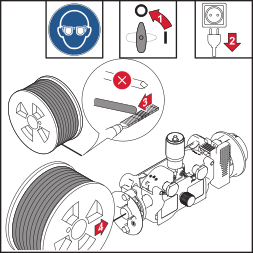
2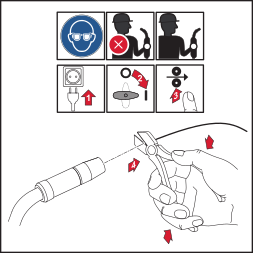
Setting the contact pressure for the WF 25i Robacta Drive
NOTE!
Set the contact pressure in such a way that the wire electrode is not deformed but nevertheless ensures proper wirefeeding.
IMPORTANT! In the event of a large change in contact pressure, a system calibration must be carried out.
How to perform the system calibration is explained in the welding machine operating instructions.

Contact pressure standard values for steel rollers:
| Al, AlSi | 1-2 |
| AlMg | 2-4 |
| FCW | 3-5 |
| CuSi | 5-7 |
| Steel | 6-8 |
| CrNi | 6-8 |
Setting the contact pressure for the WF 60i Robacta Drive CMT
NOTE!
Set the contact pressure in such a way that the wire electrode is not deformed but nevertheless ensures proper wirefeeding.
IMPORTANT! In the event of a large change in contact pressure, a system calibration must be carried out.
How to perform the system calibration is explained in the welding machine operating instructions.

Contact pressure standard values for steel rollers:
| Al, AlSi | 1-2 |
| AlMg | 2-4 |
| FCW | 3-5 |
| CuSi | 5-7 |
| Steel | 6-8 |
| CrNi | 6-8 |
Start-up
Cable management
NOTE!
Inductances can lead to welding problems, for example, when several systems are welding one component.
With the help of inductance measurement and appropriate cable management, welding problems can be promptly prevented when commissioning a welding system.
Measure inductances in the welding circuit, e.g., with the "Welding circuit coupling" function of the welding machine.
Observe the operating instructions "Cable Management Guide".
The operating instructions are available as an HTML file at the following link:
Requirements
- All components are installed and connected as described in the "Installation" chapter
- All appropriate welding media is connected
- Feed rollers are inserted in wirefeeders or drive unit
- Wire electrode is threaded in
- Feed roller contact pressure is set
- Motor adjustment completed
- All covers closed, all side panels in place, all safety devices intact and in their proper place (e.g. protective covers)
General
WARNING!
Risk of machines starting automatically.
This can result in serious injury and damage to property.
In addition to this document, observe all user documentation of the robot manufacturer.
Ensure that all protective measures have been taken and will remain in place in the working area of the robot.
The device is commissioned by means of an active welding start signal.
Fault diagnosis, troubleshooting, maintenance
Troubleshooting
Sicherheit
WARNING!
Gefahr durch Fehlbedienung und fehlerhaft durchgeführte Arbeiten.
Schwere Personen- und Sachschäden können die Folge sein.
Alle in diesem Dokument beschriebenen Arbeiten und Funktionen dürfen nur von technisch geschultem Fachpersonal ausgeführt werden.
Dieses Dokument vollständig lesen und verstehen.
Sämtliche Sicherheitsvorschriften und Benutzerdokumentationen dieses Gerätes und aller Systemkomponenten lesen und verstehen.
WARNING!
Gefahr durch elektrischen Strom.
Schwere Personen- und Sachschäden können die Folge sein.
Vor Wartungs- oder Service-Arbeiten alle beteiligten Geräte und Komponenten ausschalten und vom Stromnetz trennen.
Alle beteiligten Geräte und Komponenten gegen Wiedereinschalten sichern.
Nach dem Öffnen des Gerätes mit Hilfe eines geeigneten Messgerätes sicherstellen, dass elektrisch geladene Bauteile (beispielsweise Kondensatoren) entladen sind.
CAUTION!
Gefahr durch heiße Systemkomponenten und / oder Betriebsmittel.
Verbrennungen und Verbrühungen können die Folge sein.
Vor Beginn der Arbeiten alle heißen Systemkomponenten und / oder Betriebsmittel auf +25 °C / +77 °F abkühlen lassen (z. B. Kühlmittel, wassergekühlte Systemkomponenten, Antriebsmotor des Drahtvorschubes, ...).
Geeignete Schutzausrüstung tragen, wenn ein Abkühlen nicht möglich ist (z. B. hitzebeständige Schutzhandschuhe, Schutzbrille, ...).
NOTE!
Gefahr durch austretendes Kühlmittel.
Sachschäden können die Folge sein.
Das Kühlgerät bei Wartungstätigkeiten oder beim Tausch von Komponenten und Verschleißteilen abschalten.
Das Kühlsystem muss während der Tätigkeiten drucklos sein.
Sicherheit
WARNUNG!
Gefahr durch Fehlbedienung und fehlerhaft durchgeführte Arbeiten.
Schwere Personen- und Sachschäden können die Folge sein.
Alle in diesem Dokument beschriebenen Arbeiten und Funktionen dürfen nur von technisch geschultem Fachpersonal ausgeführt werden.
Dieses Dokument vollständig lesen und verstehen.
Sämtliche Sicherheitsvorschriften und Benutzerdokumentationen dieses Gerätes und aller Systemkomponenten lesen und verstehen.
WARNUNG!
Gefahr durch elektrischen Strom.
Schwere Personen- und Sachschäden können die Folge sein.
Vor Wartungs- oder Service-Arbeiten alle beteiligten Geräte und Komponenten ausschalten und vom Stromnetz trennen.
Alle beteiligten Geräte und Komponenten gegen Wiedereinschalten sichern.
Nach dem Öffnen des Gerätes mit Hilfe eines geeigneten Messgerätes sicherstellen, dass elektrisch geladene Bauteile (beispielsweise Kondensatoren) entladen sind.
VORSICHT!
Gefahr durch heiße Systemkomponenten und / oder Betriebsmittel.
Verbrennungen und Verbrühungen können die Folge sein.
Vor Beginn der Arbeiten alle heißen Systemkomponenten und / oder Betriebsmittel auf +25 °C / +77 °F abkühlen lassen (z. B. Kühlmittel, wassergekühlte Systemkomponenten, Antriebsmotor des Drahtvorschubes, ...).
Geeignete Schutzausrüstung tragen, wenn ein Abkühlen nicht möglich ist (z. B. hitzebeständige Schutzhandschuhe, Schutzbrille, ...).
HINWEIS!
Gefahr durch austretendes Kühlmittel.
Sachschäden können die Folge sein.
Das Kühlgerät bei Wartungstätigkeiten oder beim Tausch von Komponenten und Verschleißteilen abschalten.
Das Kühlsystem muss während der Tätigkeiten drucklos sein.
Fault diagnosis
Make a note of the serial number and configuration of the device and contact our After-Sales Service team with a detailed description of the error, if
- errors occur that are not listed below
- the troubleshooting measures listed are unsuccessful
Welding machine does not function
Mains switch is on, but indicators are not lit up
| Cause: | There is a break in the mains lead; the mains plug is not plugged in |
| Remedy: | Check the mains lead, ensure that the mains plug is plugged in |
| Cause: | Mains socket or mains plug faulty |
| Remedy: | Replace faulty parts |
| Cause: | Mains fuse protection |
| Remedy: | Change the mains fuse protection |
| Cause: | Short circuit on the 24 V supply of SpeedNet connection socket or external sensor |
| Remedy: | Unplug connected components |
No response after setting a welding start signal
Welding machine mains switch is on and indicators are lit
| Cause: | Welding torch or welding torch control line is faulty |
| Remedy: | Replace welding torch |
| Cause: | Interconnecting hosepack is faulty or not connected properly |
| Remedy: | Check the interconnecting hosepack |
No welding current
Welding machine mains switch is on and indicators are lit
| Cause: | Grounding (earthing) connection is incorrect |
| Remedy: | Check the grounding (earthing) connection for correct polarity |
| Cause: | There is a break in the power cable in the welding torch |
| Remedy: | Replace welding torch |
No protective gas shield
All other functions are OK
| Cause: | Gas cylinder is empty |
| Remedy: | Change the gas cylinder |
| Cause: | The gas pressure regulator is faulty |
| Remedy: | Replace the gas pressure regulator |
| Cause: | Gas hose is not fitted or is damaged |
| Remedy: | Fit or change the gas hose |
| Cause: | Welding torch is faulty |
| Remedy: | Change the welding torch |
| Cause: | Gas solenoid valve is faulty |
| Remedy: | Contact After-Sales Service |
Irregular wire feed speed
| Cause: | Hole in the contact tip is too narrow |
| Remedy: | Use a suitable contact tip |
| Cause: | Faulty inner liner in welding torch |
| Remedy: | Check the inner liner for kinks, dirt, etc. |
| Cause: | The feed rollers are not suitable for the wire electrode being used |
| Remedy: | Use suitable feed rollers |
| Cause: | Feed rollers have the wrong contact pressure |
| Remedy: | Optimise the contact pressure |
Wire buffer empty
| Cause: | Counter lever on main wirefeeder open |
| Remedy: | Close counter lever on main wirefeeder Acknowledge service code by pressing wire threading button |
| Cause: | Main wirefeeder slipping |
| Remedy: | Check wearing parts on wirefeeder Use suitable feed rollers Decrease wire braking force Increase contact pressure on main wirefeeder Acknowledge service code by pressing wire threading button |
| Cause: | End of wire reached |
| Remedy: | Check whether sufficient wire is available Acknowledge service code using wire threading button |
Wirefeed problems
when using long hosepacks
| Cause: | Incorrect arrangement of hosepack |
| Remedy: | Arrange the hosepack in as straight a line as possible, avoid tight bends |
Welding torch becomes very hot
| Cause: | Welding torch is inadequately dimensioned |
| Remedy: | Observe the duty cycle and loading limits |
| Cause: | Only on water-cooled systems: inadequate coolant flow |
| Remedy: | Check coolant level, coolant flow, for coolant contamination, etc. For further information refer to the cooling unit operating instructions |
| Cause: | The distance from the workpiece is too small |
| Remedy: | Increase stickout |
Poor weld properties
| Cause: | Incorrect welding parameters |
| Remedy: | Check the settings |
| Cause: | Poor ground earth connection |
| Remedy: | Ensure good contact to workpiece |
| Cause: | Inadequate or no shielding gas |
| Remedy: | Check the pressure regulator, gas hose, gas solenoid valve, torch gas connection, etc. |
| Cause: | Welding torch is leaking |
| Remedy: | Change welding torch |
| Cause: | Wrong contact tip, or contact tip is worn out |
| Remedy: | Replace contact tip |
| Cause: | Wrong wire alloy or wrong wire diameter |
| Remedy: | Check the wire electrode that has been inserted |
| Cause: | Wrong wire alloy or wrong wire diameter |
| Remedy: | Check weldability of the base material |
| Cause: | The shielding gas is not suitable for this wire alloy |
| Remedy: | Use the correct shielding gas |
| Cause: | Contaminated gas nozzle |
| Remedy: | Clean the gas nozzle, remove any welding spatter |
Care and maintenance
General
Under normal operating conditions, the device requires only a minimum of care and maintenance. However, it is vital to observe some important points to ensure the device remains in a usable condition for many years.
General
Under normal operating conditions, the device requires only a minimum of care and maintenance. However, it is vital to observe some important points to ensure the device remains in a usable condition for many years.
Sicherheit
WARNUNG!
Gefahr durch Fehlbedienung und fehlerhaft durchgeführte Arbeiten.
Schwere Personen- und Sachschäden können die Folge sein.
Alle in diesem Dokument beschriebenen Arbeiten und Funktionen dürfen nur von technisch geschultem Fachpersonal ausgeführt werden.
Dieses Dokument vollständig lesen und verstehen.
Sämtliche Sicherheitsvorschriften und Benutzerdokumentationen dieses Gerätes und aller Systemkomponenten lesen und verstehen.
WARNUNG!
Gefahr durch elektrischen Strom.
Schwere Personen- und Sachschäden können die Folge sein.
Vor Wartungs- oder Service-Arbeiten alle beteiligten Geräte und Komponenten ausschalten und vom Stromnetz trennen.
Alle beteiligten Geräte und Komponenten gegen Wiedereinschalten sichern.
Nach dem Öffnen des Gerätes mit Hilfe eines geeigneten Messgerätes sicherstellen, dass elektrisch geladene Bauteile (beispielsweise Kondensatoren) entladen sind.
VORSICHT!
Gefahr durch heiße Systemkomponenten und / oder Betriebsmittel.
Verbrennungen und Verbrühungen können die Folge sein.
Vor Beginn der Arbeiten alle heißen Systemkomponenten und / oder Betriebsmittel auf +25 °C / +77 °F abkühlen lassen (z. B. Kühlmittel, wassergekühlte Systemkomponenten, Antriebsmotor des Drahtvorschubes, ...).
Geeignete Schutzausrüstung tragen, wenn ein Abkühlen nicht möglich ist (z. B. hitzebeständige Schutzhandschuhe, Schutzbrille, ...).
HINWEIS!
Gefahr durch austretendes Kühlmittel.
Sachschäden können die Folge sein.
Das Kühlgerät bei Wartungstätigkeiten oder beim Tausch von Komponenten und Verschleißteilen abschalten.
Das Kühlsystem muss während der Tätigkeiten drucklos sein.
Every start-up
- Check all hosepacks and the ground earth connection for damage. Replace any damaged components.
- Check feed rollers and inner liners for signs of damage. Replace any damaged components.
- Check the wirefeeding hoses for damage. Replace any damaged components.
- Check contact pressure of feed rollers and adjust if necessary.
- Check that all screw connections between the robot, wirefeeder holder and wire-feed unit are secure.
Special care of O-rings
IMPORTANT! When replacing O-rings, grease the new O-ring before fitting it.
When repeatedly connecting and disconnecting the coolant hoses on the torch hosepack, grease the O-rings regularly.
Unless a special grease is specified for the O-rings, use the O-ring grease from Fronius with item number 40,0009,0044.
Whenever the welding torch or torch hosepack is changed
Whenever the welding torch or torch hosepack is changed, ensure that the coupling point is clean and dry. Remove any coolant that has escaped from the coupling point.
Ensure that the cooling unit is switched off.
Schweißbrenner-Schlauchpaket wechseln, Verbindungs-Schlauchpaket wechseln
Ist ein Roboter-Drahtvorschub oder eine Medien-Trennstelle in der 3. Roboter-Achse montiert, beim Wechsel von Schweißbrenner-Schlauchpaket oder Verbindungs-Schlauchpaket folgendes berücksichtigen:
VORSICHT!
Beschädigungsgefahr von Roboter-Drahtvorschub oder Medien-Trennstelle durch austretendes Kühlmittel.
Nach dem Abschließen der Kühlmittel-Schläuche am Schweißbrenner-Schlauchpaket die Kühlmittelanschlüsse sofort mit der dafür vorgesehenen Abdeckung verschließen.
Roboter so positionieren, dass austretendes Kühlmittel nicht zurück in den Roboter-Drahtvorschub oder in die Medien-Trennstelle gelangen kann.
HINWEIS!
Wartungstätigkeiten am aktiven Roboter-Schweißsystem sind nur im "Stop" coolant pump service position - Working mode 17 zulässig.
Roboter in eine geeignete Position fahren, die das Wechseln von wassergekühlten Komponenten und Verschleißteilen ermöglicht.
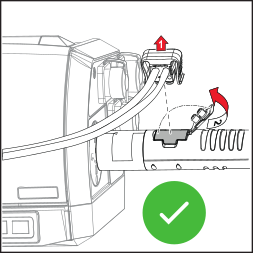
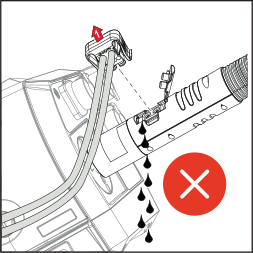
Every 6 months
CAUTION!
Danger from compressed air at close range.
Electronic components may be damaged.
Do not bring the air nozzle too close to electronic components.
- Open covers, remove device side panels and clean inside of device with dry reduced compressed air. After cleaning, restore device to its original state.
"Stop" coolant pump service position - Working mode 17
Prerequisites:
- Min. welding machine firmware V3.2.30
- Min. firmware RI FB PRO/I interface RI FB PRO/I 1.9.0
Description:
In Working mode 17, switch the coolant pump to "stop". The cooling circuit is interrupted, while all other functions of the welding machine remain active. The "Cooling circuit mode" process parameter on the welding machine does not need to be changed.
Once Working mode 17 has ended, the robot controller continues from the last active program step
Working mode 17 only works in automatic mode via the robot controller.
NOTE!
Performing maintenance on the active robot welding system is only permitted in Working mode 17 .
Move the robot to a suitable position to allow water-cooled components and wear parts to be changed.
NOTE!
Detailed information can be found in the operating instructions 42,0426,0227 ... Description of TPS/i interface signals
Recognising faulty wearing parts

- Insulating parts
- Burned-off outside edges, notches
- Nozzle fittings
- Burned-off outside edges, notches
- Heavily covered in welding spatter
- Spatter guard
- Burned-off outside edges, notches
- Contact tips
- Worn-out (oval) wire entry and wire exit holes
- Heavily covered in welding spatter
- Penetration on the tip of the contact tip
- Gas nozzles
- Heavily covered in welding spatter
- Burned-off outside edges
- Notches
Replacing the WF 25i Robacta Drive clamping lever
1
2
Replacing the WF 60i Robacta Drive CMT clamping lever
1
2
Replacing the WF Robacta Drive gas-saver nozzle
CAUTION!
Danger of property damage due to dirty or wet coupling point.
Whenever the welding torch is fitted or removed, ensure that the coupling point is clean and dry.
Remove any coolant that has escaped from the coupling point.
1
2
3
4
5
6
7
Replacing the SB 60i R inner liner
Removing the inner liner
1
2
3
4
Inserting the inner liner
1
2
3
4
Drahtpuffer TPSi Draht-Führungseinsatz wechseln
1Vor Beginn der Montagearbeiten:
Drahtelektrode aus dem Drahtpuffer ausfädeln.
WICHTIG! Bei Verwendung einer Drahtelektrode mit einem Durchmesser von 1,6 mm (1/16 in.) , das Gleitstück und den Draht-Führungseinsatz im Drahtpuffer mit dem „Erstausrüstungs-Set 1,6 mm (1/16 in.)“ ausrüsten.
Drahtelektrode aus dem Drahtpuffer ausfädeln.
WICHTIG! Bei Verwendung einer Drahtelektrode mit einem Durchmesser von 1,6 mm (1/16 in.) , das Gleitstück und den Draht-Führungseinsatz im Drahtpuffer mit dem „Erstausrüstungs-Set 1,6 mm (1/16 in.)“ ausrüsten.
2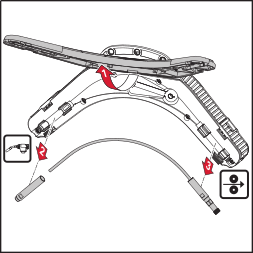
3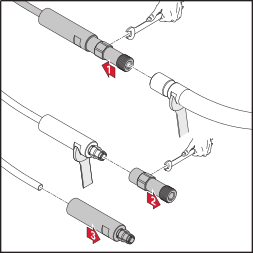
4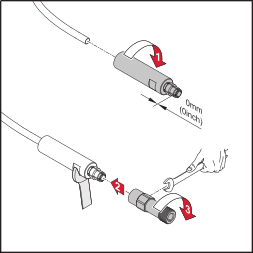
Arbeitsrichtung Drahtpuffer TPSi wechseln
WICHTIG! Steuerleitung nach Umbau wieder ordnungsgemäß in die dafür vorgesehene Zugentlastung verlegen.
1
2
3
4
5
6
Replacing the TPSi wire buffer lever
NOTE!
Before fitting the new wire buffer lever, turn the locating sleeve into the central position (Figure 3).
1
2
3
4
5
6
Fitting wearing parts to the torch body
1
2
3
MTG d, MTW d, MTB - Fitting wearing parts to the torch body
1
Tightening torques:
- Contact tube M5 3 Nm / 2.21 lb ft
- Nozzle holder M5
- Clamping nut M12 8 Nm / 5.9 lb ft
2
3
Fitting wearing parts to the torch body - MTW 700 i
1
2
CrashBox PAP am Roboter demontieren
1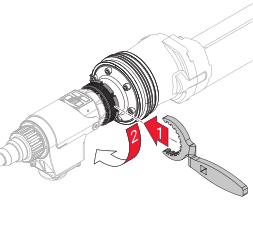
2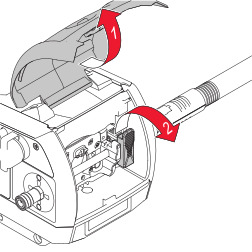
3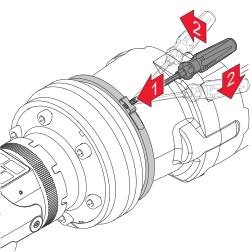
4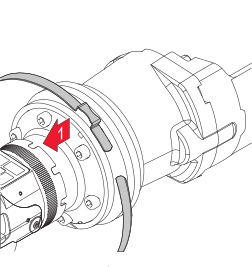
5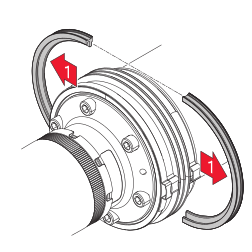
6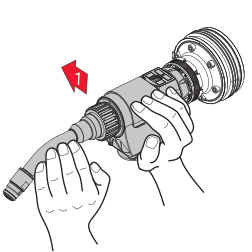
CrashBox manuell auslenken
7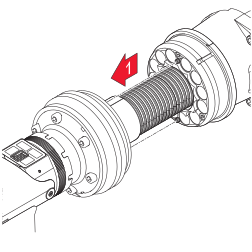
8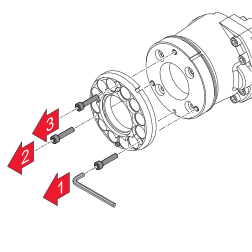
9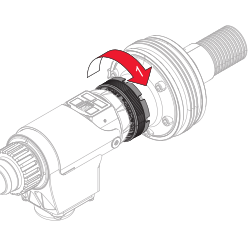
Technical data
SB 500i R, R left variant, PAP
SB 500i R, R left-hand version, PAP
Supply voltage | 24 V DC / 60 V DC |
Nominal current | 0.5 A / 0.8 A |
Welding current at 10 min / 40 °C | 40% ED* 650 A |
Maximum pressure of shielding gas | 7 bar/101.53 psi |
Coolant | Original Fronius |
Maximum pressure of coolant | 5 bar/72.53 psi |
Degree of protection | IP 43 |
Mark of conformity | CE, CSA |
Dimensions l × w × h | 658 x 282 x 362 mm |
Weight | 3.6 kg/7.9 Ib |
|
|
SB 60i R
SB 60i R
Supply voltage | 24 V DC / 60 V DC |
Nominal current | 0.5 A / 0.8 A |
Welding current at 10 min / 40 °C |
|
95 mm² | 40% ED* 500 A |
Maximum pressure of shielding gas | 7 bar/101.53 psi |
Coolant | Original Fronius |
Maximum pressure of coolant | 5 bar/72.53 psi |
Degree of protection | IP 20 |
Mark of conformity | CE |
Dimensions l × w × h | 480 x 252 x 114 mm |
Weight | 2.818 kg/6.21 Ib |
|
|
CrashBox /i
CrashBox /i

Item numbers | |
CrashBox /i | 44,0350,3589 |
CrashBox /i XL | 44,0350,3760 |
CrashBox /i XXL | 44,0350,3380 |
CrashBox Drive /i PAP | 44,0350,3379 |
CrashBox Drive /i PAP XXL | 44,0350,3754 |
Degree of repeatability (1) | ± 0.05 mm a) |
Triggering torques in x/y direction |
|
CrashBox /i | 21 Nm / 15.49 lb-ft |
CrashBox /i XL | 42 Nm / 30.98 lb-ft |
CrashBox /i XXL | 63.1 Nm / 46.54 lb-ft |
CrashBox Drive /i PAP | 21 Nm / 15.49 lb-ft |
CrashBox Drive /i PAP XXL | 42 Nm / 30.98 lb-ft |
Maximum displacement in x/y direction |
|
CrashBox /i | ~ 45° |
CrashBox /i XL | ~ 45° |
CrashBox /i XXL | ~ 45° |
CrashBox Drive /i PAP | ~ 30° |
CrashBox Drive /i PAP XXL | ~ 30° |
Weight |
|
CrashBox /i | 1200 g |
CrashBox /i XL | 1200 g |
CrashBox /i XXL | 1200 g |
CrashBox Drive /i | 920 g |
CrashBox Drive /i PAP XXL | 920 g |
Dimensions |
|
CrashBox /i | Ø90 mm x 60 mm b) |
CrashBox /i XL | Ø90 mm x 60 mm b) |
CrashBox /i XXL | Ø90 mm x 60 mm b) |
CrashBox Drive /i PAP | Ø90 mm x 84.5 mm b) |
CrashBox Drive /i PAP XXL | Ø90 mm x 84.5 mm b) |
a) A distance of 300 mm away from the robot flange
b) with bellows: Ø110 mm
Max. possible displacement | z direction [mm] | ~ 30 | ~ 30 | ~ 30 | ~ 30 | ~ 30 |
| Triggering torques and weight-distance diagram 
|
x/y direction [°] | ~ 45 | ~ 45 | ~ 45 | ~ 30 | ~ 30 |
| ||
Activated within 300 mm distance | max [°] | 1.5275 | 1.5275 | 1.5275 | 0.6684 | 0.6684 |
| |
max [mm] | 8 | 8 | 8 | 3.5 | 3.5 |
| ||
min [°] | 0.684 | 0.684 | 0.684 | 0.382 | 0.382 |
| ||
min [mm] | 3.5 | 3.5 | 3.5 | 2.0 | 2.0 |
| ||
Weight (distance [mm]) [kg] | 400 | 5.25 | 10.50 | 15.78 | 5.25 | 10.50 |
| |
300 | 7.00 | 14.00 | 21.03 | 7.00 | 14.00 |
| ||
200 | 10.5 | 21.0 | 31.55 | 10.5 | 21.0 |
| ||
100 | 21.0 | 42.0 | 63.1 | 21.0 | 42.0 |
| ||
50 | 42.0 | 84.0 | 126.2 | 42.0 | 84.0 |
| ||
Triggering | 21 Nm | 42 Nm | 63.1 Nm | 21 Nm | 42 Nm |
| ||
CrashBox /i | CrashBox /i XL | CrashBox /i XXL | CrashBox Drive /i PAP | CrashBox Drive /i PAP XXL |
| |||
CrashBox /i
Item numbers | |
CrashBox /i | 44,0350,3589 |
CrashBox /i XL | 44,0350,3760 |
CrashBox /i XXL | 44,0350,3380 |
CrashBox Drive /i PAP | 44,0350,3379 |
CrashBox Drive /i PAP XXL | 44,0350,3754 |
Degree of repeatability (1) | ± 0.05 mm a) |
Triggering torques in x/y direction |
|
CrashBox /i | 21 Nm / 15.49 lb-ft |
CrashBox /i XL | 42 Nm / 30.98 lb-ft |
CrashBox /i XXL | 63.1 Nm / 46.54 lb-ft |
CrashBox Drive /i PAP | 21 Nm / 15.49 lb-ft |
CrashBox Drive /i PAP XXL | 42 Nm / 30.98 lb-ft |
Maximum displacement in x/y direction |
|
CrashBox /i | ~ 45° |
CrashBox /i XL | ~ 45° |
CrashBox /i XXL | ~ 45° |
CrashBox Drive /i PAP | ~ 30° |
CrashBox Drive /i PAP XXL | ~ 30° |
Weight |
|
CrashBox /i | 1200 g |
CrashBox /i XL | 1200 g |
CrashBox /i XXL | 1200 g |
CrashBox Drive /i | 920 g |
CrashBox Drive /i PAP XXL | 920 g |
Dimensions |
|
CrashBox /i | Ø90 mm x 60 mm b) |
CrashBox /i XL | Ø90 mm x 60 mm b) |
CrashBox /i XXL | Ø90 mm x 60 mm b) |
CrashBox Drive /i PAP | Ø90 mm x 84.5 mm b) |
CrashBox Drive /i PAP XXL | Ø90 mm x 84.5 mm b) |
a) A distance of 300 mm away from the robot flange
b) with bellows: Ø110 mm
Max. possible displacement | z direction [mm] | ~ 30 | ~ 30 | ~ 30 | ~ 30 | ~ 30 |
| Triggering torques and weight-distance diagram
|
x/y direction [°] | ~ 45 | ~ 45 | ~ 45 | ~ 30 | ~ 30 |
| ||
Activated within 300 mm distance | max [°] | 1.5275 | 1.5275 | 1.5275 | 0.6684 | 0.6684 |
| |
max [mm] | 8 | 8 | 8 | 3.5 | 3.5 |
| ||
min [°] | 0.684 | 0.684 | 0.684 | 0.382 | 0.382 |
| ||
min [mm] | 3.5 | 3.5 | 3.5 | 2.0 | 2.0 |
| ||
Weight (distance [mm]) [kg] | 400 | 5.25 | 10.50 | 15.78 | 5.25 | 10.50 |
| |
300 | 7.00 | 14.00 | 21.03 | 7.00 | 14.00 |
| ||
200 | 10.5 | 21.0 | 31.55 | 10.5 | 21.0 |
| ||
100 | 21.0 | 42.0 | 63.1 | 21.0 | 42.0 |
| ||
50 | 42.0 | 84.0 | 126.2 | 42.0 | 84.0 |
| ||
Triggering | 21 Nm | 42 Nm | 63.1 Nm | 21 Nm | 42 Nm |
| ||
CrashBox /i | CrashBox /i XL | CrashBox /i XXL | CrashBox Drive /i PAP | CrashBox Drive /i PAP XXL |
| |||
PushPull hosepack
Gas-cooled PushPull hosepacks
MHP 400i RD / G | |
|---|---|
Welding current at 10 min / 40 °C
|
- |
Wire diameter | 0.8 - 1.6 mm |
Length | 0.935 / 1.085 /1.235 / 1.435 / 1.735 / 2.235 / 1.935 / 2.735 / 3.235 / 3.735 m 3.07 / 3.56 / 4.05 / 4.71 / 5.69 / 7.33 / 6.35 / 8.97 / 10.60 / 12.25 ft |
Voltage rating (V-Peak) for machine-guided welding torches | 141 V |
This product meets the requirements set out in standard IEC 60974-7
* ED = Duty cycle
MHP 400i RD / G / PAP | |
|---|---|
Welding current at 10 min / 40 °C
| 40% ED* / 400 A - |
Wire diameter | 0.8 - 1.6 mm |
Length | 0.915 / 0.925 / 0.945 / 1.025 / 1.045 / 1.075 / 1.105 / 1.115 / 1.135 / 1.165 / 1.175 / 1.185 / 1.205 / 1.295 / 1.335 / 1.355 / 1.385 / 1.415 / 1.495 / 1.575 / 1.935 / 1.985 / 2.115 / 2.265 / 2.385 / 2.585 / 3.415 m 3.00 / 3.03 / 3.1 / 3.36 / 3.43 / 3.35 / 3.63 / 3.66 / 3.72 / 3.82 / 3.86 / 3.89 / 3.95 / 4.25 / 4.38 / 4.45 / 4.54 / 4.64 / 4.9 / 5.17 / 6.35 / 6.51 / 6.94 / 7.43 / 7.82 / 8.48 / 11.20 ft |
Voltage rating (V-Peak) for machine-guided welding torches | 141 V |
This product meets the requirements set out in standard IEC 60974-7
* ED = Duty cycle
Water-cooled PushPull hosepacks
MHP 500i RD / W | |
|---|---|
Welding current at 10 min / 40 °C |
|
Wire diameter | 0.8 - 1.6 mm |
Lowest cooling capacity as per IEC standard 60974-2 as function of hosepack length | Length |
550 | 0.935 m / 3.07 ft |
Minimum coolant flow Qmin | 1 l/min |
Minimum coolant pressure pmin | 3 bar |
Maximum coolant pressure pmax | 5 bar |
Voltage rating (V-Peak) for machine-guided welding torches | 141 V |
This product meets the requirements set out in standard IEC 60974-7
| * | ED = Duty cycle |
MHP 500i RD / W / PAP | |
|---|---|
Welding current at 10 min / 40 °C |
|
Wire diameter | 0.8 - 1.6 mm |
Lowest cooling capacity as per IEC standard 60974-2 as function of hosepack length | Length |
550 W | 0.915 m (3.00 ft) / 0.925 m (3.03 ft) / |
600 W | 1.075 m (3.53 ft) / 1.105 m (3.63 ft) / |
650 W | 1.295 m (4.25 ft) / 1.335 m (4.38 ft) / |
700 W | 1.415 m (4.64 ft) / 1.495 m (4.9 ft) / |
800 W | 1,735 m (5.69 ft.) |
850 W | 1.935 m (6.35 ft) / 1.985 m (6.51 ft) / |
900 W | 2.115 m (6.94 ft) |
950 W | 2.265 m (7.43 ft) / 3.415 m (11.20 ft) |
1000 W | 2.385 m (7.82 ft) |
Minimum coolant flow Qmin | 1 l/min |
Minimum coolant pressure pmin | 3 bar |
Maximum coolant pressure pmax | 5 bar |
Voltage rating (V-Peak) for machine-guided welding torches | 141 V |
This product meets the requirements set out in standard IEC 60974-7
| * | ED = Duty cycle |
WF 25i Robacta Drive
WF 25i Robacta Drive /G
Welding current at 10 min / 40 °C
|
60% ED* / 320 A |
Wire diameter | 0.8 - 1.6 mm |
Supply voltage | 60 V DC |
Nominal current | 3 A |
Wire speed | 1 - 25 m/min |
Voltage rating (V-Peak) for machine-guided welding torches | 141 V |
|
|
This product meets the requirements set out in standard IEC 60974-7
| * | ED = Duty cycle |
WF 25i Robacta Drive /W
Welding current at 10 min / 40 °C |
|
Wire diameter | 0.8 - 1.6 mm |
Minimum coolant flow Qmin | 1 l/min |
Minimum coolant pressure pmin | 3 bar |
Maximum coolant pressure pmax | 5 bar |
Supply voltage | 60 V DC |
Nominal current | 3 A |
Wire speed | 1 - 25 m/min |
Voltage rating (V-Peak) for machine-guided welding torches | 141 V |
|
|
This product meets the requirements set out in standard IEC 60974-7
| * | ED = Duty cycle |
WF 60i Robacta Drive CMT
WF 60i Robacta Drive CMT /G
Welding current at 10 min / 40 °C |
|
C1 (EN ISO 14175) | 60% ED* / 320 A (standard) |
Wire diameter | 0.8 - 1.6 mm |
Supply voltage | 60 V DC |
Nominal current | 1.5 A RMS |
Wire speed | 1 - 60 m/min |
Voltage rating (V-Peak) for machine-guided welding torches | 141 V |
|
|
This product meets the requirements set out in standard IEC 60974-7
| * | ED = Duty cycle |
WF 60i Robacta Drive /W CMT
Welding current at 10 min / 40 °C
|
100% ED* / 500 A (standard) |
Wire diameter | 0.8 - 1.6 mm |
Minimum coolant flow Qmin | 1 l/min |
Minimum coolant pressure pmin | 3 bar |
Maximum coolant pressure pmax | 5 bar |
Supply voltage | 60 V DC |
Nominal current | 1.5 A RMS |
Wire speed | 1 - 60 m/min |
Voltage rating (V-Peak) for machine-guided welding torches | 141 V |
|
|
This product meets the requirements set out in standard IEC 60974-7
| * | ED = Duty cycle |
WFi Reel
WF 30i REEL R /2R/G/W
Supply voltage | 24 V DC / 60 V DC |
Nominal current | 0.5 A / 0.9 A |
Wire speed | 1 - 30 m/min |
Wire drive | 2-roller drive |
Wire diameter | 0.8 - 1.6 mm |
Degree of protection | IP 21 |
Mark of conformity | CE, CSA |
Dimensions l x w x h | 250 x 210 x 190 mm |
Weight | 4.6 kg |
WF 25i REEL R /4R/G/W
Supply voltage | 24 V DC / 60 V DC |
Nominal current | 0.5 A / 1.2 A |
Wire speed | 1 - 25 m/min |
Wire drive | 4-roller drive |
Wire diameter | 0.8 - 2.4 mm |
Degree of protection | IP 21 |
Mark of conformity | CE, CSA |
Dimensions l x w x h | 250 x 210 x 190 mm |
Weight | 4.8 kg |
Robot welding torch
Gasgekühlte Roboter-Schweißbrenner
MTB 250i G/R (TX, TXM)
Schweißstrom bei 10 min/40° C
|
- |
Drahtdurchmesser | 0,8 - 1,2 mm |
MTB 320i G/R (TX, TXM)
Schweißstrom bei 10 min/40° C
|
- |
Drahtdurchmesser | 0,8 - 1,6 mm |
MTB 330i G/R (TX, TXM)
Schweißstrom bei 10 min/40° C
|
- |
Drahtdurchmesser | 0,8 - 1,6 mm |
MTB 350i G/R (TX, TXM)
Schweißstrom bei 10 min/40° C)
|
- |
Drahtdurchmesser | 0,8 - 1,6 mm |
MTB 400i G/R (TX, TXM)
Schweißstrom bei 10 min/40° C)
|
- |
Drahtdurchmesser | 0,8 - 1,6 mm |
|
|
| * | ED = Einschaltdauer |
Water-cooled robot welding torches
MTB 250i W/R
Welding current at 10 min/40° C |
|
Wire diameter | 0.8 - 1.2 mm / 0.032 - 0.047 inch |
MTB 330i W/R (TX, TXM)
Welding current at 10 min/40° C |
|
Wire diameter | 0.8 - 1.6 mm / 0.032 - 0.063 inch |
MTB 400i W/R (TX, TXM)
Welding current at 10 min/40° C |
|
Wire diameter | 0.8 - 1.6 mm / 0.032 - 0.063 inch |
MTB 500i W/R (TX, TXM)
Welding current at 10 min/40° C |
|
Wire diameter | 1.0 - 1.6 mm / 0.039 - 0.063 inch |
MTB 700i W/R (TX, TXM)
Welding current at 10 min/40° C |
|
Wire diameter | 1.0 - 1.6 mm / 0.039 - 0.063 inch |
|
|
| * | ED = Duty cycle |
Interconnecting hosepacks
HP 70i
Welding current at 10 min / 40 °C | 40% ED* / 400 A |
|
|
| * | ED = Duty cycle |
Welding current at 10 min / 40 °C | 40% ED* / 400 A |
|
|
| * | ED = Duty cycle |
Welding current at 10 min / 40 °C | 40% ED* / 500 A |
|
|
| * | ED = Duty cycle |
HP 120i
Welding current at 10 min / 40 °C | 40% ED* / 600 A |
|
|
| * | ED = Duty cycle |
HP 70i + OPT/i HP PC Cable HD 70
Welding current at 10 min / 40 °C | 60% ED* / 600 A |
|
|
| * | ED = Duty cycle |
The technical data only applies when combining the HP 70i interconnecting hosepack with the OPT/i HP PC Cable HC 70 option.